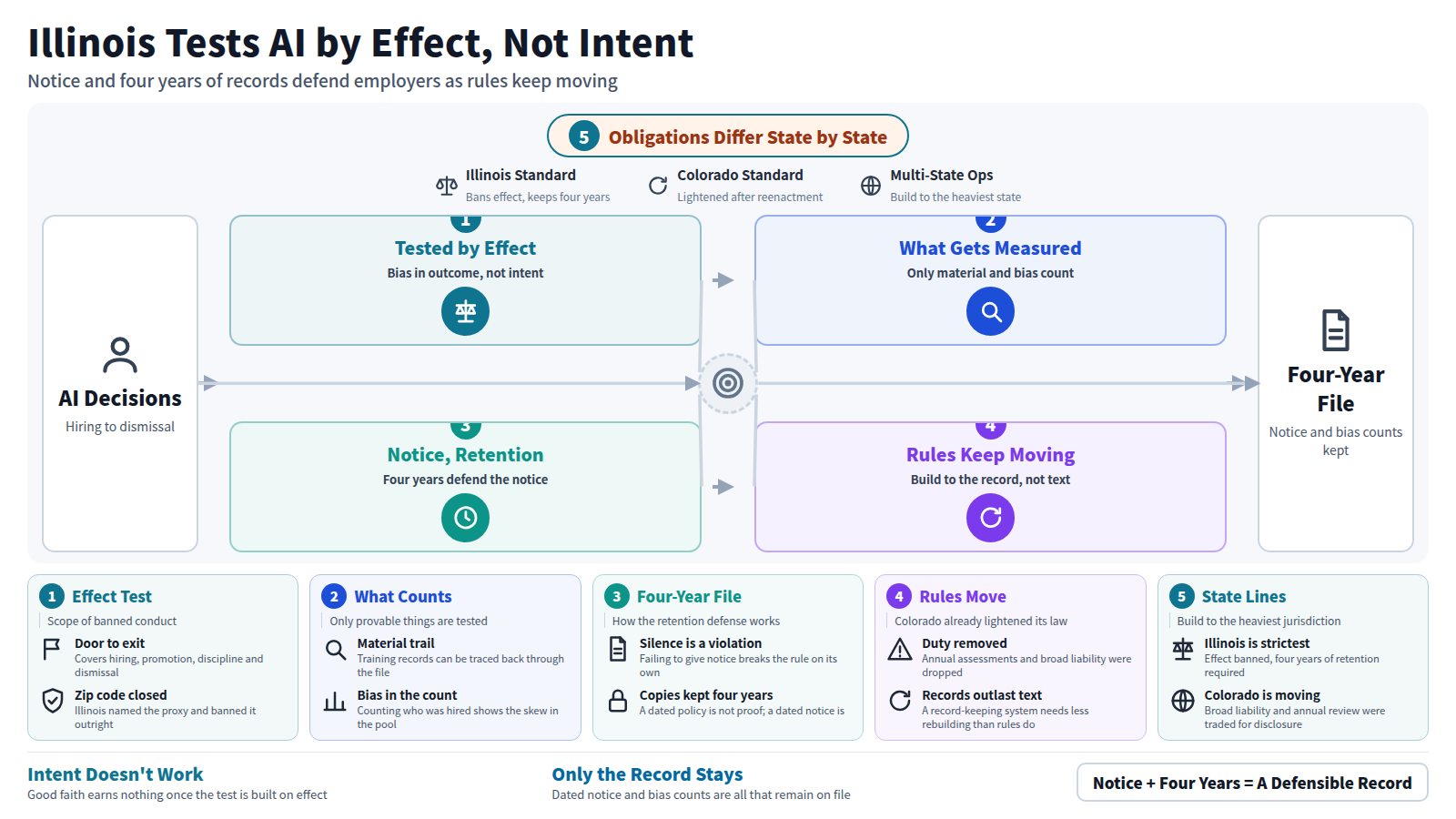
On 1 January 2026, an amended Human Rights Act took effect in Illinois, regulating the use of AI in decisions about hiring, promotion and dismissal. When an AI decision turns out to discriminate, does the absence of intent excuse the employer? It does not. The statute asks about effect rather than intent, and puts notice, plus four years of records, on whoever used the tool.
01Decisions made with AI are now tested by the bias in the outcome, not by the intent behind them
What the amended Illinois Human Rights Act forbids is the effect itself: AI use that disadvantages people on the basis of protected classes. Whether anyone set out to discriminate is not part of the test. The same statute separately forbids using zip codes as a proxy for protected classes.
Under a rule shaped this way, what protects an employer changes. The document explaining at rollout that the tool is fair does nothing against a provision written around effect. Two things enter the test: dated proof that applicants and employees were told AI was in use, and numbers showing how much bias appeared in the results. Of the two, only the first is something the employer can produce in its own favour. Regulations adopted by the Illinois Department of Human Rights require employers to preserve those notices, postings and disclosures for four years.
For a company already screening candidates with AI, the first thing to assemble under this law is not a policy document. It is the file of notices, and a way of counting outcomes.
02The statute bans the effect itself: AI use that disadvantages protected classes
Set out precisely which situations the statute names. Recruitment, hiring, promotion, renewal of employment, selection for training or apprenticeship, discharge, discipline, tenure. Terms and privileges of employment are swept in alongside them. This is not a rule about the interview alone.
The prohibition on zip codes is the most concrete line in the law. A zip code is not a protected class. But where someone lives tends to overlap with race and national origin, so a model fed zip codes can arrive at the same outcome without ever touching a protected class directly. Illinois named that path and closed it.
A provision that declines to ask about motive nevertheless bans one specific input. The whole approach of the statute is visible in that pairing.
Decisions at the door
Recruitment and hiring. The rule applies from the moment an employer hands the narrowing of applications to AI.
Decisions along the way
Promotion, renewal of employment, selection for training or apprenticeship. Assessment during employment falls under the same provision.
Decisions at the exit
Discharge and discipline. The statute names the moment an employer decides whether to keep someone on.
03The rule follows the hiring decision, not the industry, so pharmaceutical employers are inside it
The statute names decisions: hiring, promotion, dismissal. Industry appears nowhere in it. Any company that employs, assesses and dismisses people in Illinois sits inside this law, whatever sector it belongs to.
A pharmaceutical company choosing reviewers for its promotional materials is in the same position. If AI narrows the applications and the results skew along protected classes, the provision applies regardless of how specialised the reviewing work is. The expertise of the role is no answer; against a charge of failing to give notice, all the employer can produce is the dated record that notice was given.
There is a boundary to the reach, though. This law governs employment in Illinois, and other states have their own. An employer with offices in several states that wants one internal standard covering all of them ends up building to the heaviest state.
Choosing reviewers
When a pharmaceutical company narrows candidates for materials review with AI, that decision falls inside the statute.
Deciding assessment and promotion
An employer using AI scores to assess current staff is not outside the duties of notice and retention either.
Crossing state lines
The weight of the obligation differs state by state. One internal standard for every office means building to the heaviest of them.
04Testing by effect fits the fact that intent cannot be extracted from a model and proven
A statute that reaches this widely across hiring and promotion still left motive out of its requirements. The statute does not give its reason. But the fact that motive cannot be proven fits the shape it took.
Open up a model as far as you like and nothing corresponding to an intent to discriminate comes out. Two things do. One is the material used in training and in the decision, which a record can trace. The other is the bias in the selected pool, which counting who was hired and who was not will show. Motive alone never emerges in countable form.
The zip code prohibition illustrates the approach. Illinois did not write that zip codes must not be used for discriminatory purposes. It banned the input regardless of purpose. The same choice runs through both provisions: make the test out of what can be proven.
Seen from the employer's side, this is a hard shape of rule. If motive is never examined, then demonstrating good faith earns nothing. A recruiter who worked carefully to be fair has no place to put that fact among the requirements. What does have a place is the date of the notice and the composition of the people selected. Effort leaves no trace in the file; numbers do.
05The defence is a system that keeps four years of proof that notice was given
If material and outcome are the only measurable things, what an employer keeps follows from that. Under the regulations adopted by the Illinois Department of Human Rights, failing to tell applicants and employees that AI is in use is itself a violation. AI-related notices, postings and disclosures must be preserved for four years.
That four-year figure sets how long notice can still be proved. When an applicant from three years ago raises the bias in the outcome, an employer holding nothing but a policy document cannot show that notice was given. An employer holding dated copies of the notice can. The difference amounts to that alone.
Under this rule, whether notice can be shown at all is decided by retention, not by the standing of the document. A company that keeps a plain notice for four years is in a stronger position under this rule than one that files an impressive policy and discards it after twelve months.
06The rules themselves move, so build to the record rather than to the current text
If a four-year retention period decides the defence, what should an employer build towards? Three things can be said at once here.
First, the plea that there was no intent does not work. The Illinois provision is built around effect and establishes no procedure for examining motive, so "we did not mean to discriminate" corresponds to nothing in the requirements.
Second, notice is a duty, and the retention period sets how long that notice can be proved. Since failing to give notice is itself a violation, whether notice was given can become the point in dispute. An employer that discarded the file before four years elapsed has given up its own material for that dispute.
Third, the rules move. Colorado enacted a replacement statute on 14 May 2026 that removed the broad discrimination duty and the annual impact assessments it had earlier imposed. A company that built its system around the text currently in force rebuilds each time the text changes. A system for keeping records is less likely to need rebuilding, though what must be kept and for how long does change with the text.
| Test | Illinois (in force 1 Jan 2026) | Colorado (due 1 Jan 2027) |
|---|---|---|
| What is examined | Discriminatory effect on protected classes | Disclosure of automated decision technology |
| Duty on the user | Notice, and four years of retention | Annual impact assessment removed |
| Scope covered | Employment decisions | Consequential decisions broadly |
07Colorado dropped the duty and switches to a disclosure regime in 2027
Take one state that actually moved, and follow it. Colorado passed a law in 2024 requiring developers and deployers of high-risk AI to use reasonable care to protect consumers from algorithmic discrimination. At the time it was read as the furthest any state had gone.
The effective date was then pushed back, with no agreement reached. On 14 May 2026, Governor Polis signed a new bill that repealed the earlier framework and reenacted it. The annual impact assessments went, and so did the broad discrimination duty. The replacement is framed around automated decision-making technology and is due to take effect on 1 January 2027.
What an employer should take from that sequence is plain enough. A system built to match the text of a rule must be rebuilt the moment that text disappears. Companies in Colorado that set up annual impact assessment procedures lost the basis for those procedures before the law ever applied. The work itself is not wasted, but its grounding is gone.
Across three years, Colorado's obligations grew heavier once and then lighter before they ever applied. Europe, meanwhile, applies its requirement of automatic logging for high-risk AI from 2 December 2027. A state that is lightening and a framework that makes logging mandatory are advancing at the same time. How Colorado's replacement will work in practice is not yet known by anyone; it has not been applied.
- Illinois amended its Human Rights Act from 1 January 2026, barring AI use that has a discriminatory effect and barring zip codes as a proxy. Motive is not part of the test.
- Under the state rules, failing to give notice is itself a violation, and AI notices must be kept for four years. Whether notice can be proved is set by retention, not by policy documents.
- Colorado enacted a replacement on 14 May 2026, removing annual impact assessments and the broad discrimination duty, with a disclosure regime from 1 January 2027. Obligations are not moving in one direction.
The absence of intent is no defence once the rule asks about effect. What stays with a company that let AI choose its people is dated proof of notice, and numbers that show the bias in the outcome.
The text of the law moved in Illinois and moved again in Colorado. What does not move is the record of who was told what, when, and what skew followed. Build towards that and the work lasts longer.
- The National Law Review. Illinois Anti-Discrimination Law to Address AI Goes Into Effect on 1 January 2026. 1 May 2025. (Scope of the prohibited conduct, and effect as the test.)
- Hinshaw & Culbertson LLP. Illinois Adopts AI-in-Employment Regulations: What Employers Need to Know for 2026. 26 February 2026. (Notice duty, four-year retention, effective date of 1 January 2026.)
- Morgan, Lewis & Bockius LLP. Illinois Passes New Law to Address AI in the Workplace. 12 September 2024. (Statutory wording, and the ban on zip codes as a proxy.)
- Colorado General Assembly. SB24-205 Consumer Protections for Artificial Intelligence. 17 May 2024. (Reasonable care required of developers and deployers of high-risk AI.)
- AI Compliance Atlas. Colorado AI Act (SB 24-205): 2026 Status & SB 26-189. 14 May 2026. (Repeal and reenactment, effective 1 January 2027.)
- EU Artificial Intelligence Act (article commentary site). Article 12: Record-Keeping. 12 July 2024. (Automatic logging for high-risk systems, applying from 2 December 2027.)