
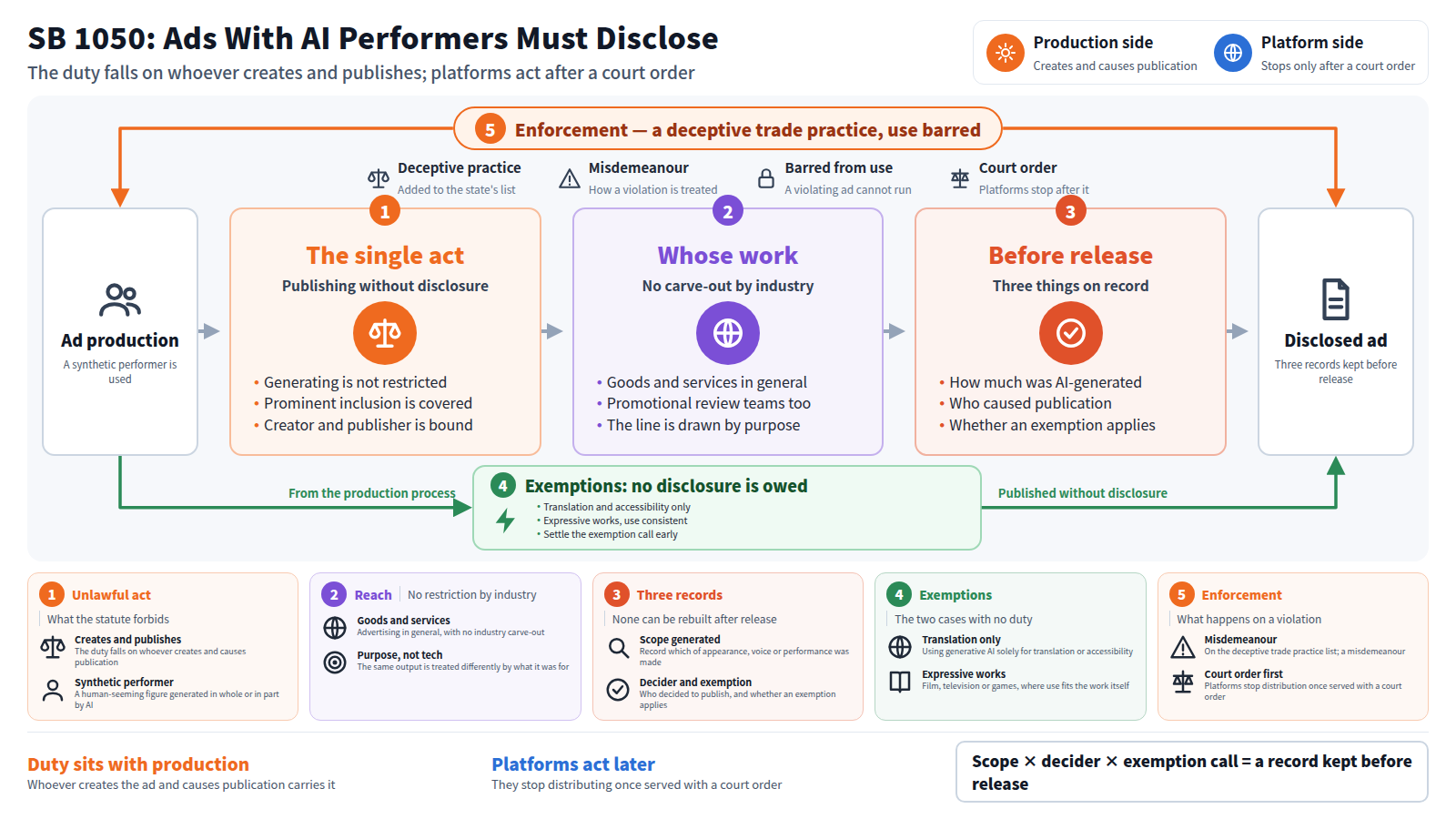
On 16 September 2026, the Governor of California signed SB 1050, requiring a clear and conspicuous disclosure on any advertisement that prominently features a performer generated by AI. When an ad uses a generative AI performer, who carries the duty to disclose? Whoever creates the ad and causes it to be published. Distributors act only after a qualifying court order.
01From 2027, ads using generative AI performers must disclose
Take the answer first: responsibility sits with production. From 1 January 2027, SB 1050 requires a clear and conspicuous disclosure on advertisements that prominently include a synthetic performer. The duty falls on whoever creates that advertisement and causes it to be published in an advertising medium. Platforms are placed one step back — required to stop distributing a non-compliant ad once served with a qualifying court order.
That placement settles an order of operations. Adding a label after publication is not enough, because whether a disclosure is owed depends on what was generated and how far, and the material for that judgement exists only inside the production process. Reconstructing after release how much of a figure a machine produced is hard work.
So what a production team should move is not the label field after release. It is whether the scope of what was generated, and the name of whoever decided to publish it, can be put on record before release. What follows takes that order: what the statute makes unlawful, whose work it reaches, why it took this shape, what needs checking, and the three places where judgement divides.
02The law binds publication without disclosure, not the making of content
To say responsibility sits with production, it is worth reading what the statute actually forbids. It makes it unlawful for any person to create and cause to be published in an advertising medium an advertisement that prominently includes a synthetic performer without a clear and conspicuous disclosure. A synthetic performer is a human-seeming figure — appearance, voice or performance — generated in whole or in part by AI and not readily identifiable as a specific real individual.
The drafting narrows the target to a single point. Generating such a figure is not restricted. Distribution in general is not restricted. What becomes unlawful is publishing an ad that prominently includes one, without disclosure.
The narrowing matters. Ban the technology itself and translation, voice synthesis and caption generation stop alongside it. Put the duty on publication and what stops is only the publishing of an ad that features such a figure prominently without a disclosure. The regulated act is not the making; it is the act that governs how the thing is received.
03The duty applies across industries, reaching teams that build promotional materials
If publishing without disclosure is what is unlawful, the next question is whose work that reaches. The statute covers advertising for goods and services generally, with no restriction by industry. There are two exemptions: using generative AI solely for translation or accessibility, and advertising for expressive works such as film, television or games where the use is consistent with the work itself.
| What to look at | Disclosure required | Exempt |
|---|---|---|
| What the AI was used for | Producing a figure that reads as a human performance | Translation and accessibility only |
| What is advertised | Goods and services generally | Expressive works, where use is consistent with the work |
| Who carries responsibility | Whoever creates it and causes publication | Media act once served with a court order |
The line is drawn by purpose, not by technology. The same generation system falls inside an exemption when used for translation and triggers a disclosure when used to produce a figure that reads as a human performer. The material for that call is not in the output. It sits in the process — in what the thing was made for.
Teams that build promotional materials and review them for compliance are not outside this rule. For an advertisement distributed in California there is no industry carve-out. That said, regulation specific to drug promotion and this state's trade-law disclosure duty are separate systems. Satisfying one does not satisfy the other.
04Worker protection and deception control were bundled into one statute
Reaching every industry does not explain where the statute came from. The signing took place at the headquarters of the actors' union. The state presented the law as protection for creative work and as protection for the judgement of buyers alike. The governor's line was that Californians deserve to know when the person selling them something is not a person at all.
Two purposes sit in one statute, and in it a disclosure is not left as a presentational matter. The synthetic-performer provisions were added to the state's list of deceptive trade practices, and a violation is treated as a misdemeanour. An advertisement found to violate the law is barred from continued use.
So disclosure is not a presentational nicety. It is a condition on whether the advertisement may run at all. An ad that fails the condition is not corrected and reissued; it becomes unusable. Between "add a label" and "may this run", the amount that has to be settled before production begins is different.
05Scope, responsibility and exemptions can all be checked before release
If disclosure is a condition of lawfulness, what is enough to check? The statute offers example wording to the effect that the performance was produced by a synthetic performer, or that no human performer appears. Clarity is judged against the medium and the context: text or audio, and how long it is on screen, change how clear the same words are.
Translated into practice, three things need to be on record before release.
How much was AI-generated
Record the scope — appearance, voice, performance — that was produced. Partial generation is inside the statutory definition too.
Who caused publication
Record, stage by stage, who made the thing and who decided to publish it. That person is the one carrying the duty.
Whether an exemption applies
Decide before release whether the use was solely translation and accessibility, or advertising for an expressive work.
None of the three can be reconstructed after publication. Scope survives only inside production, a decision survives only at the moment it was made, and the exemption call cannot be reproduced without someone who can explain the purpose. Arguing later that no disclosure was owed requires exactly the same three records.
06Disclosure is not a labelling chore; it demands a record of the production
Those three checks are also the three places where judgement divides.
First, with responsibility on the production side, the place to check is not after distribution. Platforms only stop once served with a court order, so until then the exposure stays entirely with whoever made the ad. The longer an order takes, the longer that stretch of sole exposure runs.
Second, the line is drawn by purpose rather than technology. The same generated material is treated differently depending on whether it was used for translation or to produce a figure that reads as human. This follows from the drafting: both exemptions are written in terms of use. Looking at the output alone will not tell you which use produced it.
Third, whether a disclosure is owed is settled by the production record, not by the label after release. Even the conclusion that no disclosure was owed cannot be proved later without a record. The duty turns on what was generated and how far, and only the production process holds that fact.
Review runs before release
With responsibility on the production side, the place to check is not after distribution.
Purpose draws the line
The same generated material is treated differently by what it was used for. The output alone will not settle it.
No record, nothing to show
Even the conclusion that no disclosure was owed cannot be proved later without a record.
07State disclosure rules are stacking up, and records will be needed first
If the production record is what settles the question, its weight rises as the rules multiply. New York's comparable law took effect on 9 June, the first state requirement of its kind. Penalties there are set at 1,000 dollars for a first violation and 5,000 dollars for subsequent ones, and four complaints over undisclosed advertising are pending before the state attorney general. California's law takes effect on 1 January 2027.
Two states, and the commencement dates, the required wording and the form of the penalty all differ. Running the same advertisement in both means choosing between meeting the stricter requirement everywhere and cutting separate versions per state. Either choice draws on the same material: a record of what was generated and how far.
What is unsettled should be said as well. Which state's wording governs a distribution that crosses several states cannot be answered from what is available now. The penalty amounts under the California provisions and who enforces them have not been checked here. Whether a comparable federal duty appears is not at a stage where a forecast is worth making. What is certain is narrow: the record needed to show later whether a disclosure was owed exists nowhere except inside the production of the advertisement being made now.
- SB 1050 makes it unlawful to publish an ad prominently featuring a synthetic performer without disclosure, while leaving generation itself unrestricted. The duty falls on whoever creates it and causes publication.
- The exemptions are two: AI used solely for translation or accessibility, and advertising for expressive works where the use is consistent with the work. The line is drawn by purpose, not by technology.
- New York's comparable law took effect on 9 June with penalties of 1,000 and 5,000 dollars and four complaints pending. Wording and penalties will differ state by state for some time.
When an advertisement uses a generative AI performer, the duty to disclose falls on whoever creates it and causes it to be published. Distributors act only after a court order.
What that placement demands is not the work of adding a label. It is writing down, before release, how much a machine produced and who decided to put it out. The conclusion that a disclosure is owed, and the conclusion that it is not, both come from the same record.
Commencement is 1 January 2027, so there is time. But the thing that has to be ready is not the wording in a label field; it is the way production records are kept. That one has to start with the advertisement being made now, or the date will arrive first.
- Office of Governor Gavin Newsom. Governor Newsom signs new law to protect workers, require disclosures on AI-generated advertising. 16 September 2026. gov.ca.gov(The signing, and the twin purposes of protecting creative work and buyers' judgement)
- California Legislative Information. SB-1050 False advertising: synthetic performers. 16 September 2026. leginfo.legislature.ca.gov(Statutory text, the definition of a synthetic performer, example disclosure wording, and the two exemptions)
- ContentGrip. California SB 1050: AI actor ad rules. 18 September 2026. contentgrip.com(Primary responsibility on whoever creates and causes publication; platform duties following a qualifying court order; commencement and exemptions)
- Bloomberg Law. California Enacts Synthetic Performer Advertising Disclosure Law. 16 September 2026. news.bgov.com(Continued use of an advertisement found to violate the law is prohibited)
- Hoodline. Newsom signs law forcing California ads to reveal hidden AI actors. 17 September 2026. hoodline.com(Treatment as a misdemeanour; New York's 9 June commencement and its 1,000 and 5,000 dollar penalties)
- U.S. Food and Drug Administration. Basics of Drug Ads (Office of Prescription Drug Promotion). Accessed 20 September 2026. fda.gov(Review of promotional material runs separately under existing supervision)