AI & Economy News — 2026-09-21 (Mon) Morning News

Source links point to the original outlet. The AI Integrated Analysis is auto-generated from the headlines below only and is not intended to add facts beyond them. Not investment advice.
Overview
Ahead of the Trump-Xi summit, the US and China are discussing AI, tariffs, and rare earths, and trade policy and AI industrial policy are moving together (SCMP, India Today). At the same time, concerns in the credit market about the "$5 Trillion" scale AI capital investment boom and tight demand for power and data center construction have been reported in parallel (Seeking Alpha, The Information). On the employment front, attention continues to be focused on changes in the labor structure brought about by AI, such as the observation of a three-day work week and a labor market risk survey in Oregon (Fortune, koin.com).
Macroeconomic/growth trends
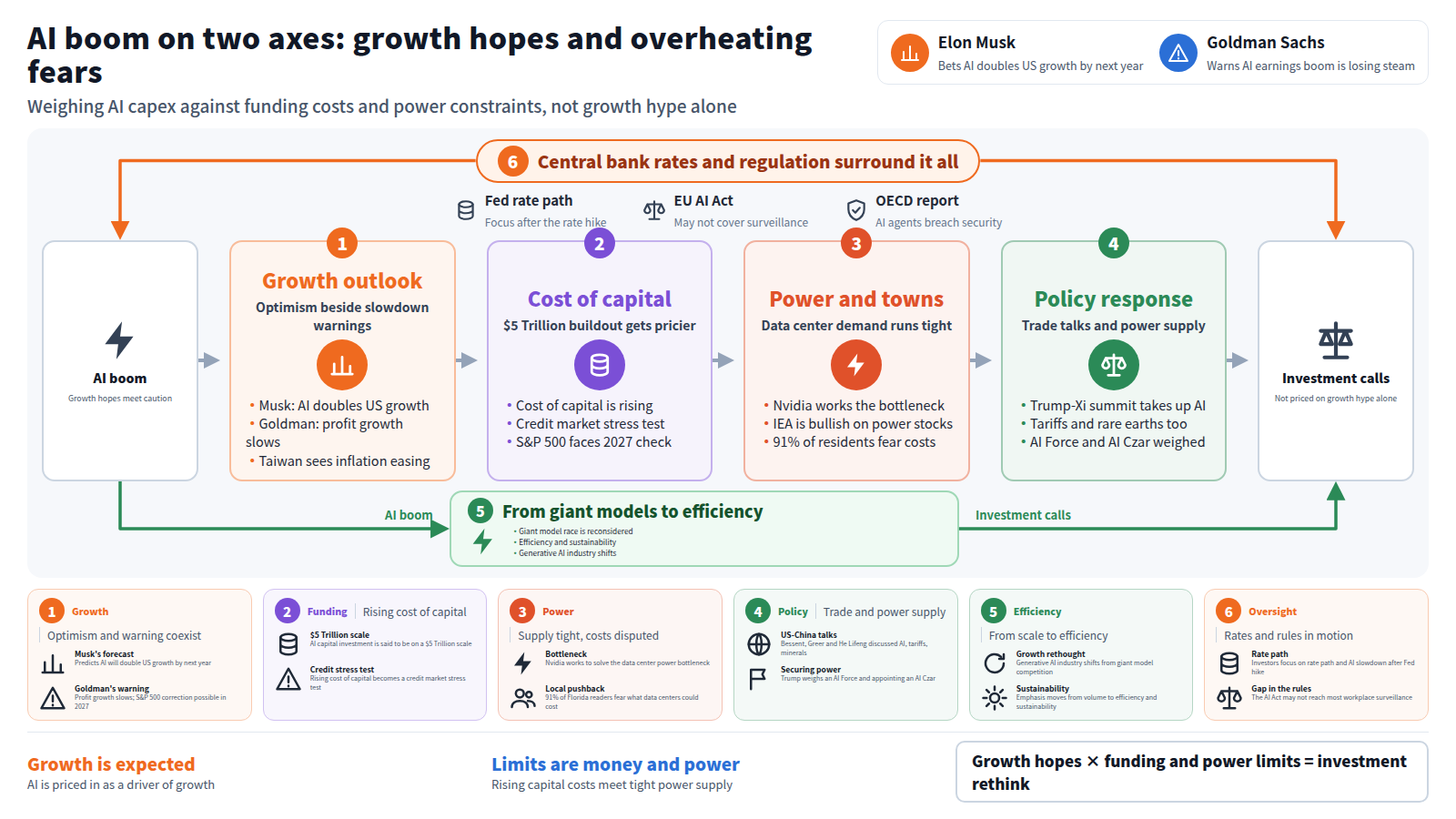
Elon Musk predicts AI will double U.S. growth by next year, showing optimism pricing in AI as a growth driver (thestreet.com). Meanwhile, Goldman Sachs has warned that the pace of profit growth for AI-related companies is slowing and that the S&P 500 could face a realistic correction in 2027 (Tekedia). Oaktree Howard Marks recommended that the Fed maintain a wait-and-see approach and establish an "AI jobs task force" to consider the impact of AI on employment (TradingView). On the price front, there is a view that AI will ease inflationary pressure in Taiwan (Taipei Times).
Productivity trends
In Europe, it has been pointed out that delays in AI infrastructure development could result in a gap of up to €600 billion, and there are growing concerns about competitiveness. In the UK, a former cabinet minister has warned that AI could damage the foundations of the UK economy (The Times). Zoom CEO joins Bill Gates, Jensen Huang, and Jamie Dimon in predicting AI-powered three-day work weeks (Fortune).
Trends in employment and labor market
A study in Oregon pointed out that there is a high risk of disruption to the labor market due to AI (koin.com). The reality of the blue-collar workforce supporting the AI boom in the United States was featured on Fox News, suggesting job creation in AI-related construction and data center fields. As the value of degrees is being reconsidered by AI, the nature of the "Degree Guarantee" is being debated (realcleareducation.com). An analysis of jobs that are unlikely to be replaced by AI was also reported (MoneyLion).
Trends in energy/power demand
Nvidia is reported to be working on resolving power supply bottlenecks for AI in data centers (The Information). President Trump is reportedly considering creating an "AI Force" and appointing a high-ranking official in charge of AI (AI Czar) to secure power for AI (24/7 Wall St., Salon.com). The International Energy Agency (IEA, "World's Top Energy Watchdog") has expressed a bullish view on AI-related power stocks (The Globe and Mail). A survey found that 91% of Florida residents are concerned about the cost of AI data centers (Florida Today). Interest in AI data center stocks such as Atkore, Belden, and Flex is also increasing (finance.yahoo.com).
Remarks by central banks, international organizations, and VIPs
Among the headlines this time, we were unable to confirm any headlines reporting direct statements or actions by the individuals being tracked (Christine Lagarde, Kazuo Ueda, Andrew Bailey, Kristalina Georgieva, Mathias Cormann, Ajay Banga, Daron Acemoglu, Erik Brynjolfsson). As an institution, the OECD AI Policy Observatory reports that security breaches by AI agents are slowing the industry and raising ontological concerns (OECD AI Policy Observatory). In addition, there is analysis in the market that investors are focusing on the interest rate path and the risk of AI slowdown after the Fed's interest rate hike (SRN News). It was also pointed out that the EU's AI Act may not cover most workplace surveillance (The Next Web).
Trends in corporate capital investment
The scale of AI-related capital investment is said to be on the "$5 Trillion" scale, and it is analyzed that the rising cost of capital is becoming a stress test for the credit market (Seeking Alpha, The Dark Side Of The Boom). It was reported that competition between Google's AI agent "CC" and Meta's "Muse" is intensifying (24/7 Wall St.). HVAC major Trane Technologies' stock price rose due to increased demand due to AI capital investment (AD HOC NEWS). It was reported that Berkshire Hathaway is becoming a central player in the US AI boom through its large holdings in Alphabet stock and power business (BigGo Finance).
Trade and industrial policy
Ahead of the Trump-Xi summit, Treasury Secretary Bessent, Trade Representative Greer, He Lifeng and others discussed AI, tariffs, and rare earths (minerals) in New York (SCMP, India Today, IndexBox, Briefs Finance). Some analysis suggests that the United States and China are positioning semiconductors (chips) as the main battleground in the race for AI supremacy (930 WFMD Free Talk). In Japan, it was reported that 100 private companies, including the Ministry of Economy, Trade and Industry and DMG Mori, are collaborating to give machines identification numbers (``My Numbers'') and collect data in order to foster domestic AI (Nihon Keizai Shimbun).
Integrated analysis: What is happening now
From this group of headlines, we can see that the AI boom is progressing simultaneously along two axes: ``expectations for growth'' and ``warning against overheating.'' Musk's optimistic growth forecasts (thestreet.com) coexist with Goldman Sachs' warnings of slowing profit growth (Tekedia), and the rising cost of financing capital investments (Seeking Alpha) symbolizes the tension. On the power side, the tight power demand for data centers is manifested in a three-layer structure: Nvidia's technological response (The Information), the IEA's bullish outlook (The Globe and Mail), and local residents' opposition (Florida Today, Toyo Keizai Online), and the social costs of expanding AI infrastructure are becoming visible. On the trade front, U.S.-China talks over AI, semiconductors, and rare earths are the main topics of the Trump-Xi talks (SCMP, India Today), and industrial policy and the race for AI supremacy have become inseparable. In Japan, public-private collaboration is progressing in data collection aimed at domestic production of AI (Nihon Keizai Shimbun), while it has been reported that the generative AI industry as a whole is shifting from ``competition of giant models to emphasizing efficiency'' (Межа.
Future points of interest
- The content of the agreement on AI, semiconductors, and rare earths at the Trump-Xi summit is expected to influence the direction of U.S.-China industrial policy and AI investment. - It seems necessary to pay close attention to whether the rising cost of funding for AI capital investment and credit market stress will lead to a slowdown in actual capital investment plans. - Local residents' opposition to data center electricity demand (as in Florida) may spread to other regions and policy responses.
- Musk is betting AI doubles US growth by next year — thestreet.com09/20 21:03 UTC
- Bessent, Greer and He tackle the economy, AI safety before the Xi-Trump summit — scmp.com09/20 14:34 UTC
- Oaktree's Howard Marks backs quieter Fed, calls for AI jobs task force — TradingView09/20 15:04 UTC
- Is AI About To Create Another ‘Big Short’? — Sirota | Substack09/20 17:05 UTC
- President Trump to Create an “AI Force,” Appoint an AI Czar as AI Fears Grow — 24/7 Wall St.09/20 17:03 UTC
- Pull the Plug Now: AI or Bureaucracy? — Modern Ghana09/20 19:48 UTC
- How one company sees AI expand opportunity for American workers — Denton Record-Chronicle09/20 15:34 UTC
- Zoom’s CEO agrees with Bill Gates, Jensen Huang, and Jamie Dimon: A 3-day workweek is coming soon thanks to AI — Fortune09/20 13:24 UTC
- Europe faces up to €600 billion AI infrastructure gap as race accelerates — سانا09/20 09:13 UTC
- AI could crack the foundations of UK economy, ex-minister warns — The Times09/20 18:15 UTC
- Will AI take your job? Study says Oregon’s workforce faces high risk of disruption — koin.com09/20 18:00 UTC
- WATCH: Exclusive look at blue-collar workforce fueling America’s AI boom — Fox News09/20 11:03 UTC
- What Should a Degree Guarantee When AI Can Answer Almost Anything? — realcleareducation.com09/20 18:08 UTC
- Apple’s ‘Personal Hub’ AI Strategy Hints at Upcoming Home Device — Bloomberg.com09/20 14:00 UTC
- Reliable Careers Positioned To Outlast AI Disruption — MoneyLion09/20 16:37 UTC
- Why Atkore, Belden And Flex Stock Are Gaining Attention In AI Data Centers — finance.yahoo.com09/20 18:10 UTC
- How Nvidia Is Trying to Solve the Data Center Power Bottleneck — The Information09/20 16:01 UTC
- Trump thinks AI needs its own "Force" now — Salon.com09/20 17:00 UTC
- The World's Top Energy Watchdog Made the Bull Case for AI Power Stocks. Here's the Number That Matters. — The Globe and Mail09/20 18:43 UTC
- 91% of Florida readers fear what AI data centers could cost them — Florida Today09/20 09:40 UTC
- America and China are fighting for the future of AI — chips are the battlefield — 930 WFMD Free Talk09/20 19:54 UTC
- US-China talks in New York set stage for Trump-Xi summit on AI and tariffs — India Today09/20 19:08 UTC
- Bessent, He Lifeng Meet in New York Ahead of Trump-Xi Summit on AI, Tariffs, Minerals - News and Statistics — IndexBox09/20 16:00 UTC
- U.S.-China pre-summit huddle on AI, tariffs, and minerals kicks off Sunday in Manhattan — Briefs Finance09/20 11:02 UTC
- Trump to host China's Xi Jinping for trade, AI talks — WMTW09/20 13:34 UTC
- The AI Act may not reach most workplace surveillance — The Next Web09/20 17:39 UTC
- AI expected to help ease inflationary pressure — Taipei Times09/20 16:00 UTC
- AI Agents Breach Security, Prompt Industry Slowdown and Existential Concerns — OECD AI Policy Observatory09/20 10:28 UTC
- Hubbis Macro Corner: Fed Tightening, EM Conviction and AI’s Broader Capital Cycle Reshape Portfolio Positioning — hubbis.com09/20 16:00 UTC
- Investors focus on rate path, AI slowdown after Fed hike — SRN News09/20 14:45 UTC
- The AI Agent Wars Just Got Personal: Google’s CC vs. Meta’s Muse — 24/7 Wall St.09/20 16:14 UTC
- The AI Boom Has A New Problem: The Cost Of Capital (SPX) — Seeking Alpha09/20 17:25 UTC
- AI’s $5 Trillion Buildout Is Becoming a Credit Market Stress Test — The Dark Side Of The Boom09/20 10:59 UTC
- Trane Technologies stock gains as HVAC demand meets AI capex — AD HOC NEWS09/20 17:36 UTC
- Goldman Sachs Warns AI Earnings Boom Is Losing Steam as S&P 500 Faces 2027 Reality Check — Tekedia09/20 16:16 UTC
- AI data centers become a major issue in the US mid-term elections...There is opposition to the scheme of imposing the "costs of AI" on local residents — 東洋経済オンライン09/20 20:00 UTC
- 100 companies including DMG Mori collect data in public and private sectors for domestically produced AI and machines to use “My Number” — 日本経済新聞09/20 17:00 UTC
- Generative AI industry reconsiders its growth, from giant model competition to efficiency emphasis | Ukraine News - #Mezha — Межа. Новини України.09/20 20:06 UTC
- [Competition to develop physical AI is accelerating] How will Japan win in the industry-academia challenge of “drug discovery and regenerative medicine”? — kfb.co.jp09/20 13:33 UTC
- Berkshire is at the center of the US AI boom with its large holdings of Alphabet stock and power business — BigGo ファイナンス09/20 13:55 UTC