1. What Problem Does This Paper Address?
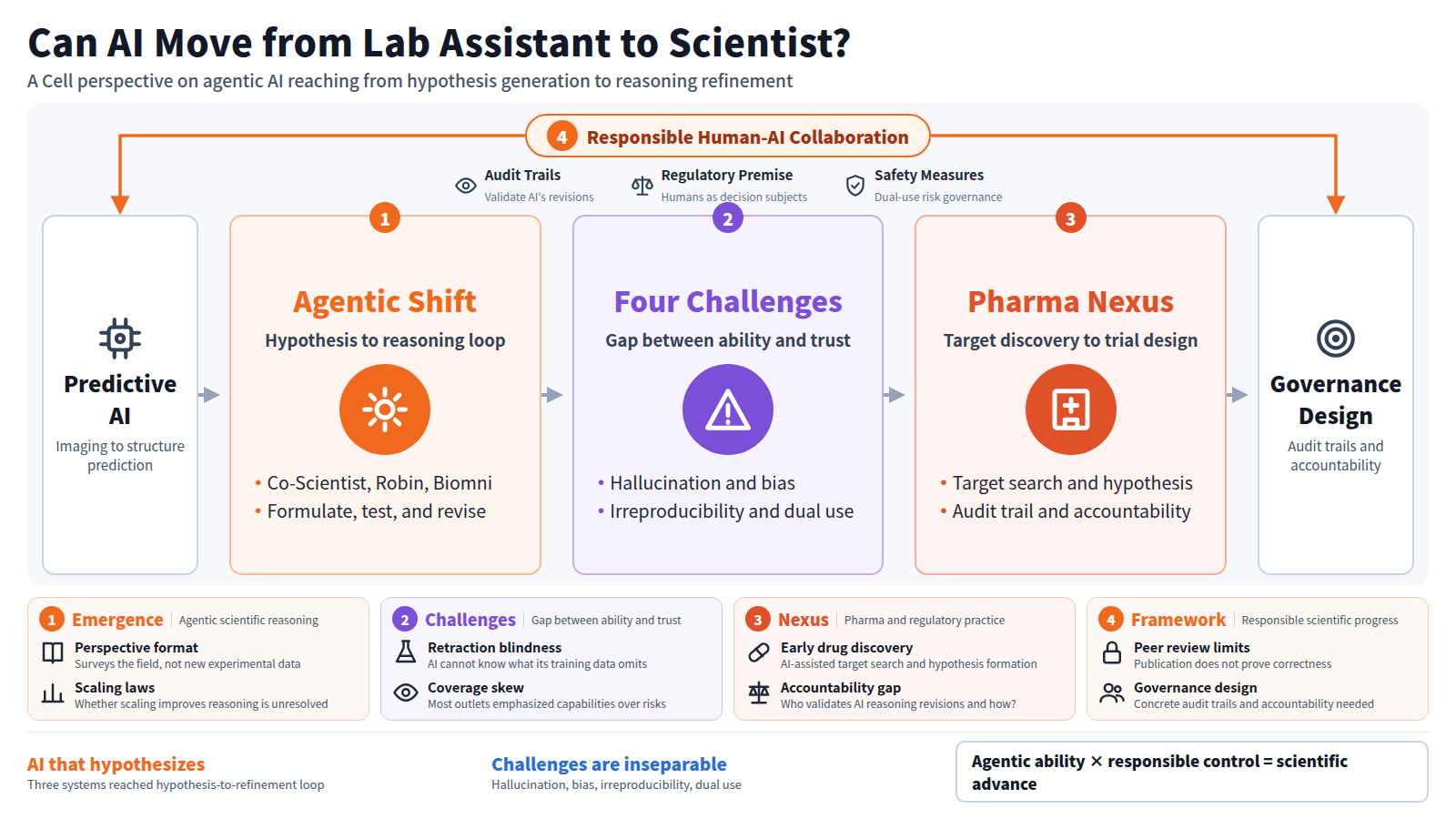
AI in biomedicine began with pattern recognition for medical image analysis, then moved to generative models like AlphaFold for protein structure prediction. According to the abstract, tools such as Elicit, GPT-Rosalind, and Claude Science are now bridging prediction and reasoning through literature synthesis, domain-tuned models, and agentic workbenches. The question is whether these remain tools for isolated tasks or become agents capable of scientific reasoning itself.
This paper argues the boundary has already shifted. The distinction matters because a tool that answers questions and an agent that formulates its own questions, tests them, and revises its reasoning operate under fundamentally different accountability structures.
2. What Does It Propose?
The authors focus on three systems: Co-Scientist, Robin, and Biomni. As described in the abstract, these demonstrated agentic AI capable of generating hypotheses, designing experiments, performing computational analysis, and refining reasoning through experimental feedback. In other words, they are positioned not as AI that returns answers, but as AI that formulates questions, tests them, and adjusts.
As a perspective article, this paper does not report new experimental data. Instead, it traces the emergence of agentic scientific reasoning and extends the discussion to scaling laws and autonomous laboratories. The inclusion of scaling laws is notable: it implies the authors expect these capabilities to grow with model size and compute, though the abstract does not present evidence for this expectation.
3. What Did It Show?
Within the scope of the abstract, the paper does not report novel experimental results. It traces the emergence of agentic scientific reasoning using the track records of these three systems and organizes four challenges: hallucination, bias, irreproducibility, and dual use.
The authors conclude that scientific progress will depend on responsible human-AI collaboration. This framing places the burden not on the AI systems themselves but on the governance structures surrounding them — a position that has practical implications for any organization considering deployment.
4. A Practical View
A drug discovery team conversation (fictional)
Researcher A: "I had the AI generate hypotheses for this target."
Researcher B: "And the evidence behind the hypothesis?"
Researcher A: "It synthesized the literature. But one of the cited papers failed to replicate."
Researcher B: "Does the AI know that?"
Researcher A: "No. The retraction data isn't in its training set yet."
This exchange illustrates the gap between an AI's ability to generate hypotheses and the trustworthiness of those hypotheses. The hallucination and bias issues raised in the paper appear in the same structural form whether in the laboratory or in regulatory document preparation. When an agent synthesizes literature to form a hypothesis, the quality of that synthesis depends on the completeness and accuracy of its source material — something the agent itself cannot fully verify.
5. What Is Not New, and Where Are the Limits?
The idea that AI can support scientific research is not new. Automated literature search, structure prediction, and experimental design optimization all predate this paper. What this perspective adds is a conceptual framing of the "agentic" paradigm, not a report of previously unknown capabilities.
Within the abstract, it remains unclear under what conditions and for which types of tasks these three systems succeeded. The phrase "from hypothesis generation to reasoning refinement" is broad, but success rates and failure modes are not discussed in the abstract. This is partly a limitation of the perspective format, which surveys a field rather than reporting controlled experiments.
The paper mentions scaling laws, but whether scaling reliably improves scientific reasoning — as opposed to, say, text generation fluency — remains an open question in the field. The abstract does not present data on this point. Additionally, the dual-use concern the authors raise is stated but not developed in the abstract: which specific capabilities create dual-use risk, and what governance mechanisms might mitigate them, are left to the full text.
6. How Did Coverage Frame This Story?
This topic was covered by Science, Nature, Stanford Medicine, McKinsey, NVIDIA Blog, and Frontiers, among others. Their framing varied considerably.
Science used the headline "Autonomous biomedical research with an artificial intelligence agent," foregrounding autonomy as the defining feature. Stanford Medicine asked "Agentic AI in biomedical research: What is it and can it expedite science?," emphasizing practical acceleration of research timelines. Nature featured a concrete case — an autonomous X-ray scientist operating at a synchrotron beamline — which demonstrated agentic capabilities in a physical laboratory rather than a computational setting[4]. McKinsey reframed the story as "Reimagining life science enterprises with agentic AI," placing it within corporate strategy and organizational change.
Where the paper itself devotes significant attention to four challenges — hallucination, bias, irreproducibility, and dual use — most coverage articles emphasized the "AI accelerating science" angle. The thinning of the caution layer is a structural tendency in science reporting, and readers should be aware that the challenges discussed in the paper received substantially less attention in the coverage than the capabilities.
7. What Connects to Pharma and Regulatory Practice?
Agentic AI that generates hypotheses and designs experiments connects to pharma at two points: early-stage target discovery and hypothesis formation, and clinical development trial design support. In target discovery, an agent that can synthesize literature, identify gaps, and propose testable hypotheses could accelerate the earliest and most uncertain phase of drug development. In clinical trial design, an agent that can analyze prior trial data and suggest protocol modifications could reduce iteration cycles.
From a regulatory perspective, the unavoidable question is: who is accountable for AI-generated hypotheses and experimental designs? Current regulatory frameworks assume that a human is the decision-making subject. When an AI revises its reasoning based on experimental feedback, who validates that revision, and how is the validation documented? The paper's call for "responsible human-AI collaboration" translates, in regulatory practice, into concrete audit trail design and accountability allocation. Without clear answers on these points, the systems described in this perspective cannot be straightforwardly adopted in regulated environments.
Publication in a peer-reviewed journal means this discussion has been organized to a recognized academic standard. However, passing peer review does not constitute proof of the claims' correctness or clinical value. It means the arguments met the reviewers' threshold for rigor and relevance — nothing more, nothing less.