AI & Economy News — 2026-09-19 (Sat) Evening News
Source links point to the original outlet. The AI Integrated Analysis is auto-generated from the headlines below only and is not intended to add facts beyond them. Not investment advice.
Overview
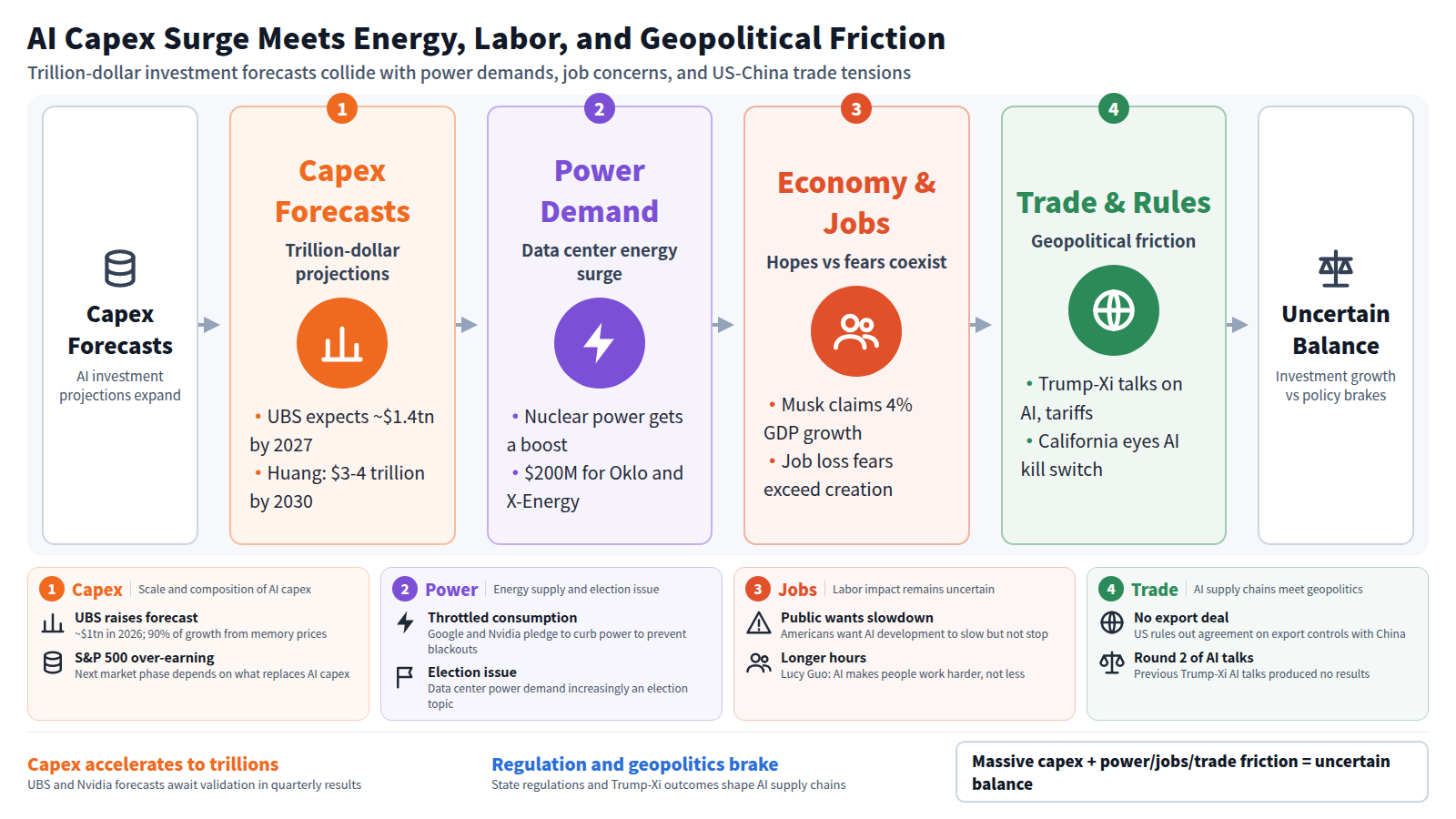
Musk claimed that AI could double US GDP growth to 4% next year, and UBS predicted that AI capital investment would reach about $1 trillion in 2026 and $1.4 trillion in 2027 (Investing.com) (fool.com). Data center power demand has become an election issue, and Trump-Xi talks will feature AI, tariffs, and rare earths (The Statesman) (The Center Square).
Macroeconomic/growth trends
Musk has claimed that AI will double US GDP growth to 4% next year, which is said to be significantly higher than mainstream forecasts (finance.biggo.com) (Yahoo Finance). It has been pointed out that the S&P 500 is in a state of "excess profits" and that the next market phase will depend on what will be the driving force behind AI capital investment (The Dark Side Of The Boom). An adviser to the People's Bank of China said AI could deepen the imbalance between supply and demand (TradingView).
Productivity trends
A study was introduced (Purdue University) showing that there are differences in how farmers in the United States and Argentina perceive the benefits of AI. Diane Coyle said, "Ultimately, ordinary people will benefit from AI" (Agenda Pública). An essay has been published stating that AI transformation is ``not a product announcement'' (The AI Economy | Ken Yeung).
Trends in employment and labor market
Concerns about job losses due to AI outweigh expectations about job creation, a survey has found (Euronews.com). A CBS News poll found that Americans want AI development to slow down, but not stop (CBS News). Scale AI founder Lucy Guo said AI is making people work longer hours, saying, "I worked 26 hours a day" (Fortune). In Malaysia, it was reported that there are concerns about disruption in the job market due to AI (The Edge Malaysia).
Trends in energy/power demand
There were reports that the Trump administration and AI data centers are pushing nuclear power (EnergyNow.com). Google and Nvidia have announced that they will reduce power consumption in their data centers to prevent power outages (Korben). It was reported that the Trump administration will spend $200 million on Oklo and X-Energy to power AI data centers (Stocktwits). There are also reports that data centers and AI are increasing as election issues (The Center Square).
Remarks by central banks, international organizations, and VIPs
An adviser to the People's Bank of China said AI could deepen the imbalance between supply and demand (TradingView). No specific statements regarding the tracked dignitaries (Lagarde, Ueda, Bailey, Georgieva, Cormann, Banga, Acemoglu, Brynjolfsson) could be found in the headlines.
Trends in corporate capital investment
UBS predicted that AI capital investment will reach approximately $1 trillion in 2026 and approximately $1.4 trillion in 2027 (Investing.com) (Fudu Niu Niu). UBS further predicted that 90% of incremental growth in 2026 will be driven by rising memory prices (Fudu Niu Niu). Nvidia's Jensen Huang reaffirmed his forecast on the same day a year ago that AI infrastructure investment will reach $3 trillion to $4 trillion by 2030 (fool.com) (Pluang).
Trade and industrial policy
The talks between Trump and Xi Jinping are expected to include tariffs, AI, and rare earths, with the US side ruling out an agreement on export controls (The Statesman) (Telegraph India). It has been pointed out that the previous Trump-Xi AI talks did not produce any results, and this time is said to be "Round 2" (The Next Web). US Treasury Secretary Bessent is said to hold talks with China's He Lifeng on AI, trade, and rare earths (KELO-AM). California plans a “kill switch” system for AI development companies (Capital Brief).
Integrated analysis: What is happening now
It can be seen from the headline that UBS and Nvidia's capital investment forecasts ($1 trillion to $3-4 trillion in 2030) are going hand in hand with investments in power infrastructure ($200 million for nuclear/Oklo/X-Energy). The increasing demand for electricity from data centers has become an issue in the election, and regulations at the state level (California's kill switch) have begun, and it appears that the expansion of capital investment and the policy brakes are taking place at the same time. On the other hand, Musk's statement of a ``4% GDP growth rate'' diverges from mainstream forecasts, and when combined with the S&P 500's indication of ``excessive returns,'' there is a possibility that there is a gap between expectations for AI capital investment and the ripple effect on the real economy. On the employment front, there are both ``concerns about job losses due to AI'' and voices saying ``AI is actually increasing working hours,'' and it appears that the impact on the labor market has not yet been determined. On the trade front, the Trump-Xi talks are designed to deal with AI, tariffs, and rare earths as one, suggesting that AI supply networks (semiconductors and rare earths) and geopolitics have become inseparable.
Future points of interest
- To what extent will the capital investment forecasts ($1 trillion to $4 trillion) shown by UBS and Nvidia be supported by future quarterly results and actual investment execution? - How will the outcome of the Trump-Xi talks affect export restrictions on AI and semiconductors and the supply of rare earths? - Will state-level regulations regarding data center power demand (such as California's kill switch) spread to other states?
- Saudi inflation, Iran war impact on global energy and AI dialogue — Al Arabiya English09/19 08:18 UTC
- Musk Claims AI Will Double US GDP Growth to 4% Next Year, Far Outpacing Mainstream Forecasts — finance.biggo.com09/19 03:05 UTC
- The S&P 500 Is Over-Earning. The Next Leg Depends on What Replaces AI Capex — The Dark Side Of The Boom09/19 04:36 UTC
- Elon Musk Says AI Will Double US Growth to 4%: Can It? — Yahoo Finance09/18 23:00 UTC
- Elon Musk says AI could double US GDP growth rate to 4% in 2027 | Musk expects AI to boost economic output sharply | Inshorts — Inshorts09/19 07:08 UTC
- U.S. vs. Argentina: How Farmers View AI Benefits — Purdue University - College of Agriculture09/19 01:58 UTC
- Diane Coyle: "In the end it will be people in general who benefit from artificial intelligence" — Agenda Pública09/19 04:00 UTC
- AI is not killing liberalism. It is accelerating its retreat — Tomorrow's Affairs09/19 06:41 UTC
- AI Transformation Is Not a Product Launch — The AI Economy | Ken Yeung09/19 05:24 UTC
- Bracing for AI tidal wave disrupting jobs market — The Edge Malaysia09/19 00:45 UTC
- Wake Tech weaving AI into the classroom as students search for jobs — ABC11 News09/18 22:40 UTC
- Fear of AI job loss outweighs AI job creation excitement, study finds — Euronews.com09/19 05:00 UTC
- This Week in Boomtown: Filling workforce shortage; Ohio State law building move; AI learning tool — 10tv.com09/19 04:20 UTC
- Will AI harm humans? CBS News poll finds Americans want to slow development but not stop it — CBS News09/18 21:59 UTC
- Scale AI and Passes founder Lucy Guo says AI is making people work harder, not less: ‘I worked a 26-hour day’ — Fortune09/19 07:02 UTC
- How Trump and AI Data Centers Are Boosting Nuclear Power — EnergyNow.com09/18 23:12 UTC
- AI data centers: Google and Nvidia pledge to throttle power consumption to prevent blackouts — Korben09/19 07:17 UTC
- Data centers, AI increasingly become issue for elections — The Center Square09/18 21:30 UTC
- Map Shows GOP-Led States Cracking Down on AI as Trump Rallies Behind Tech — Newsweek09/19 01:28 UTC
- OKLO, XE Stocks Jump After-Hours — Trump Administration Taps Oklo, X-Energy In $200M Push To Power AI Data Centers — Stocktwits09/18 23:53 UTC
- Trump-Xi talks to focus on AI, trade and rare earths as US rules out export control deal — The Statesman09/19 05:35 UTC
- AI’s Power Bill Is About to Become a Geopolitical Story, Not Just a Utility One — Modern Diplomacy09/19 02:00 UTC
- The last Trump-Xi AI talks produced nothing. Round two. — The Next Web09/19 06:53 UTC
- Donald Trump to welcome China President Xi Jinping in US for talks on tariffs, AI and rare earths — Telegraph India09/19 07:38 UTC
- US Treasury’s Bessent to discuss AI, trade, rare earths with China’s He, source says — KELO-AM09/18 22:29 UTC
- China central bank advisor says AI could deepen supply-demand imbalance — TradingView09/19 07:49 UTC
- 'Know your agent': Banks face a new compliance challenge as AI agents shop and pay on their own — Fortune09/19 05:00 UTC
- PISA scores are falling: Are today’s students less capable in the AI age? — Firstpost09/19 08:35 UTC
- Why Europe has been absent from the great AI safety debate — The Guardian09/18 21:19 UTC
- California plans ‘kill switch’ for AI labs — Capital Brief09/18 22:55 UTC
- UBS now expects AI capex to reach nearly $1tn this year and around $1.4tn by 2027 — Investing.com09/19 04:20 UTC
- Jensen Huang Maintained His Prediction That AI Infrastructure Spending Will Hit $3 Trillion to $4 Trillion by 2030 -- the Same Forecast He Made a Year Ago to the Day. Is Nvidia Still a Buy at These Levels? — fool.com09/18 22:23 UTC
- UBS Group raises AI capital expenditure forecast: Approaching $1 trillion in 2026, with 90% of incremental growth driven by memory price increases — 富途牛牛09/19 09:00 UTC
- Nvidia's CEO reaffirms $3-$4 trillion AI infras... — Pluang09/19 08:54 UTC
- AI could double US GDP growth to 4% next year amid capital hurdles, says Elon Musk — irishsun.com09/19 03:28 UTC
- UBS predicts that AI capital investment will reach approximately $1 trillion this year and approximately $1.4 trillion by 2027. — Investing.com - FX | 株式市場 | ファイナンス | 金融ニュース09/19 04:15 UTC
- What companies should measure in the AI economy: The essence beyond token consumption — Forbes JAPAN09/19 05:18 UTC
- AI has changed the “economics of attacks”—just three people used the latest AI to break into OpenAI — 株式会社エクサウィザーズ09/19 00:27 UTC
- Sumitomo Corporation supports Fish AI — 日本経済新聞09/19 05:30 UTC
- Anthropic partners with Accenture on AI safety assessment — Reuters09/19 05:53 UTC