AI & Economy News — 2026-09-19 (Sat) Morning News
Source links point to the original outlet. The AI Integrated Analysis is auto-generated from the headlines below only and is not intended to add facts beyond them. Not investment advice.
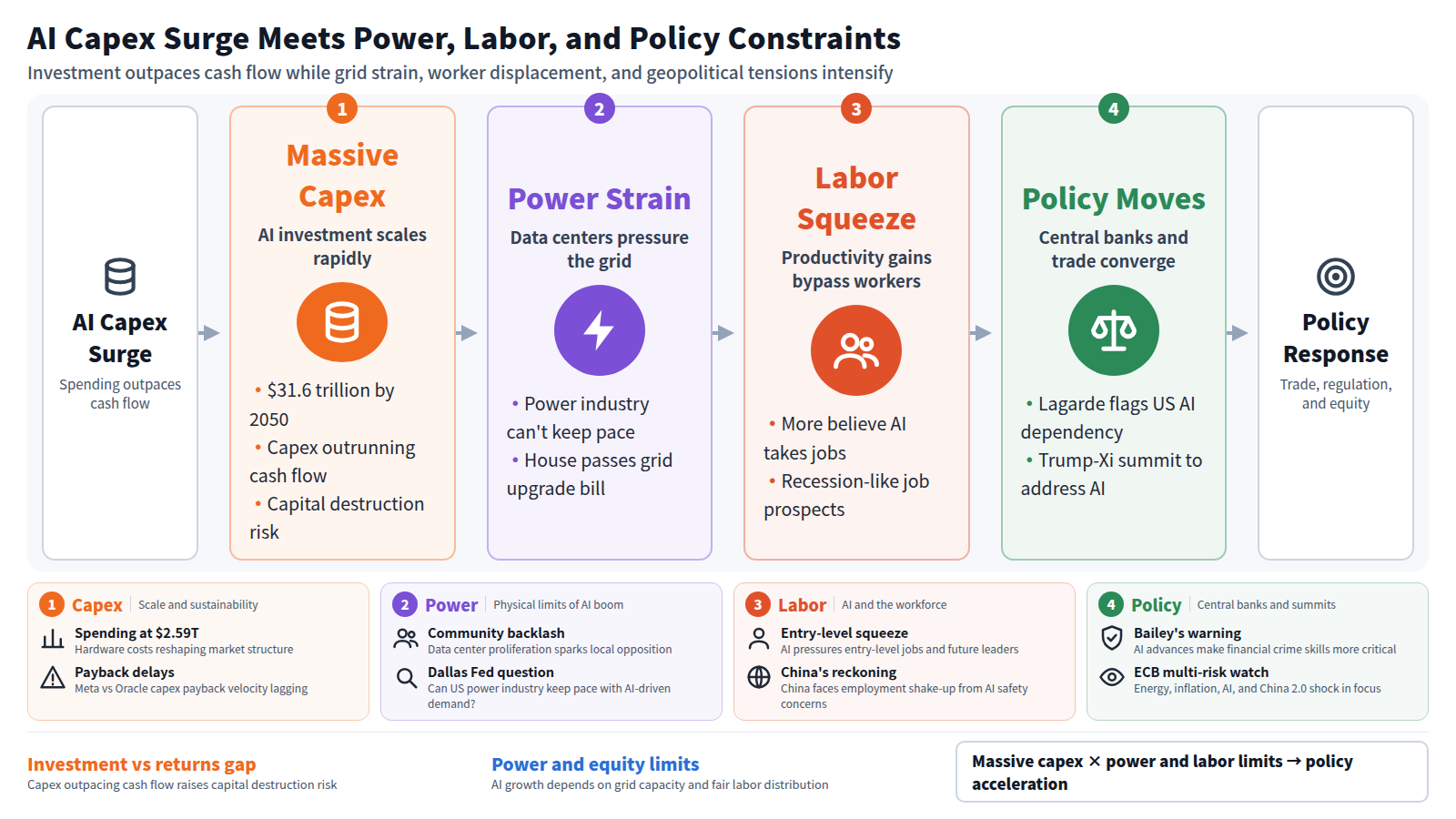
Overview
With the expansion of AI-related capital investment and the tightening of electricity infrastructure, capital markets are increasingly wary of overheating AI investment. In the labor market, while there are growing concerns about AI replacing jobs, it has been pointed out that the benefits of increased productivity are not being fully returned to workers (ISI Markets). ECB President Christine Lagarde warned of Europe's dependence on AI from the US (Crypto Briefing).
Macroeconomic/growth trends
The US stock market has been in a tug of war between inflation concerns and AI optimism (WSJ). Musk predicts AI will double U.S. economic growth next year (Investing.com). Meanwhile, Trump dismissed concerns about AI as "hoax," but discussions within the White House are reportedly more complicated (NYT). The RBA has warned of emerging inflation risks due to oil and AI pressures (proactiveinvestors.com).
Productivity trends
AI is boosting productivity, but workers are hardly benefiting from it, according to an analysis (ISI Markets). Google welcomes new experts to its AI & Economy team (blog.google). Deloitte research confirms a rapid increase in the use of "shadow AI" (CFO.com). There was also an analysis that discussed the similarities between AI and globalization (Council on Foreign Relations).
Trends in employment and labor market
A growing number of people believe that AI will eliminate jobs rather than create them (Computerworld). New graduates majoring in computer science face "recession-level" job difficulties due to the impact of AI (The Register). There are also reports that AI is particularly putting pressure on entry-level jobs and future leadership candidates (hcamag.com). China is also facing changes in its employment structure due to AI (NBC News). San Francisco Fed Governor participated in a panel on AI transitioning to the labor market (Scotsman Guide).
Trends in energy/power demand
The proliferation of data centers is creating both an AI boom and a community backlash (cfpublic.org). The question is whether the U.S. electric power industry can respond to the rapid increase in demand driven by AI (Dallas Federal Reserve Bank). NVIDIA, Google, and Emerald AI launch the AI Data Center Power Coalition (qz.com). The US House of Representatives has passed a bill that would make AI data centers pay for power grid upgrades (Tom's Hardware).
Remarks by central banks, international organizations, and VIPs
- Christine Lagarde, ECB President: warns that Europe faces "dangerous dependence" if it does not develop its own AI technology (Crypto Briefing). - Andrew Bailey, Governor of Bank of England, warns that advances in AI will make skills to combat financial crime "even more important" (AML Intelligence). - The ECB mentioned trends surrounding energy prices, inflation, AI, and the "China 2.0 shock" (IndexBox). - Cleveland Fed analyzes AI complementarity in relation to “AI footprint” (Buttondown). - San Francisco Fed Governor participates in a panel discussing AI's transition to the labor market (Scotsman Guide, duplicate).
Trends in corporate capital investment
Global AI infrastructure investment is expected to reach $31.6 trillion by 2050 (Yahoo Finance). AI infrastructure spending reaches $2.59 trillion, with hardware costs reshaping market structure (Cloud Wars). It was pointed out that the recovery speed of AI capital investment is delayed due to the Meta vs. Oracle composition (24/7 Wall St.). An analysis (USFunds) found that Big Tech's AI capital investment is expanding faster than cash flow, and a market strategist warned that the AI capital investment boom risks leading to "massive capital destruction" (Benzinga).
Trade and industrial policy
Concerns about AI and tariffs are expected to be on the agenda at next week's Trump-Xi summit (Yahoo Finance UK). Disney's AI transformation and the issue of importing Chinese-made cars are also being talked about at the same time (Baton Rouge Business Report).
Integrated analysis: What is happening now
Across the headlines, AI investment is talked about as both a ``macro growth driver'' and ``bubble-like concerns.'' While Mr. Musk predicts doubling growth and predicts huge future investment in AI infrastructure ($31.6 trillion, $2.59 trillion), there are also reports that capital investment is progressing at a faster pace than cash flow, warnings of capital destruction risk, and delayed investment recovery for Meta and Oracle, and it appears that the gap between the rapid expansion of investment scale and delays in monetization is becoming apparent. This expansion in capital investment is directly linked to the physical constraints of tight power infrastructure, and as coalitions and legislation are being developed to address the power demands of data centers (mandating the cost of power grid upgrades), it is possible that the limiting factor for the AI boom is shifting to power supply rather than computing resources themselves. In the labor market, it has been pointed out that the benefits of increased productivity are not reaching workers, and concerns about job replacement are growing at the same time, and central banks and international organizations (Lagarde, Cleveland Fed, San Francisco Fed) are also beginning to recognize the issue of AI's contribution to economic growth and the imbalance in distribution. On the trade front, ahead of the Trump-Xi talks, AI is being treated as a negotiation topic along with the tariff issue, suggesting that AI policy is becoming part of trade and geopolitical negotiations rather than a stand-alone technology debate.
Future points of interest
- To what extent will the funding structure for AI capital investment (discrepancy from cash flow) be considered as a cause for caution in the market? - Concrete results of the discussion on AI and tariffs at the Trump-Xi summit. - Whether progress in power and grid infrastructure development will be a constraint on the pace of data center expansion.
- U.S. Stocks Mixed as Inflation Trepidation Offsets AI Optimism — WSJ09/18 20:29 UTC
- Trump Calls A.I. Fears a Hoax. Inside the White House, the Debate Is More Complex. — nytimes.com09/18 18:09 UTC
- Musk bets AI will double US economic growth next year — Investing.com09/18 18:40 UTC
- Compsci grads facing recession-like job prospects thanks to AI — The Register09/18 19:48 UTC
- RBA warns inflation risks are materialising as oil and AI pressures build — proactiveinvestors.com09/18 15:23 UTC
- It’s Déjà Vu All Over Again: The Parallels of AI and Globalization — Council on Foreign Relations09/18 16:33 UTC
- New experts join Google’s AI & Economy team — blog.google09/18 14:18 UTC
- AI is boosting productivity, but labor is barely reaping any benefits — ISI Markets09/18 17:53 UTC
- Shadow AI use booms, finds new Deloitte survey — CFO.com09/18 14:19 UTC
- AI News for the Week of September 18; Updates from Agentic AI Foundation, Cisco, EY & More — Solutions Review09/18 18:23 UTC
- More and more people believe that AI will take away jobs rather than create new ones — Computerworld09/18 18:07 UTC
- What Do Omaha Employers Want in the Age of AI? UNO Skills Report Reveals the Top 10 — University of Nebraska at Omaha09/18 15:33 UTC
- A China alarmed over AI safety reckons with an employment shake-up — NBC News09/18 15:11 UTC
- San Francisco Fed president joins cutting-edge panel to chart labor market’s AI transition — Scotsman Guide09/18 19:48 UTC
- AI is squeezing entry-level jobs, and future leaders with them: report — hcamag.com09/18 15:03 UTC
- Data Centers Fuel AI Boom and Community Backlash — cfpublic.org09/18 20:29 UTC
- Can the U.S. power industry keep pace with rapid growth in AI? — Federal Reserve Bank of Dallas09/18 19:30 UTC
- NVIDIA, Google, Emerald AI launch AI data center power coalition — qz.com09/18 13:31 UTC
- The Startup That Built OpenAI’s Biggest Data Center Is Now Making Tiny Ones — WSJ09/18 20:58 UTC
- House passes act to make AI data centers pay for grid upgrades to minimize impact on residents — measure directs states to consider adoption of federal standard within two years of passing — Tom's Hardware09/18 15:20 UTC
- AI concerns, tariffs on the docket for Trump-Xi summit next week — Yahoo Finance UK09/18 14:35 UTC
- Ramps Logistics CEO Joins Global Tariffs Panel at Breakbulk Americas 2026 as Trinidad-Developed AI Platform Returns — Business Wire09/18 16:44 UTC
- Roundup: Copper shipments to US / Chinese car imports / Disney’s AI pivot — Baton Rouge Business Report09/18 17:17 UTC
- Is AI evolving too quickly for us? — KTAR News 92.3 FM09/18 19:51 UTC
- How Kraken's AI Technology is Revolutionising Good Energy — energydigital.com09/18 14:50 UTC
- COMMENTARY: Global rates reset, AI angst and oil's long haul: The financial week in five charts — Reuters09/18 12:32 UTC
- NEWS: Bank of England governor warns AI advances make financial crime skills ‘even more critical’ — AML Intelligence09/18 09:31 UTC
- ECB on Energy Prices, Inflation, AI and China 2.0 Shock - News and Statistics — IndexBox09/18 10:12 UTC
- AI Footprint: Cleveland Fed complementarity, AEMA, and Canada’s AI transparency clock — Buttondown09/18 09:15 UTC
- Wall St Week Ahead Investors focus on rate path, AI slowdown after Fed hike — Reuters09/18 10:05 UTC
- Global AI Infrastructure Spending Will Hit $31.6 Trillion by 2050. This Is the Stock That Could Benefit the Most — Yahoo Finance09/18 16:12 UTC
- AI Infrastructure Spending Hits $2.59 Trillion as Hardware Costs Reshape the Market — Cloud Wars09/18 12:00 UTC
- Meta Vs. Oracle: The Laggards of AI Capex Payback Velocity — 24/7 Wall St.09/18 11:15 UTC
- Why Big Tech’s AI Capex Is Now Outrunning Cash Flow — USFunds09/18 20:30 UTC
- AI Capex Boom Risks 'Massive Capital Destruction' in the US, Warns Veteran Market Strategist: 'You Could — Benzinga09/18 13:52 UTC
- Akio Yamaguchi, representative secretary of Japan Association of Corporate Executives, says that the US's theory of slowing down AI development is an "appropriate decision," but "development competition will probably never stop." — 読売新聞09/18 14:58 UTC
- Musk predicts AI will double US economic growth next year — Investing.com - FX | 株式市場 | ファイナンス | 金融ニュース09/18 18:38 UTC
- Corporate loans speed up with AI Regional banks in Ishikawa and Toyama Hokkoku Bank calculates loan amounts and interest rates Hokuriku Bank to develop screening assistance tools — 北國新聞09/18 20:00 UTC
- AI development without regrets Martin Wolf — 日本経済新聞09/18 15:00 UTC
- China's Jiji Jump makes a big deal with AI with a $29.6 billion loan -- Zhang Yiming puts in all the chips — BigGo ファイナンス09/18 11:55 UTC
- Christine Lagarde warns Europe must develop its own AI technology or face dangerous dependency — Crypto Briefing09/18 18:44 UTCChristine Lagarde / ECB President
