1. What Problem Does This Paper Address?
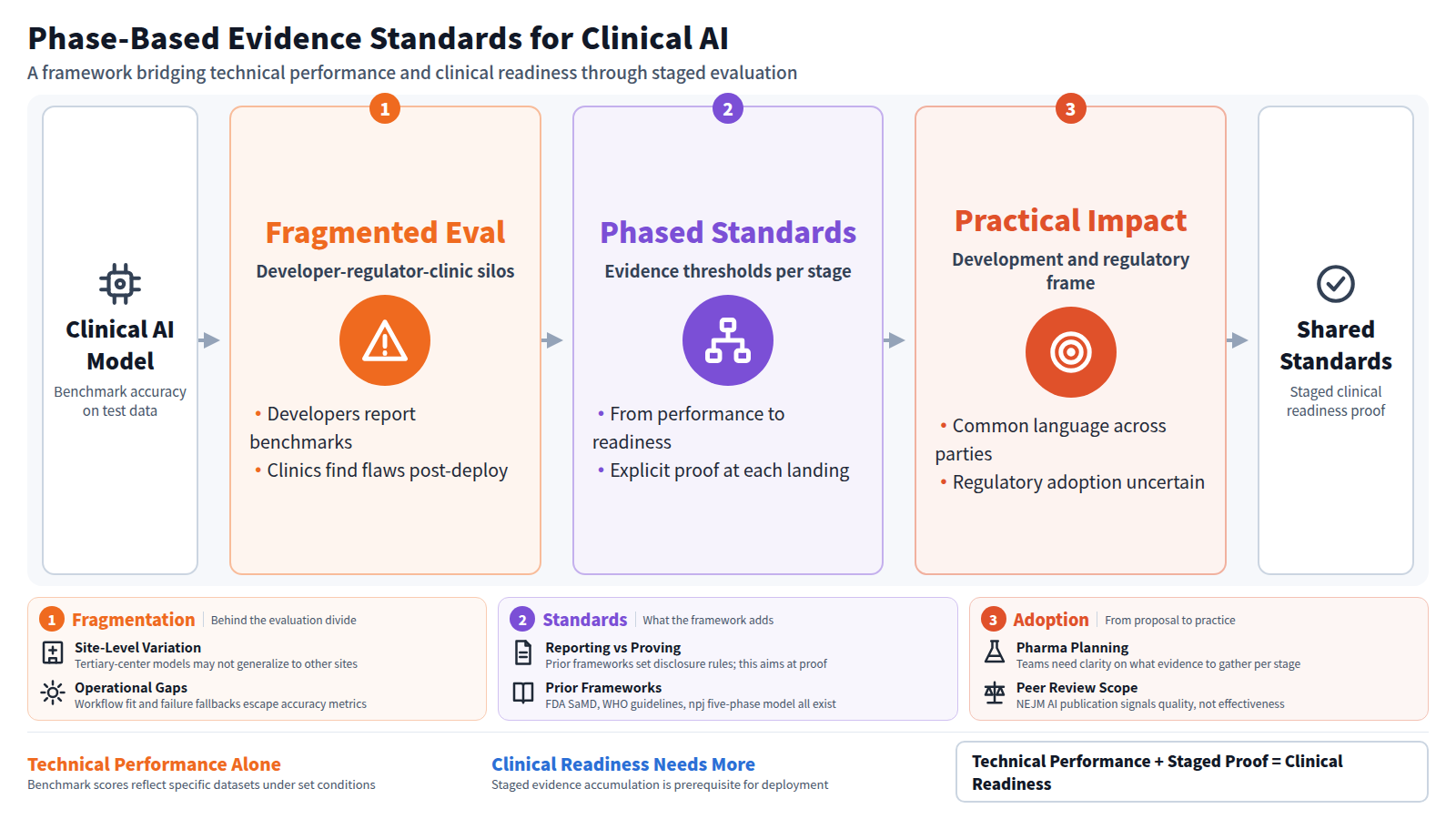
The evaluation of clinical AI is fragmented. Developers report benchmark accuracy, regulators review submission dossiers, and clinical sites discover problems after deployment. Because these three stages operate in silos, there is no coherent framework that connects "technically functional" to "beneficial for patients."
This fragmentation creates real consequences. A model validated on retrospective data from one institution may fail silently when deployed at another site with different patient demographics, different imaging equipment, or different clinical workflows. The paper takes this fragmentation itself as the problem to solve, rather than proposing yet another benchmark or reporting standard.
2. What Does It Propose?
As the title indicates, the authors propose a phase-based framework for evidence standards. The abstract is minimal — "NEJM AI, Ahead of Print" — but the title signals a design that segments clinical AI maturity into phases and specifies the type and level of evidence required at each stage.
This shares problem awareness with a similar five-phase framework published in npj Digital Medicine, which defines technical validation, operational robustness validation, controlled interaction validation, clinical evidence validation, and real-world integration validation as distinct stages[4]. The NEJM AI paper's publication platform suggests a deliberate connection to clinical trial design and regulatory submissions — NEJM AI's readership is heavily weighted toward clinicians and clinical trialists who make deployment decisions.
3. What Did It Show?
Within the scope of the abstract, no experimental data or numerical results are reported. As an Ahead of Print perspective, the framework proposal appears to be the primary contribution.
Two terms in the title provide the key interpretive lens. "Technical Performance" refers to metrics like accuracy, sensitivity, specificity, and AUC on test datasets — numbers that tell you how a model performs under controlled conditions. "Clinical Readiness" refers to a state where the system can be safely and effectively used in a real clinical environment, with all its variability, edge cases, and human factors. Treating these as distinct — and articulating what evidence is needed to move from one to the other — is the paper's core argument.
4. A Practical View
The World of Technical Performance
"High diagnostic accuracy on test data." "Top benchmark ranking." Developers report outcomes here. But these numbers are measured on specific datasets under specific conditions. A model trained on data from tertiary care centers may not generalize to community hospitals. A model evaluated on English-language records may fail on records in other languages.
The World of Clinical Readiness
"Can it safely return a judgment for this patient, in this situation?" That is the question the clinic asks. Data bias, environmental variation, workflow integration, latency under load, fallback procedures on failure, staff training requirements — none are captured by technical performance alone.
The framework this paper proposes reads as an attempt to build a staircase between these two worlds, with explicit checkpoints at each landing. The value of such a staircase lies not in telling developers something they do not know, but in giving all stakeholders — developers, regulators, clinicians, procurement teams — a shared vocabulary for where a given system stands.
5. What Is Not New, and Where Are the Limits?
Staging the evaluation of clinical AI is not new to this paper. The five-phase framework in npj Digital Medicine, FDA guidance on Software as a Medical Device (SaMD), WHO guidelines on clinical AI evaluation, and the EU AI Act's risk-classification approach all offer related structures. Each defines stages, but the specific evidence thresholds at each stage remain loosely specified in most of them.
The specific added value of this paper cannot be determined from the abstract alone. What the title suggests is that, where existing frameworks tend to define reporting standards (what to disclose), this one may go further by specifying evidence standards (what to prove). This distinction — reporting versus proving — is consequential, but whether the paper delivers on it requires reading the full text, which is not yet available in the abstract.
Another limitation worth noting: any phase-based framework risks implying a linear progression. In practice, clinical AI deployment is iterative — models are updated, patient populations shift, clinical workflows change. Whether this framework accounts for post-deployment iteration or treats deployment as an endpoint is unknown from the abstract.
6. How Did Coverage Frame This Story?
The Clinical Trial Vanguard ran the headline "Autonomous AI Agents Can Outperform Physicians. That's Not the Hard Part.[2]" The framing is significant: outperforming physicians on a benchmark is presented as the easy part, while the hard part — evidence of safe, equitable, and accountable deployment — remains unresolved. This aligns closely with the paper's distinction between technical performance and clinical readiness.
Nature's npj Digital Medicine covered the related theme as "Rethinking clinical trials for medical AI with dynamic deployments of adaptive systems[3]," arguing that the clinical trial paradigm itself needs to evolve to accommodate AI systems that change over time. This goes beyond the paper's framework by questioning whether the traditional trial structure — designed for fixed interventions — is even the right container for evaluating adaptive AI.
Where the paper's title suggests a structured framework for evidence standards, the coverage articles each translate it into a more urgent, action-oriented question. This gap between the paper's methodical framing and the coverage's urgency reflects how far the field is from consensus on how to evaluate clinical AI.
7. What Connects to Pharma and Regulatory Practice?
When pharmaceutical companies develop products incorporating clinical AI — companion diagnostic support, trial enrollment screening, safety signal detection, or real-world evidence generation — the question of what evidence to present, in what order, from the "technically functional" stage to the "regulatorily defensible" stage is a major practical challenge. Development teams frequently discover, late in the process, that the evidence they gathered does not address the regulator's actual concerns.
If this framework concretizes evidence standards at each phase, it could function as a skeleton for development planning. It would tell teams: at this stage, you need this type of evidence to this standard, before you can credibly move to the next stage. That kind of clarity is valuable precisely because it is rare in the current regulatory environment for AI-based medical devices.
That said, proposing a framework and having regulators adopt it are different events. The FDA has its own evolving approach to SaMD, and PMDA is developing its own guidelines. Whether this NEJM AI framework will influence those processes, or remain an academic contribution, is unknown at this point.
Publication as a peer-reviewed article in NEJM AI indicates that the quality of this discussion meets a recognized academic standard. However, passing peer review does not constitute proof of the framework's effectiveness or clinical validity. It means the argument was judged to be sound and relevant by reviewers — a necessary condition for influence, but not a sufficient one.