1. What Problem Does This Paper Address?
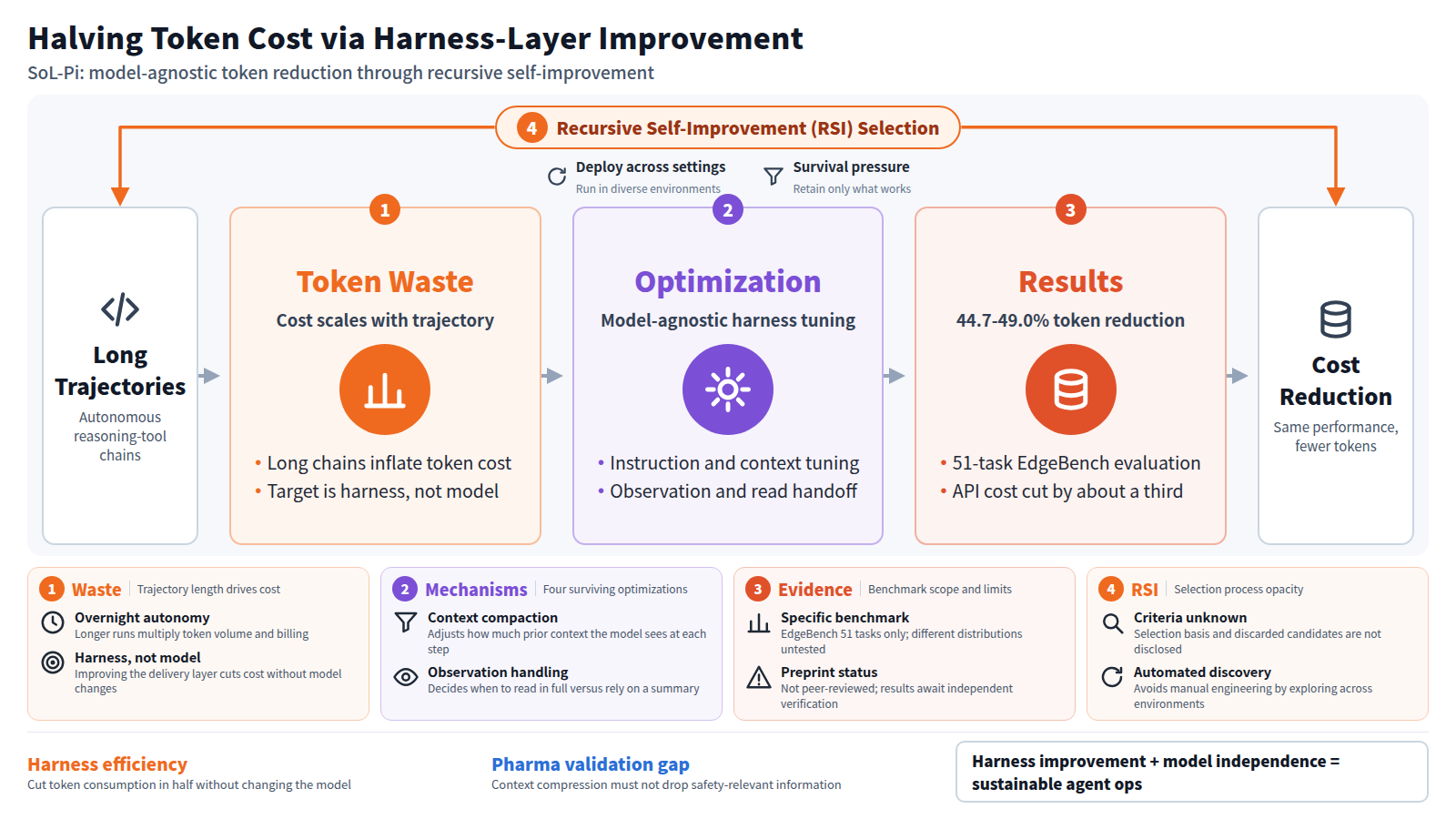
Coding agents are shifting from short code-completion tasks to long trajectories of reasoning, tool use, and feedback. According to the abstract, this shift makes token efficiency critical for scaling recursive self-improvement. The underlying logic is straightforward: an agent that runs for hours or days generates token volumes that scale with trajectory length, not with individual task complexity. If the cost of running an agent is proportional to the tokens it consumes, then efficiency at the token level directly determines whether sustained autonomous operation is economically viable.
The paper targets not the agent's "brain" (the model itself) but its "running gear" — the harness layer that passes instructions to the model, receives outputs, and decides the next action. This distinction matters because improving the harness is orthogonal to improving the model: you can deploy a better harness on any model without retraining.
2. What Does It Propose?
The authors take an RSI-inspired (Recursive Self-Improvement) approach, scaling auto-research loops across numerous and diverse environments for harness rollouts. The idea is to let the harness evolve by running it in many different settings and retaining only the improvements that consistently help. According to the abstract, four mechanisms survive this selection process and form SoL-Pi, spanning action execution, context compaction, observation handling, and delegated reading.
Each of these addresses a different source of token waste. Action execution governs how instructions are passed to the model. Context compaction determines what prior context the model sees at each step. Observation handling controls how the model processes outputs from tools and the environment. Delegated reading decides when to have the model read something in full versus rely on a summary. Together, they constitute a set of harness-level optimizations that are model-agnostic.
3. What Did It Show?
The main results reported in the abstract are as follows. On the 51-task EdgeBench evaluation, SoL-Pi achieves performance comparable to Pi across GPT-5.6 Sol and Opus 5 while reducing recorded token traffic by 44.7–49.0% and API cost by about one third. Estimated hourly savings are $8.75–$13.50 relative to native Codex and Claude Code harnesses, and $4.36–$5.71 relative to Pi.
All numbers cited here appear in the abstract. This article has added none. The reported cost savings are denominated in current API pricing, which means the absolute dollar figures will change as pricing changes, though the relative efficiency gain may persist.
4. A Practical View
In an agent operations team (fictional)
Engineer A: "The overnight agent's monthly bill is double what we budgeted."
Engineer B: "Task completion is fine — performance isn't the issue. It's token usage."
Engineer A: "Switch models?"
Engineer B: "We don't need a different model. The harness is reading the full observation every turn when a summary would suffice."
SoL-Pi targets exactly this kind of problem. Rather than swapping the model's brain, it improves the delivery mechanism. In settings where agent operating cost directly determines adoption decisions — and in enterprise environments, cost per task is almost always a gating variable — this kind of efficiency gain matters as much as a performance improvement. A team that cannot afford to run an agent overnight will not benefit from the agent's capabilities, regardless of how high those capabilities are.
5. What Is Not New, and Where Are the Limits?
Token efficiency improvements through prompt compression and context management are well-studied areas. Techniques like context window pruning, retrieval-augmented generation, and various forms of prompt caching all aim to reduce token consumption without degrading output quality. SoL-Pi's distinguishing feature is that it discovers improvements through a recursive selection process rather than manual engineering — the harness improves itself, rather than being improved by a human designer.
However, the abstract leaves several questions open. It does not explain how the four surviving mechanisms were selected, what the selection criteria were, or what mechanisms were discarded during the process. Understanding the discarded approaches would help assess how general the surviving mechanisms are.
The evaluation uses EdgeBench, a specific benchmark of 51 tasks. Behavior under different task distributions, in domains outside coding, or on trajectories substantially longer than those in EdgeBench is not discussed in the abstract. Cost-saving estimates also depend on specific API pricing structures; different pricing would yield different numbers, and the gap between recorded token traffic and billed tokens (which may differ due to caching, batching, or pricing tiers) is not addressed.
This is a preprint that has not undergone peer review. These results have not been independently verified.
6. Why Is This Topic Clustering Now?
Coding agent efficiency is not a one-off topic. As agents shift from single-turn question-answering to extended autonomous operation, token costs grow not linearly but in proportion to trajectory length. This site recently covered Dream-RSI, which proposed using discovery-history replay to improve an agent's exploration strategy — a focus on improving the reasoning itself. SoL-Pi differs by focusing specifically on the delivery efficiency of that reasoning: not making the agent think better, but making its thinking cheaper to transmit.
The NVlabs repository's 2,235 GitHub stars indicate strong interest from the practitioner community — people who build and operate coding agents day-to-day. However, stars are user votes reflecting interest, not guarantees of code correctness or research quality. A repository can attract stars because it addresses a pain point that practitioners experience, independent of whether its approach is the best solution to that pain point.
7. What Connects to Pharma and Regulatory Practice?
When pharmaceutical companies deploy AI agents for operational tasks — document review, literature monitoring, safety data aggregation, regulatory submission preparation — running cost becomes a primary variable in adoption decisions. An agent that completes a task well but costs too much per run will not be adopted, even if its quality exceeds human performance.
If token consumption can be halved without degrading output quality, the implications for pharma are concrete: the same budget could cover twice the document volume, or the same volume could be reviewed more frequently. In pharmacovigilance, for example, more frequent review cycles directly affect how quickly safety signals are detected.
However, in the pharma context, efficiency alone is not sufficient. The process by which the harness layer compresses context or prunes observations demands separate verification that operationally essential information is not lost. If a safety-relevant phrase appears in the full observation but is dropped during context compaction, the efficiency gain becomes a liability. The abstract does not address this type of information-loss risk, and any organization deploying harness-level optimizations in a regulated environment would need to validate that the optimization does not compromise content integrity.