AI & Economy News — 2026-09-20 (Sun) Evening News

Source links point to the original outlet. The AI Integrated Analysis is auto-generated from the headlines below only and is not intended to add facts beyond them. Not investment advice.
Overview
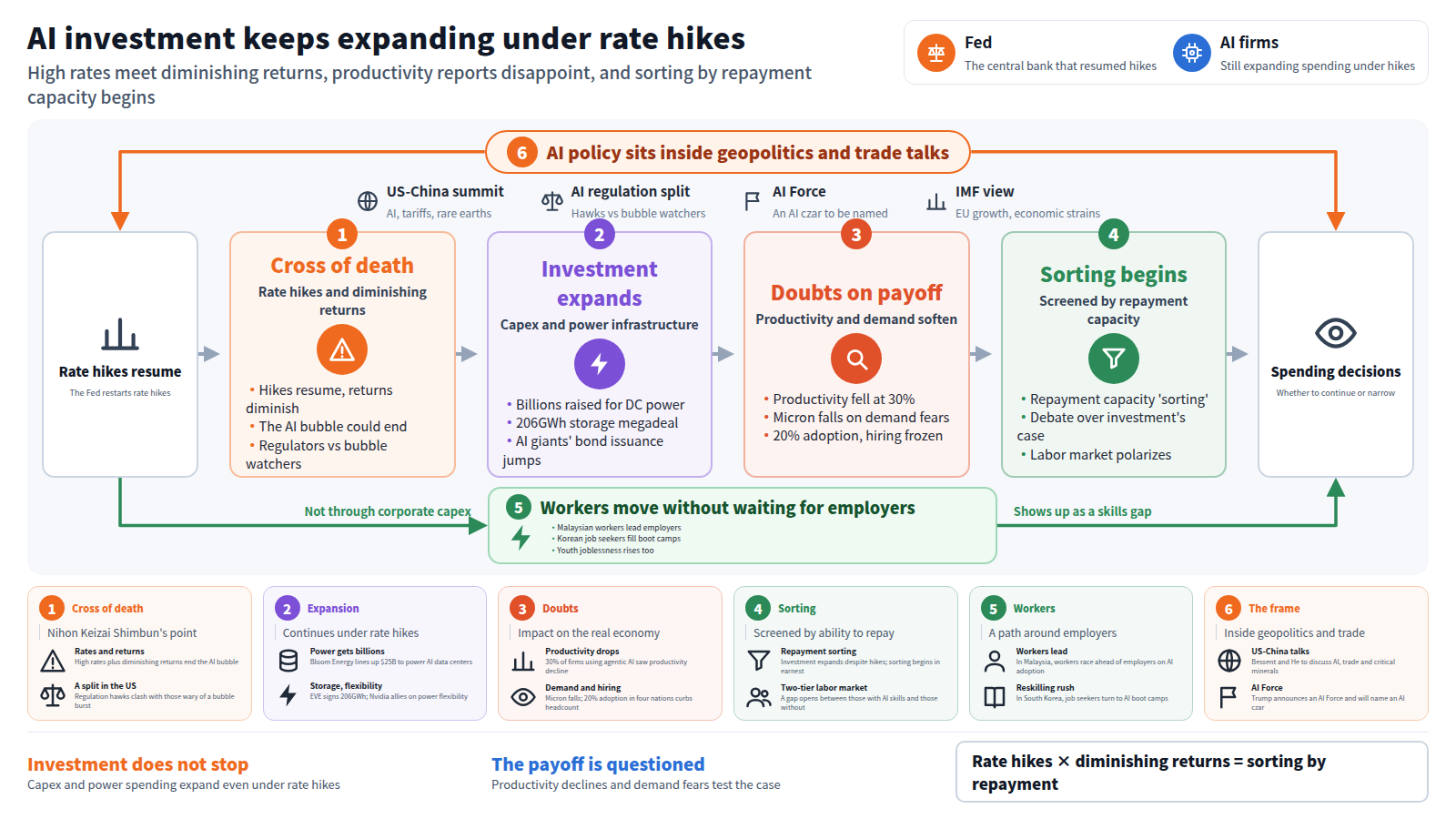
Ahead of the US-China summit, talks over AI, tariffs, and rare earths are in focus (Reuters, CNBC). The relationship between the bursting of the AI bubble and interest rate hikes has become a major theme in Japanese media coverage (Nihon Keizai Shimbun, Mainichi Shimbun), and huge investments in electricity infrastructure are proceeding in parallel.
Macroeconomic/growth trends
While some analyzes suggest that AI could change the "speed limit" on economic growth (AFR), it is noteworthy that AI investment continues to expand as the Fed resumes interest rate hikes (BigGo Finance, news.futunn.com). The Nihon Keizai Shimbun points out the possibility that the AI bubble will end due to a ``cross of death'' where interest rate hikes and diminishing returns overlap (Nihon Keizai Shimbun). In the United States, there are reports of a conflict between those who want to strengthen AI regulations and those who are wary of the collapse of the bubble (Mainichi Shimbun).
Productivity trends
McKinsey reports that 30% of companies that introduced agent-based AI experienced a drop in productivity (The Times of India). In Australia, a disconnect was pointed out between the finance minister's hopes for "heroic" AI productivity improvements and the Fed's interest rate hikes (AFR). There are also reports that in Malaysia, workers are ahead of employers in introducing AI (The Vibes).
Trends in employment and labor market
Analysis (ndtvprofit.com) shows that adoption in the tech industry is being suppressed, even though the adoption rate remains at 20% in four countries. In South Korea, job seekers are said to be rushing to AI boot camps (Korea JoongAng Daily). Anthropic CEO called for stronger AI regulation (ABC News).
Trends in energy/power demand
Nvidia announces partnership to increase power flexibility for AI data centers (Yahoo Finance). Bloom Energy reportedly raised $25 billion for data center power (Dealroom). EVE Energy enters the AI data center market by signing a large 206GWh energy storage contract via Fluence (BigGo Finance). Debate continues in North Carolina over AI and data center regulations (thegazette.com).
Remarks by central banks, international organizations, and VIPs
- Direct statements by the tracked persons (Christine Lagarde, Kazuo Ueda, Andrew Bailey, Kristalina Georgieva, Mathias Cormann, Ajay Banga, Daron Acemoglu, Erik Brynjolfsson) cannot be found in the headings of this list. - The Mainichi Shimbun correspondent's column reported that the Fed chairman's "personal opinion" drew attention in relation to AI and interest rate cuts, but the individual name of the chairman and details of what he said were not listed in the headline.
Trends in corporate capital investment
A comparison of AI-related capital investment and cash flow between Microsoft and Amazon was reported (techi.com). Micron stock is reported to have fallen due to concerns about a slowdown in AI demand (equiti.com). An analysis of the next high-growth field that will generate "10x stocks" related to AI was published in Chinese media (36Kr). Some commentators argue that it will be difficult to slow down AI investment amidst geopolitical competition (tbsnews.net).
Trade and industrial policy
US Treasury Secretary Bessent and China's He Lifeng will hold talks over AI, trade and critical minerals, Reuters reported (Reuters, CNBC). Tariffs, rare earths, and AI regulations are said to be the focus of the Washington meeting between President Trump and President Xi Jinping (ThePrint). The talks will focus on $30 billion worth of products and the future of AI (Vietnam.vn). Mr. Trump announced the creation of an "AI Force" and the upcoming appointment of an AI representative (AI czar) (KABB, Asahi Shimbun).
Integrated analysis: What is happening now
Several headlines suggest that AI-related capital investment and power infrastructure investment will continue to expand even amidst the rate hike phase (BigGo Finance, Bloom Energy-related). On the other hand, there are also factors that call into question the impact of investment on the real economy, such as McKinsey's report on productivity decline and Micron's concerns about a slowdown in demand, which is consistent with the deadly intersection theory of ``interest rate hikes and diminishing returns'' pointed out by the Nihon Keizai Shimbun. On the employment front, it has been reported that unemployment among young people is increasing and there is a rush to attend AI boot camps at the same time, and there is a possibility that the polarization of the labor market (the gap between those who have AI utilization skills and those who do not) is progressing. On the trade front, the U.S.-China talks have a framework that deals with AI, tariffs, and rare earths all at once, and it appears that AI policy is being incorporated as part of geopolitical and trade negotiations rather than as a stand-alone technology policy.
Future points of interest
- To what extent will AI regulations and export controls be materialized at the US-China summit? - Will the Fed's continued interest rate hikes and increased bond issuance by AI companies become new risk factors for financial markets (``new pressures'' as pointed out by news.futunn.com)? - Will the productivity decline (30%) pointed out by McKinsey be confirmed by other studies and the debate over the legitimacy of AI investment will expand?
- ‘There is something you can do’: How to slow down AI without crashing the economy — The Boston Globe09/20 00:01 UTC
- Trump announces he is forming 'AI Force,' will name 'AI czar' soon — KABB09/19 21:10 UTC
- AI could change the speed limit of economic growth — AFR09/19 23:00 UTC
- Weekly Market Wrap: Nvidia revived the AI trade, but inflation put rate hikes back in focus — Mitrade09/20 03:07 UTC
- Trump Wants an AI Force and a Czar Who Meets One Key Bar — CryptoRank09/20 08:25 UTC
- Productivity decline in 30% of companies using agentic AI: McKinsey report — The Times of India09/20 06:37 UTC
- AI Office: The First "Down Payment" for Self-Funded Salaried Employees in Modern Workplaces — 36Kr09/20 03:23 UTC
- Malaysian workers race ahead of employers in AI adoption — The Vibes09/20 05:40 UTC
- Fed’s rate rise shows up Chalmers’ ‘heroic’ belief in AI productivity — AFR09/19 23:03 UTC
- Warning for brain health over offloading deep-thinking skills to AI — ABC News & Headlines – Australian Broadcasting Corporation09/20 00:15 UTC
- ERICKSON: Against AI regulatory capture — heraldextra.com09/20 04:47 UTC
- More than 1m young people are out of work, and AI is about to wipe out millions more jobs. What should we do? — The Independent09/20 07:19 UTC
- AI’s Hiring Freeze? Why 20% Adoption In Just Four Nations Is Dragging Tech Headcount — ndtvprofit.com09/20 05:03 UTC
- Cramming in some extra coding: Job seekers turn to AI boot camps as hiring gets tougher — Korea JoongAng Daily09/19 22:03 UTC
- Exclusive: Anthropic CEO calls for stronger regulation of AI — ABC News - Breaking News, Latest News and Videos09/20 00:21 UTC
- Nvidia (NVDA) Forms Alliance To Build A Power Flexible AI Data Center — Yahoo Finance09/19 23:09 UTC
- Bloom Energy lines up $25B to power AI data centers — Dealroom09/19 23:14 UTC
- Guardrails or global race? NC in focus as AI faces crossroads — thegazette.com09/19 22:03 UTC
- Videos - Data Center Insights — Low-Carbon Power for the AI Boom — JD Supra09/20 04:38 UTC
- EVE Energy Signs 206GWh Energy Storage Megadeal, Gaining Entry to AI Data Center Market via Fluence — finance.biggo.com09/20 03:36 UTC
- U.S. Treasury's Bessent, China's He to hold talks on AI, trade, critical minerals: Reuters — cnbc.com09/20 06:17 UTC
- US, China set for talks on AI, tariffs and critical minerals ahead of summit — Investing.com09/20 06:44 UTC
- The U.S. and China to discuss artificial intelligence, tariffs, and critical minerals — 1News.az09/20 08:28 UTC
- Trump, Xi set for pivotal Washington talks; tariffs, rare earths and AI controls in focus — ThePrint09/20 04:51 UTC
- $30 billion worth of goods and the future of AI are anticipated at the US-China summit. — Vietnam.vn09/20 08:00 UTC
- IMF: AI Could Boost EU Growth But Increase Economic Strains — ASHARQ AL-AWSAT English09/20 07:02 UTC
- AI Investment Expands Despite Rate Hikes—Repayment Capacity 'Sorting' Begins in Earnest — finance.biggo.com09/20 02:05 UTC
- Canadian AI pioneer warns of human extinction threat — Yeni Safak English09/20 07:15 UTC
- The Federal Reserve has resumed interest rate hikes, but corporate bonds may not repeat the 2022 scenario. The true new pressure stems from the surge in debt issuance by AI giants. — news.futunn.com09/20 03:24 UTC
- Weekend Crypto Reset: Bitcoin Retakes $80K as VOIDTRACE AI Tracks the Next Rotation Across Ethereum, Solana and XRP — StreetInsider09/20 05:48 UTC
- Microsoft vs. Amazon stock: AI spending and cash flow — techi.com09/20 07:05 UTC
- CapEx per share of 1 Finanx AI Technologies, Inc. – OTC:FUXAD — TradingView09/20 00:02 UTC
- Micron Stock Falls as AI Slowdown Debate Tests Memory Demand Outlook — equiti.com09/20 04:14 UTC
- The Next High-Growth Track Set to Spawn 10-Bagger Stocks: Who Is Actually Making Real Money from AI? — 36Kr09/20 05:33 UTC
- AI is too big to slow in a geopolitical race — tbsnews.net09/20 05:21 UTC
- Economic plus: AI regulation theory in the US is cracking. Should we be more wary of the bursting of the "bubble" than competition with China? — 毎日新聞09/20 02:00 UTC
- Correspondent's eyes>Is AI a factor in lowering interest rates? Shadows flickering over the FRB chairman's "personal opinion" = Daiki Asakawa (Mainichi Shimbun) — Yahoo!ニュース09/20 07:00 UTC
- This is how the AI bubble will end: High interest rates and diminishing returns “death intersection” — nikkei.com09/20 02:00 UTC
- Trump ``Creates AI Force'', emphasizes superiority over China ahead of summit [US midterm elections] [Trump's return] [AI era] — 朝日新聞09/19 22:30 UTC
- AI investment expands despite interest rate hikes... "Selection" regarding repayment ability is in full swing — BigGo ファイナンス09/20 02:05 UTC