
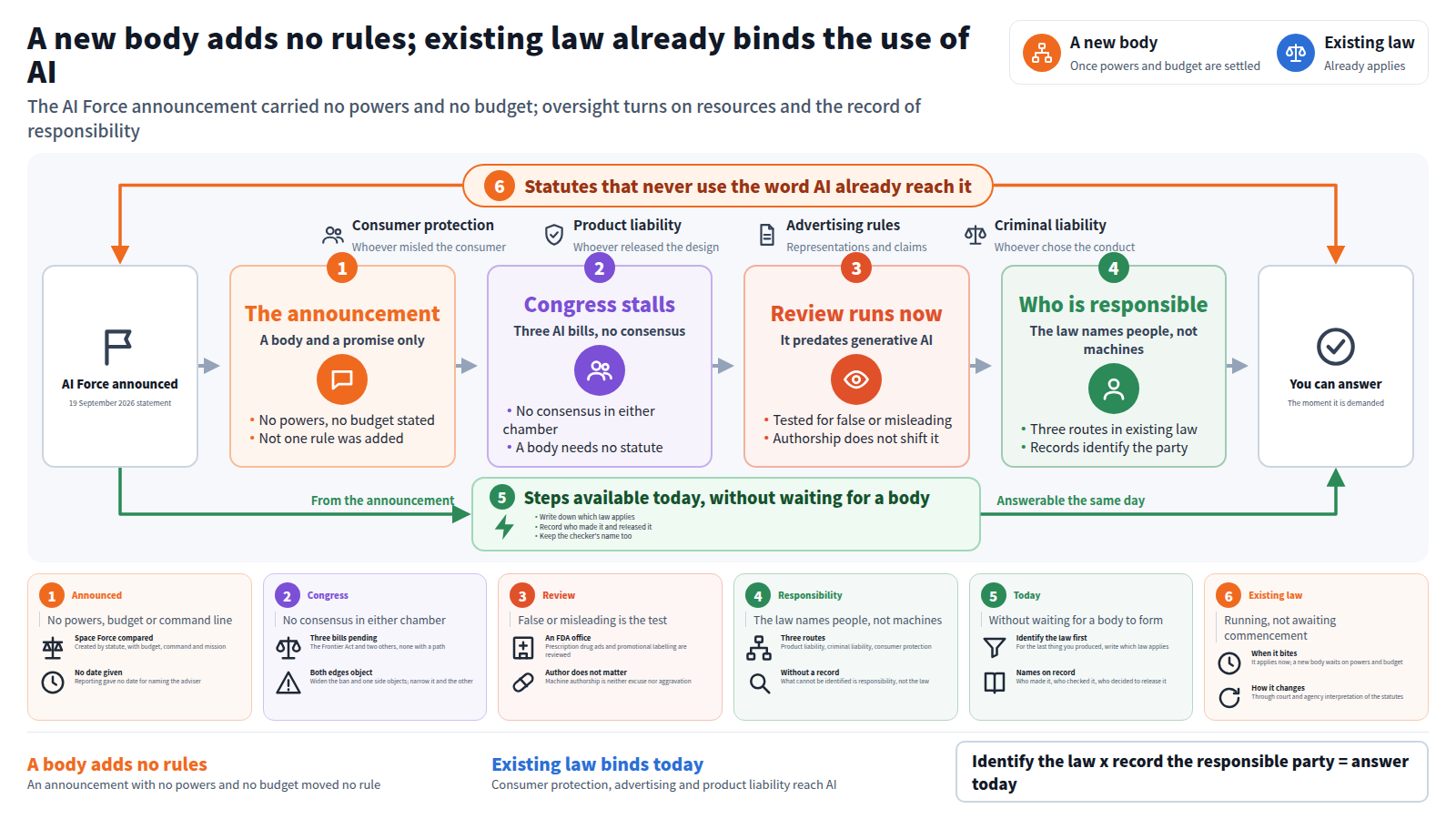
On 19 September 2026, President Trump announced that he was creating an "AI Force" and appointing an AI adviser, adding that he would not hinder the growth of the industry. Does creating a body to oversee AI amount to regulating AI? It does not. What adds rules is not a new body but the law that is already on the books.
01Existing law, not a new body, is doing the overseeing of AI
Take the answer first. One more oversight body adds not one rule. What the 19 September announcement contained was a statement that a body would be formed and notice that an adviser would be named. What powers it would hold, what budget it would carry, where in the executive branch it would sit — none of that was said.
So what actually binds the use of AI today? Consumer protection statutes, advertising rules, product liability. None of them contains the word AI. Without containing it, they already reach decisions made with AI and text produced by it. What changes is not the naming of a new body but the moment courts and agencies apply those statutes to an AI case. That application has already started.
So the thing worth checking tomorrow is not where a new body will sit on the org chart. It is which law already reaches your own work, and where that law places responsibility. This piece follows that order: what was announced, what review already runs, why legislation has stalled, how existing law can be used, and where the judgement calls divide.
02Only the body was announced; no powers and no budget were given
The claim that no rules were added can be tested against the announcement itself. The president wrote that he was forming the AI Force, much as he had formed the Space Force, and went on to say that he would not in any way hinder or stifle the growth of the industry. Reporting from the same day records that no details were given about the group, nor about when the new adviser would be appointed.
The body he offered as a comparison was created by statute and carries a budget, a chain of command and a defined mission. Not one of those three is attached to this announcement. There is a name and a stated intention. While the shape of a body is undecided, there is nothing to argue over as to what it will forbid or permit.
What can be said is narrow: the announcement contained no addition of rules. The body may go on to write rules. It may not. Nothing available today settles which, and trying to settle it would mean going past what the reporting says. So the fact worth holding is the other one — that the count of rules to obey is the same before and after the announcement.
03Drug promotional materials are still reviewed under existing law
If no rules were added, then what is functioning as the rule? The clearest cases are fields that had a supervising agency long before the technology arrived. In the United States, prescription drug advertising and promotional labelling are reviewed by the Food and Drug Administration's Office of Prescription Drug Promotion. The test is whether the information in those materials is false or misleading. That review predates generative AI, and it was not designed so that the standard shifts according to who wrote the draft.
Whether a person or a machine produced the first version does not move the threshold for clearance. If a misleading phrase survives into the final material, it is treated as a misleading phrase. Authorship by a machine is neither an excuse nor an aggravating factor.
The same structure exists in advertising, in finance, in employment. Each of those fields had rules on representations, solicitation and discrimination before AI, and an agency to enforce them. Not one of those rules is waiting for a new body to stand up. Review of promotional material in Japan rests on the same idea, but the governing statutes and procedures are separate from the American ones, so I will not fold the two together here.
04A new body is chosen because it is faster than legislation and avoids conflict
If the rules sit on the side of existing law, why does the move come as an announced body rather than a new statute? The reason lies in Congress. Three bills are pending — the Frontier Act, the AI Kill Switch Act, and the AI Research, Innovation and Accountability Act — but reporting describes no consensus in either chamber on how to tackle the issue and little prospect of action on the dangers before Election Day. Expert testimony may startle members; being startled does not produce statutory text.
Legislation requires both sides to agree on the same words. Write down who is forbidden to do what, and the party being forbidden objects. Narrow the prohibition, and the party who thinks it insufficient objects. As long as those conditions hold, no text emerges.
Announcing a body, by contrast, is something the executive can do alone. It defers the work of turning disagreement into statutory language, and it answers the charge of doing nothing. In this case a second element travelled with it: the promise not to hinder the industry sat inside the same announcement. A posture of oversight and an assurance of no constraint were presented together.
05Existing law can be used in a way that names who is responsible
A stalled legislature leaves the question of which rules are usable today. The answer overlaps with a practitioner's point: AI can be handled inside existing regulatory programmes without inventing a new field of law. One commentator put the underlying requirement plainly — we require people not to create unreasonably dangerous products. That requirement does not change when the product is software.
There are three broad routes by which existing law reaches the use of AI.
The duty not to build a dangerous product
Product liability places responsibility on whoever released a dangerous design into the world. That placement does not move when what was released is a text-generating system.
Responsibility for endangering others
Criminal liability attaches to the person who chose the conduct that created the danger. Where the choice was to automate, a person still made it.
Consumer protection and anti-discrimination
Existing rules on trade, hiring, privacy, data use and defamation are not waived because the judgement was handed to a machine.
What these three share is that the responsible party is fixed as a person or an organisation. The law names whoever released the dangerous product, whoever chose the dangerous conduct, whoever misled the consumer. A machine is not among the names it can reach. So if you work out which law applies and record who produced it, who checked it and who decided to release it, the responsible party can be identified after the fact. Without such a record, what cannot be identified is the responsibility — not the application of the law.
06An org chart does not fill the oversight gap; located responsibility does
Responsibility can be located through records. What we have seen so far divides into three judgement calls.
First, counting bodies tells you nothing about the strength of oversight. One more body changes nothing unless the people and money available for review and enforcement also rise. The announcement contained neither budget nor headcount, so there is nothing in it to suggest that the volume will rise. Oversight is not performed by declaration; it is performed as investigation, review and enforcement. The volume of that work is set by the volume of resources.
Second, waiting for a new statute makes you miss the statutes already in force. Work carried out on the assumption that "this is not regulated yet" gets judged later against rules that were in force all along. The grounds are the three routes above. Product liability and consumer protection are not awaiting commencement; they are running.
| What to look at | A new body | Existing law |
|---|---|---|
| When it starts to bite | Once powers and budget are settled | Already applies |
| Who carries responsibility | Not stated | Whoever made it and put it out |
| How it changes | At the administration's discretion | Through court and agency interpretation |
Third, the reach of oversight is decided by whether the responsible party can be named. In a process where nobody can be named, the rule that should apply cannot reach anyone to answer for it. That is because the law names people and organisations. If the record does not show who made it, who checked it and who decided to release it, the rule that should have applied sits unapplied.
Do not count bodies
The strength of oversight is set by the resources available for investigation and enforcement, not by whether a body exists.
Identify the applicable law first
Waiting for new law hides the law already in force. Identification can be finished before work starts.
Keep the responsible party on record
If the record shows who made it and who decided to release it, you can answer the moment an explanation is demanded.
07The AI adviser's reach will be decided by existing agencies' budgets and staff
If the reach of oversight is decided by located responsibility, the reach of a new adviser can be measured on the same scale. With neither powers nor budget stated, what the adviser can move is limited to the investigative, review and enforcement resources the existing agencies already hold. Increasing those resources takes a separate decision, and that decision returns to the congressional budget. The stalled legislature bears on this point in exactly the same way.
So the indicator to watch is not the name of a new body. It is whether headcount at the existing agencies rises, whether review times shorten or lengthen, and whether the number of enforcement actions moves. All of those are published figures, and all of them change before an org chart does.
What has not been established should be stated plainly. No appointment date was given for the adviser. Whether the body will hold enforcement authority of its own is unknown. How far the promise not to hinder the industry will show up in day-to-day administration is also unknown. What can be asserted is two things: that the rules to obey are unchanged across the announcement, and that checking where those rules place responsibility is work that can be done today, without waiting for any body to stand up.
- The 19 September announcement contained only the creation of a body and notice of an adviser, with no powers and no budget. Not a single rule was added.
- In the United States, prescription drug advertising and promotional labelling are already reviewed for false or misleading content, and that review predates generative AI. The applicable rules are not waiting for a new body.
- None of the three federal AI bills has a visible path to passage. The more legislation stalls, the more the reading of existing law becomes the actual content of regulation.
Creating a body to oversee AI is not the same as regulating AI. Regulation is already running as consumer protection, advertising rules and product liability — statutes that never use the word.
Hoping for something from a new body is not itself a mistake. The mistake is spending the wait without looking at the law that already reaches your own work. Materials keep going out while the waiting happens.
The check is short. For the most recent thing you helped produce, write down which law applies. Then look at whether the record holds the name of who made it, who checked it and who decided to release it. With those two in place, the answer you can give stays the same whether the number of oversight bodies goes up or down.
- NBC News. Trump says he's creating an AI force and appointing a czar amid concerns over the rapidly developing tech. 19 September 2026. nbcnews.com(The announcement of the body, and the stated intent not to hinder the industry)
- Al Jazeera. Trump says he will create 'AI Force' with new 'AI czar'. 19 September 2026. aljazeera.com(No details on the group, and no date for appointing the adviser)
- NBC News. Dire warnings about AI shock Congress, but action is unlikely before the election. 14 September 2026. nbcnews.com(No consensus in either chamber, little prospect of pre-election action, and the three bill names)
- The Philadelphia Inquirer. We don't need new laws to rein in AI — we already have them. 15 September 2026. inquirer.com(The duty not to create unreasonably dangerous products, and criminal exposure)
- IAPP. No new acronyms required: Governing AI without 'AI law'. 6 January 2026. iapp.org(Governing corporate use of models inside existing programmes rather than a new field of law)
- U.S. Food and Drug Administration. Basics of Drug Ads (Office of Prescription Drug Promotion). Accessed 20 September 2026. fda.gov(Review of prescription drug advertising and promotional labelling for false or misleading information)
- Foundation for Individual Rights and Expression. AI is new — the laws that govern it don't have to be. 28 March 2025. thefire.org(Existing laws on discrimination, privacy, data use and libel already place duties on companies)