AI & Economy News — 2026-09-22 (Tue) Evening News

Source links point to the original outlet. The AI Integrated Analysis is auto-generated from the headlines below only and is not intended to add facts beyond them. Not investment advice.
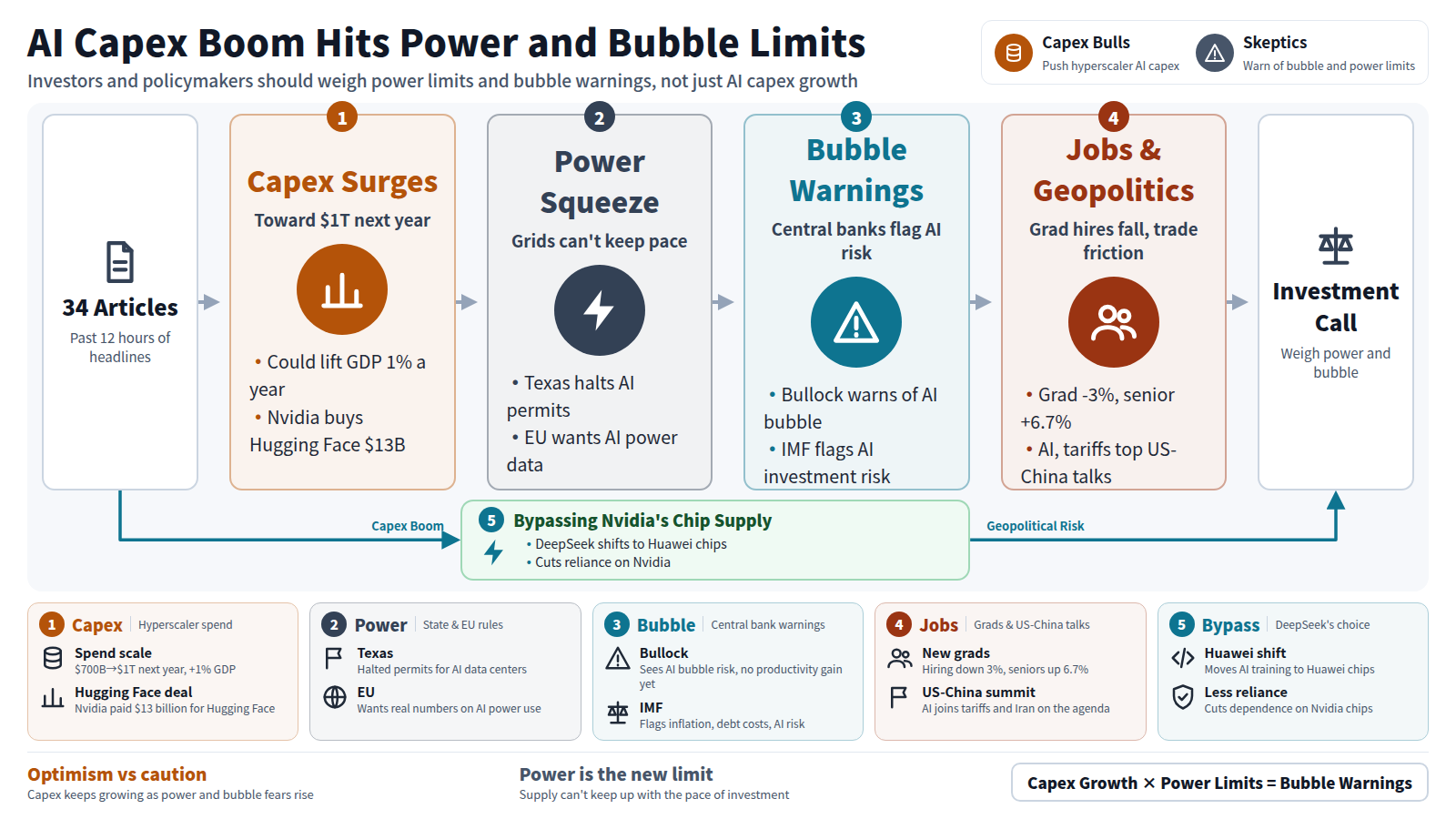
Overview
Jamie Dimon (JPMorgan CEO) hinted that hyperscaler AI capex could reach $1 trillion next year, raising both caution and optimism about the scale of capex (CNBC, finance.biggo.com, LinkedIn). While AI, tariffs, and Iran are in focus ahead of the US-China summit (CNBC and others), friction over power infrastructure has also surfaced, with the state of Texas suspending permits for AI data centers (조선일보).
Macroeconomic/growth trends
Bank of Australia Governor Michele Bullock said AI could be a bubble and has not yet contributed to Australia's productivity gains (theguardian.com). JPMorgan's Dimon said on LinkedIn that hyperscaler AI investments could be on a scale that could boost GDP by 1% annually. In the United States, there are reports that rising inflation and concerns about AI are affecting economic sentiment ahead of the midterm elections (The New York Times). It was also reported that Australia is betting on AI as a multi-decade growth strategy (Bloomberg).
Productivity trends
Data shows that while the number of new graduate hires is decreasing, the number of senior hires is increasing at companies that have adopted AI (BigGo Finance). On the other hand, there have been reports of concerns that AI is undermining worker skills (Korea JoongAng Daily, THE Journal), and there are also debates about whether AI can be a solution to America's workforce challenges (Forbes, nationalaffairs.com). There is still little evidence of productivity improvement, and we are at a stage where both concerns and expectations coexist.
Trends in employment and labor market
There are reports that AI is creating a "recession-like" job market for new graduates (Inside Higher Ed). South Korea is planning a dashboard to detect AI-related employment shocks (Digital Watch Observatory). A behavioral scientific analysis found that workers are wary of AI (Hawaii Public Radio). Managing AI teams is becoming a new job skill, but some say it's not yet accompanied by compensation (Business Insider).
Trends in energy/power demand
Regulatory responses are divided, with Texas suspending new permits for AI data centers and California requiring information disclosure. ABB announces DC power portfolio for AI data centers (Engineering.com). The EU is working to understand the reality of AI's electricity demand (Cybernews). Some analysis suggests that the data center construction boom is reshaping America's infrastructure (qz.com, Emerald Book).
Remarks by central banks, international organizations, and VIPs
- Kristalina Georgieva (IMF Managing Director): At the Qatar Economic Forum, she cited inflation, debt service costs, and AI investment risks as challenges (IndexBox). - Michele Bullock, Governor of the Reserve Bank of Australia, not on the tracking list but related, says AI could be a bubble and has not yet boosted Australia's productivity (theguardian.com). - Specific statements regarding other tracked targets (Lagarde, Ueda, Bailey, Cormann, Banga, Acemoglu, Brynjolfsson) are not found in the headings of this list.
Trends in corporate capital investment
Jamie Dimon, JPMorgan CEO, said hyperscaler AI infrastructure spending could approach $1 trillion next year, up from $700 billion this year, which would boost GDP by 1% annually (CNBC, finance.biggo.com, LinkedIn). Goldman Sachs analyzes that Microsoft's AI gross profit margin has reached the same level as its cloud business, supporting AI transformation (Fukashio TechFlow). Although a $2.7 trillion AI boom is underway, it has been pointed out that only a small portion of the funds are allocated to the models themselves (Redmond Channel Partner). The CIO of Texas Teachers (a pension fund) warned that the AI capital investment boom is similar to past bubble bursts (PitchBook). Nvidia is reportedly looking to acquire Hugging Face for $13 billion to secure the "next AI economy" (Forbes JAPAN).
Trade and industrial policy
AI is expected to be a major topic of discussion at the Trump-Xi Jinping meeting, along with tariffs and Iran (CNBC, Kursiv Media, Oz Arab Media, myMotherLode.com). DeepSeek is said to be moving to Huawei chips for AI learning in order to reduce dependence on Nvidia (조선일보).
Integrated analysis: What is happening now
Pairing headlines on capital spending (JPMorgan, Goldman Sachs, $2.7 trillion boom) and power infrastructure (Texas license suspension, ABB, EU) suggests that the scale of AI investment is already starting to hit the limits of physical power supplies. On the other hand, on the macro level, Mr. Bullock and Mr. Georgieva of the IMF have mentioned the AI bubble and investment risks, and central banks and international organizations are expressing caution about rapidly expanding capital investment. On the employment front, there are concerns about the decline in the number of new graduates being hired and the deterioration of skills, and while there is still little empirical support for productivity, it appears that only investment is taking the lead. Furthermore, as AI is treated in conjunction with tariffs and chip regulations in the US-China talks, geopolitical risks in capital investment (such as DeepSeek's migration to Huawei) are becoming more apparent.
Future points of interest
- Will electricity infrastructure regulations such as the suspension of permits in Texas spread to other states and countries? - Will the gap between hyperscaler investments, which are said to be on the scale of "$1 trillion", and actual AI revenues (such as Microsoft's gross profit margin) widen or narrow? - How will the results of the US-China summit be reflected in AI-related tariffs and export regulations (including chips)?
- Watch Australia Bets on AI to Spur Economic Growth For Decades — Bloomberg09/22 04:02 UTC
- AI could be a bubble and is not yet making Australia more productive, Michele Bullock says — theguardian.com09/22 08:56 UTC
- Jamie Dimon says hyperscaler AI spending could hit $1 trillion next year — CNBC09/22 01:30 UTC
- The State of the Economy Before the Midterms: Rising Inflation and A.I. Unease — The New York Times09/21 22:28 UTC
- Bossing around teams of AI bots is becoming a new job skill — without boss pay — Business Insider09/22 08:11 UTC
- Can AI Be A Solution To America’s Workforce Challenges? — Forbes09/22 08:36 UTC
- AI and American Workers — nationalaffairs.com09/21 23:51 UTC
- Study: AI Is Reshaping Work While Skills Erosion Remains Top Concern — THE Journal: Technological Horizons in Education09/21 22:07 UTC
- If AI hasn't taken your job, it may be sapping your skillset — Korea JoongAng Daily09/22 04:58 UTC
- The workforce is wary of AI — a behavioral scientist explains why — Hawaii Public Radio09/22 00:32 UTC
- These Tiny Startups Are Getting Even Smaller With Help From AI — WSJ09/22 01:00 UTC
- Republic of Korea plans dashboard to detect AI-related employment shocks — Digital Watch Observatory09/22 08:45 UTC
- AI Adoption Is The New Workforce Confidence Test — FutureIOT09/22 06:00 UTC
- Jobs Hit Hardest in the AI Era Are Making a Comeback—But Is It Enough to Make Related Degrees Worth It? — Investopedia09/21 21:13 UTC
- Texas Halts AI Data Center Permits, California Mandates Disclosures — 조선일보09/22 08:01 UTC
- How AI Data Centers Are Unifying America — Emerald Book09/22 06:33 UTC
- AI has a thirst for power. The EU wants the numbers — Cybernews09/22 06:52 UTC
- How the AI data center boom echoes American history — qz.com09/22 05:26 UTC
- DeepSeek Shifts to Huawei Chips for AI Training, Reducing NVIDIA Reliance — 조선일보09/22 08:47 UTC
- IMF Chief Flags Inflation, Debt Service Costs and AI Investment Risks at Qatar Economic Forum - News and Statistics — IndexBox09/22 04:30 UTC
- Nasdaq notches record-high close, AI optimism reignites and Treasury yields retreat — Reuters09/21 23:12 UTC
- Kenya targets AI's real payoff — ITWeb Africa09/22 08:11 UTC
- Arthur Hayes Says US Insurers Are Insolvent Over AI Debt: What if He's Right? — CryptoRank09/22 04:14 UTC
- US equity market developments during the AI boom — Zprávy Kurzy.cz09/22 08:00 UTC
- JPMorgan CEO: AI Infrastructure Spending to Approach $1 Trillion Next Year, Debt Financing Pressures Mounting — finance.biggo.com09/22 05:35 UTC
- Goldman Sachs Research Analysis: Microsoft AI Gross Margin Matches Cloud Business, Validating Transformation — 深潮TechFlow09/22 08:18 UTC
- "The AI Capex Boom Is Real—And Nobody Can Pick The Winners 'It went from $300B last year to $700B this year, maybe $1T next year. That's 1% increase to GDP each year.' Jamie Dimon on why the hyperscaler arms race is unlike anything we've seen: ✓ F — LinkedIn09/22 02:00 UTC
- $2.7 Trillion AI Boom Is Soaring, but Models Are Getting Only a Sliver of the Money — Redmond Channel Partner09/21 23:59 UTC
- Texas Teachers’ CIO warns AI capex boom echoes past busts — PitchBook09/21 22:12 UTC
- NVIDIA acquires Hugging Face for $13 billion to protect 'next AI economy' — Forbes JAPAN09/22 04:30 UTC
- Images/Photos: Battle for leadership in the spread of AI: Jiji.com — 時事ドットコム09/22 06:55 UTC
- France's Sogen new three-year plan, ROTE 13-14%, expanding cost reductions with AI — reuters.com09/22 04:42 UTC
- Companies introducing AI increase hiring of seniors by 6.7% over five years, while hiring of new graduates decreases by 3% — BigGo ファイナンス09/22 03:55 UTC
