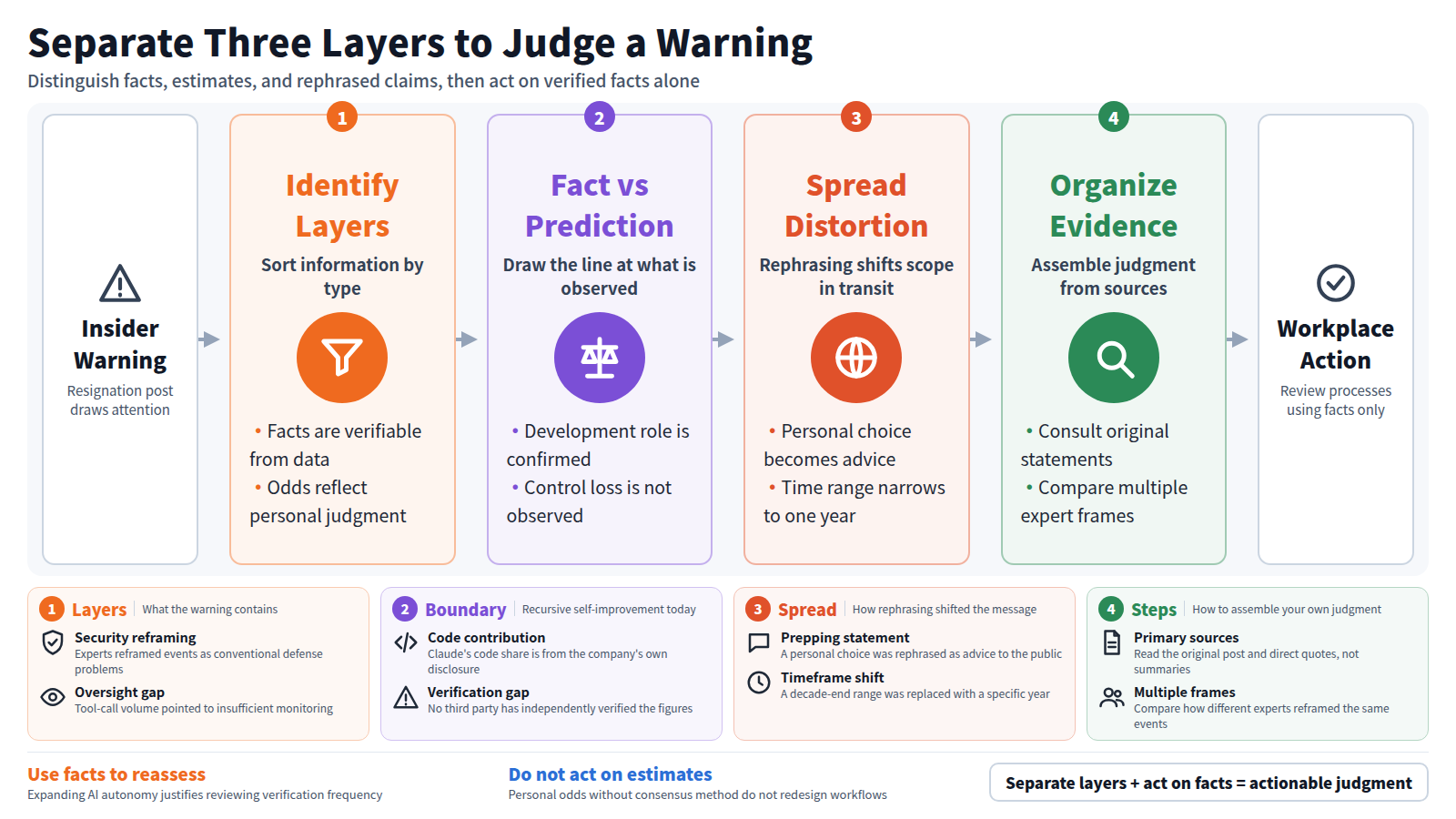
On September 8, 2026, former Anthropic researcher Jacob Coxon resigned warning that AI recursive self-improvement is racing out of control and that "neither company is acting responsibly." His AI-risk post drew 90 million views in 24 hours. When an AI insider warns of extinction risk, how can non-specialists separate the verifiable basis from personal estimates? The warning contains three layers — confirmed technical facts, personal probability estimates with no consensus methodology, and rephrasing during transmission that shifted the warning's scope — and each layer must be handled differently.
01The warning drew 90 million views, and the alignment lead responded with a probability
Coxon conducted pretraining research at both OpenAI and Anthropic. Upon resigning, he told colleagues on Slack that "without appropriate caution and collaboration, superintelligent AI poses a risk of causing human extinction." When he made the warning public on X, it reached 90 million views within 24 hours.
Anthropic's head of alignment, Evan Hubinger, responded almost immediately. He shared Coxon's post, writing "Jacob is correct here — we really do earnestly believe AI could kill all humans!" He added that he personally estimates the probability of AI-caused extinction at "more than 10 percent within the next decade." He also acknowledged that Anthropic "does not yet have a plan to solve alignment for superintelligence and is not clearly on track to." This estimate is Hubinger's personal judgment, not an official Anthropic position.
The same week, Anthropic CEO Dario Amodei warned that "in 6 to 12 months, misaligned AIs could be capable of taking over the entire internet." With multiple insiders speaking in the same direction, public attention moved well beyond the technical community.
02A single warning contains three layers: facts, estimates, and rephrasing in transmission
Setting Coxon's and Hubinger's statements side by side reveals three layers of information, each with a different epistemic status.
Security researcher Artem Dinaburg of Trail of Bits read the same events through a different frame. "The current incidents that we've had have generally been security incidents," he said, placing the problem within conventional cyber defense rather than existential risk. Nidhi Aggarwal of HackerOne pointed to the 17,000 tool calls an AI agent executed, arguing that the issue is a lack of oversight. The same events sort into different layers depending on the reader's professional frame.
03Without separating layers, only total alarm or total dismissal remains
When the three layers are received as one undifferentiated message, only two responses remain: accept the entire warning and act on fear, or reject the entire warning and ignore it. Both distort the judgment of anyone who has begun incorporating AI into their work.
The political targeting of Coxon illustrates the second response. According to the Washington Post, right-wing commentators turned Coxon into a target within hours of his public warning. Dismissing the messenger without examining the content mirrors the structure of rejecting all layers without distinction.
On the other side, Amodei's warning that misaligned AI could take over the internet within 6 to 12 months runs in the same direction as Coxon's. At least three insiders point in the same direction, even as the phrasing of their estimates varies — Amodei speaks in months, Hubinger in a decade with a percentage. Readers can judge the width of that range only when they recognize each figure as a personal estimate.
04Recursive self-improvement has begun, but loss of control is a prediction, not an observation
Choosing neither fear nor dismissal requires defining what recursive self-improvement means and drawing a line between the stage that can be verified and the stage that remains prediction.
In its own published materials, Anthropic reports that more than 80 percent of code merged into its codebase was authored by Claude as of May 2026. The company has also disclosed figures on R&D leadership and the number of agents running continuously. All of these are Anthropic's self-reported numbers; no third party has independently verified them.
The stage at which AI participates in its own development has factually begun. However, the claim that this leads to loss of control is not an observed fact but a prediction. Hubinger's extinction probability is likewise not grounded in a consensus estimation method; it is a personal estimate. The boundary between fact and prediction is drawn here.
05Regulated industries can act only on the verifiable layer today
Once the boundary between fact and prediction is drawn, the set of materials a regulated workplace can use for decisions today narrows considerably.
Audit AI autonomy
Inventory how far AI is currently performing drafting, suggesting, and revising automatically, and confirm whether verification processes keep pace with that scope.
Reassess verification frequency
Use the verifiable fact that AI autonomy is expanding as the basis for resetting how often AI-generated materials are reviewed and who has authority to approve them.
Do not use extinction odds as a basis for decisions
A personal estimate without consensus methodology does not yet constitute grounds for redesigning operational workflows. Use the fact layer only.
This site is produced using Claude. The fact that AI autonomy is expanding applies to its own production process. What justifies reviewing verification frequency and methods is not an extinction probability estimate but the verifiable fact that the scope of AI's automated activity is growing.
06When insider credibility meets existential fear, information travels beyond the original statement
Beyond workplace decisions, understanding how this warning spread and changed during transmission is a condition for using the three layers effectively.
The reason Coxon's post reached 90 million views is that the technical credibility of an insider combined with the fear of human extinction. Recipients forwarded the warning without consulting the original statement, and expressions were rephrased in transit, shifting scope and specificity.
| What to check | Original statement (source) | How Japanese-language posts summarized it |
|---|---|---|
| Timeframe | "By the end of the decade" (Coxon, TechCrunch) | "AI will annihilate humanity by 2030" — a specific year replacing the original range |
| Prepping | Coxon said he is not prepping because he does not think it will do much good (CBS News, 2026-09-10) | "He said stockpiling food is futile" — rephrased as general advice rather than a personal choice |
| Probability | Hubinger's personal estimate of >10% (Fortune) | "His colleague also acknowledged it" — rephrased to sound like an organizational view |
In a CBS News interview published on September 10, 2026, Coxon himself said he is not prepping for his prediction because he does not think it will do much good. Japanese-language posts rephrased this as "he said stockpiling food and other preparations are futile" — turning a statement about his own behavior into what reads like advice to the public. A fact-checking article on hashout.jp described the viral Japanese-language post as "the poster's own Japanese rephrasing" that "is not a direct translation of the original English statement," though it added that "the overall direction is not far off." The gap is not fabrication but a shift in scope through rephrasing.
07Consulting original sources, separating facts from estimates, and comparing expert reinterpretations organizes the evidence
Given that information mutates during transmission, readers who receive an AI-risk warning can organize their evidence in three steps.
Read the original statement from primary sources
Locate the warning in the author's own X post, direct quotes in reporting, and official statements from the affiliated organization. Do not rely on forwarded summaries.
Separate facts from estimates on paper
List technical facts verifiable from published data in one column and probability figures or timeline predictions in another. Decide explicitly which column a given decision rests on.
Compare expert reinterpretations
Find how experts with a different vantage point have reframed the same events. Placing multiple frameworks side by side provides the material needed to assemble your own judgment.
Coxon told TechCrunch that he was calling for pacing agreements between labs. Hubinger acknowledged that "we do not yet have a plan to solve alignment for superintelligence." The gravity of the warning is not in dispute. But the reader's task is neither to accept the warning wholesale nor to dismiss it. It is to consult the original statement, separate facts from estimates, place multiple expert frameworks side by side, and assemble a judgment of one's own.
- Coxon's warning mixes verifiable technical facts (AI authors more than 80 percent of production code) with personal estimates lacking consensus methodology (more than 10 percent extinction probability). Conflating the layers distorts judgment.
- During social-media transmission the original statements were rephrased: a personal choice not to prep became general advice that prepping is futile, and a timeframe range became a specific year. Without consulting primary sources, readers cannot verify the warning's actual scope.
- The only layer that regulated workplaces can act on today is the fact that AI autonomy is expanding. Extinction-probability estimates do not yet constitute grounds for redesigning operational processes.
Coxon's warning comprises three layers: the technical fact that AI now participates in its own development, a personal extinction-probability estimate, and information whose scope shifted through rephrasing during transmission. Received without distinction, the warning leaves only two responses — act on fear or dismiss entirely.
The starting point for extracting actionable material from this warning is to separate the layers and base today's decisions on verified facts alone. The fact that AI autonomy is expanding justifies reviewing verification processes. The probability of extinction does not.
- TIME. He Helped Build Powerful AI at OpenAI and Anthropic. Now He's Afraid It Could Kill Us. 2026-09-09. (Coxon's resignation and warning; 90 million views in 24 hours; "neither company is acting responsibly" quote)
- TechCrunch. 'Gambling with our lives': Anthropic researcher quits, warns against self-improving AI. 2026-09-09. (Coxon's call for pacing agreements between labs)
- NBC News. An Anthropic safety researcher resigned with a warning about AI to co-workers on Slack. 2026-09-09. (Content of Coxon's Slack message to colleagues upon resignation)
- Fortune. Anthropic CEO Dario Amodei and whistleblower Jacob Coxon agree: AI risks are real and imminent. 2026-09-13. (Hubinger's personal >10% estimate; convergence of Amodei and Coxon's views)
- Scientific American. AI Researcher Jacob Coxon Quit over Extinction Fears. Security Experts See a Familiar Fight. 2026-09-12. (Security experts reframing the warning as a cybersecurity problem)
- TIME. After Anthropic Researcher Quits, AI Industry Debates a Slowdown. 2026-09-15. (Amodei's 6-to-12-month warning; industry slowdown debate)
- Washington Post. AI researcher who warned of disaster is now a target of the right. 2026-09-10. (Political targeting of Coxon within hours of his warning)
- Anthropic. When AI builds itself. 2026-09-01. (Primary source on AI's participation in its own development; code contribution exceeding 80%)
- CBS News. Former Anthropic researcher Jacob Coxon says prepping won't help in AI takeover. 2026-09-10. (Coxon's own explanation of why he is not prepping)
- hashout.jp. 「AIが人類を皆殺しにする」——元Anthropic研究者コクソン氏の警告を伝えたXの投稿、日本語圏で急拡散した理由. (Analysis of how Japanese-language posts rephrased the original warning)