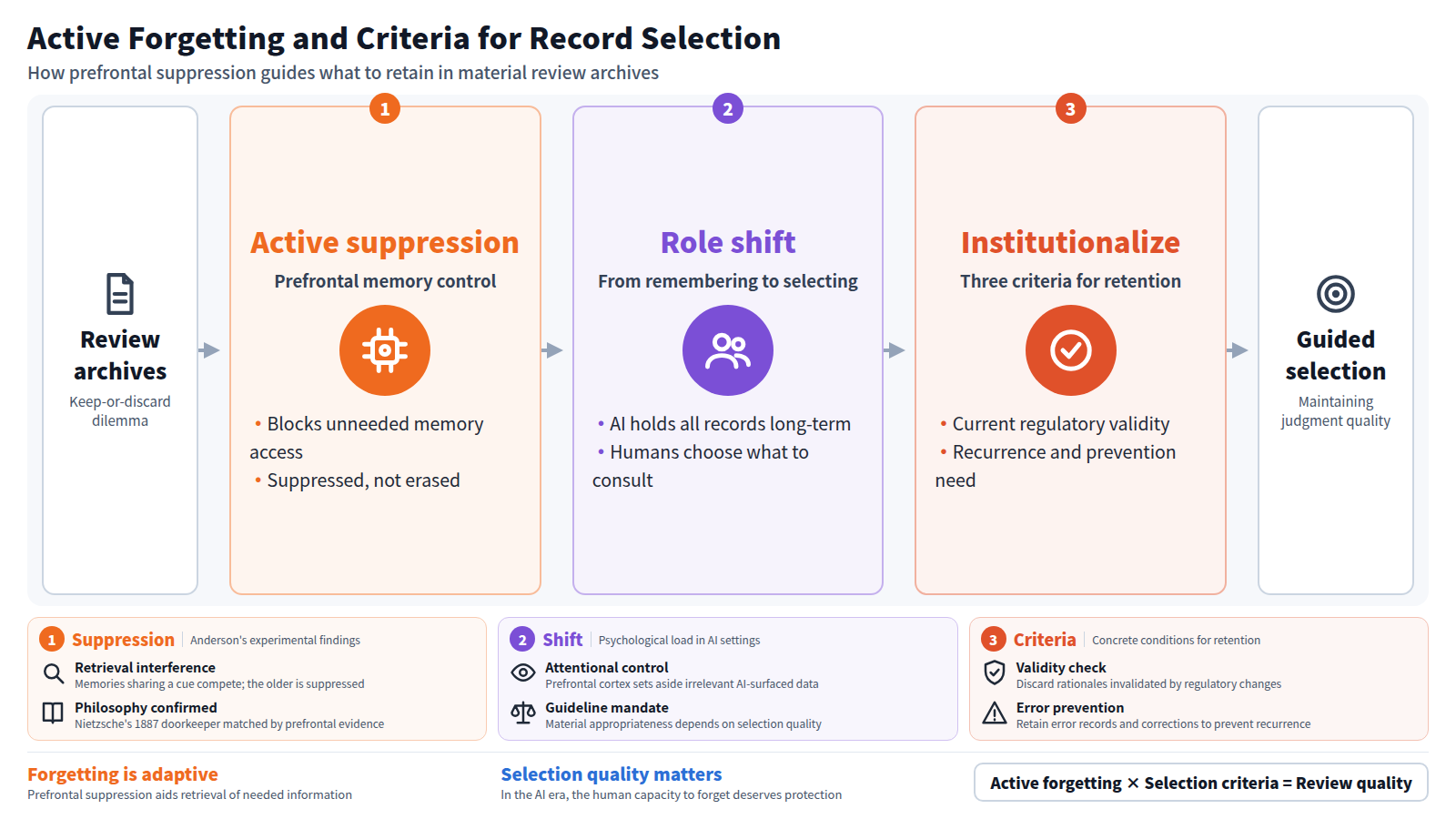
Now that AI can retain every past review record indefinitely, a recurring question sharpens at year-end: keep or discard the rationale behind a decision made three years ago. Is forgetting a loss, or a way to travel lighter? Forgetting is neither loss nor liberation — it is the act of choosing what to retain, and the quality of that choice determines the quality of judgment.
01When discarding records, the line between 'no longer needed' and 'still required' is unclear
Material review professionals periodically organize their archives. Japan's guidelines on promotional information activities for prescription drugs require the creation and management of standard operating procedures and business records, which accumulate over time. A rationale that justified approval three years ago may no longer hold under today's regulatory environment. But the month after discarding it, a similar case might arrive, and that rationale might be exactly what is needed.
This keep-or-discard decision shares the same structure as personal memory. Forgetting feels like losing something. Yet retaining everything can dull judgment. Cognitive psychology and philosophy converge on one answer: forgetting is not a malfunction. It is an adaptive function the brain is designed to perform.
02Forgetting is not a cognitive failure but an adaptive function that makes memory usable
Anderson and colleagues, writing in the Annual Review of Psychology (2021), demonstrated that forgetting operates as an adaptive mechanism driven by active prefrontal control. Memories are not erased; the prefrontal cortex suppresses access to memories that are not currently needed. Suppressed memories remain intact. Their retrieval priority simply drops.
This mechanism allows needed information to be retrieved without interference from competing memories. As the Bjork Learning and Forgetting Lab's research shows, memories can be "too accessible for our own good," and the state of memory should be "actively tuned to suit our cognitive or emotional goals." Forgetting is not a flaw in the memory system. It is part of the design.
03Retaining everything slows judgment and increases error
| Factor | Full retention | Active forgetting |
|---|---|---|
| Retrieval speed | Slowed by interference | Accelerated by suppression |
| Judgment accuracy | Old information interferes | Focus on relevant information |
| Psychological load | Dragged by the past | Focused on the present |
Bjork's New Theory of Disuse (1992) demonstrated theoretically that when old information retains high accessibility, the retrieval of new information suffers from interference. A rationale from three years ago may no longer fit the current regulatory environment, yet if it maintains high priority in memory, it interferes when searching for current regulatory requirements.
Nietzsche's words, cited in Philosophy Now, illuminate this from another angle: "Without forgetfulness, there could be no happiness, no cheerfulness, no hoping, no pride, no present." Retaining everything is not the natural human state. Forgetting supports mental health. Nietzsche stated this as philosophical intuition. As the next section shows, Anderson and colleagues identified the mechanism experimentally.
04Nietzsche's 1887 'doorkeeper of the mind' has been confirmed as prefrontal inhibitory control in modern neuroscience
Nietzsche (1887)
Forgetting is not inertia but an active inhibitory force — a doorkeeper that preserves mental order, calm, and decorum.
Anderson (2021)
The prefrontal cortex actively suppresses retrieval of unnecessary memories, facilitating access to needed information, as shown experimentally.
In On the Genealogy of Morals (1887), Nietzsche defined forgetting as an "active force." In the words of a research paper published by De Gruyter: "Nietzsche identifies the active force of forgetting as a doorkeeper to consciousness, preserving mental order, calm and decorum." This was not 19th-century speculation. Anderson's 2021 experiments identified precisely this "doorkeeper" as inhibitory control exercised by the prefrontal cortex. A philosophical hypothesis was confirmed in the laboratory.
05When AI can retain every record, the human role shifts from remembering to selecting
In material review environments that have adopted generative AI, review records can increasingly be retained indefinitely and searched in full text. As the Harvard Business Review discussed in its article on what leaders need to know about AI and psychological safety, the nature of the psychological burden changes in environments where AI holds the records. The anxiety of forgetting diminishes, replaced by a new judgment: which of the pieces of information AI presents should be adopted?
This is where the value of active forgetting paradoxically increases. AI does not forget. But humans possess the capacity to forget. The active forgetting Anderson described is memory suppression, yet the same prefrontal cortex also governs attentional control — setting aside currently irrelevant information that AI presents. When AI surfaces every past precedent, the ability to select only what is relevant to the current case and set the rest aside determines review accuracy. The human role shifts from "remembering" to "choosing what to consult and what to set aside." The guideline requirement to ensure the appropriateness of promotional materials depends on the quality of this selection.
06Retrieval interference occurs because old and new memories are linked to the same cue
Shared cues
Multiple memories belonging to the same category activate simultaneously during retrieval.
Competition and suppression
To retrieve the target, competing memories are suppressed, and their subsequent accessibility decreases.
Forgetting as adaptation
This suppression is not a malfunction but a design feature of the brain that makes retrieval efficient.
Anderson's research on retrieval-induced forgetting shows that multiple memories linked to the same cue compete during retrieval. A paper published in Frontiers in Psychology reports that "retrieval-induced forgetting is thought to be the result of inhibitory processes that help facilitate the retrieval of the target." When a material reviewer tries to recall a "similar past case," a case from three years ago and a case from one year ago may both be linked to the same cue. The suppression of the older case makes the more relevant recent case easier to retrieve.
This is the concrete mechanism of active forgetting. Old memories do not disappear; they temporarily recede to make way for current retrieval. When organizing records, a third option exists beyond keeping and discarding: lowering the access priority.
07Three criteria for record management institutionalize active forgetting
To turn record organization from an individual judgment call into an institutional practice, three criteria determine what to retain.
First, whether the rationale remains valid under current regulations. The regulatory environment changes. A rationale that was valid three years ago may not hold under revised guidelines or new notifications. Only rationales that remain valid under current regulations should be kept in a readily accessible state.
Second, whether similar reviews are likely to recur. Records of highly unusual cases that occurred only once have low probability of recurrence. Records supporting recurring, routine judgment calls carry higher retention value.
Third, whether the record is needed to prevent the recurrence of an error. When a past review contained an error, the record of that error and the correction process has preventive value. As research on intentional forgetting published in ScienceDirect shows, controlling forgetting requires deciding not "what to forget" but "what to retain" first.
Selecting what to retain using these three criteria turns active forgetting from a personal habit into an institutional practice. Even in environments where AI retains every record, narrowing the range of records humans consult — according to explicit criteria — maintains the speed and accuracy of judgment.
- Forgetting is not cognitive failure but an adaptive function in which the prefrontal cortex actively suppresses competing memories to facilitate retrieval of needed information (Anderson, 2021)
- In an era where AI can retain review records indefinitely, the human role shifts from remembering to choosing what to consult and what to set aside
- Selecting what to retain using three criteria — regulatory validity, likelihood of recurrence, and contribution to preventing repeat errors — institutionalizes active forgetting
Forgetting is neither loss nor liberation. It is the act of choosing what to retain, and the quality of that choice determines the quality of review judgment. Precisely because AI never forgets, the human capacity for forgetting is worth protecting as institutional practice.
- Annual Review of Psychology, "Active Forgetting: Adaptation of Memory by Prefrontal Control," Anderson et al., January 2021. Link
- De Gruyter, "Active Forgetting and Healthy Remembering in Nietzsche," August 2024. Link
- UCLA Bjork Learning and Forgetting Lab, "Research." Link
- Philosophy Now, "To Forget or To Remember?" April 2020. Link
- Harvard Business Review, "What Leaders Need to Know About AI and Psychological Safety," September 2026. Link
- Ministry of Health, Labour and Welfare (Japan), "Guidelines on Promotional Information Activities for Prescription Drugs," September 25, 2018. Link
- Frontiers in Psychology, "Retrieval-induced forgetting in item recognition," March 2017. Link
- ScienceDirect, "Comparing Methods to Study Intentional Forgetting in the Lab and in the Field," 2026. Link