
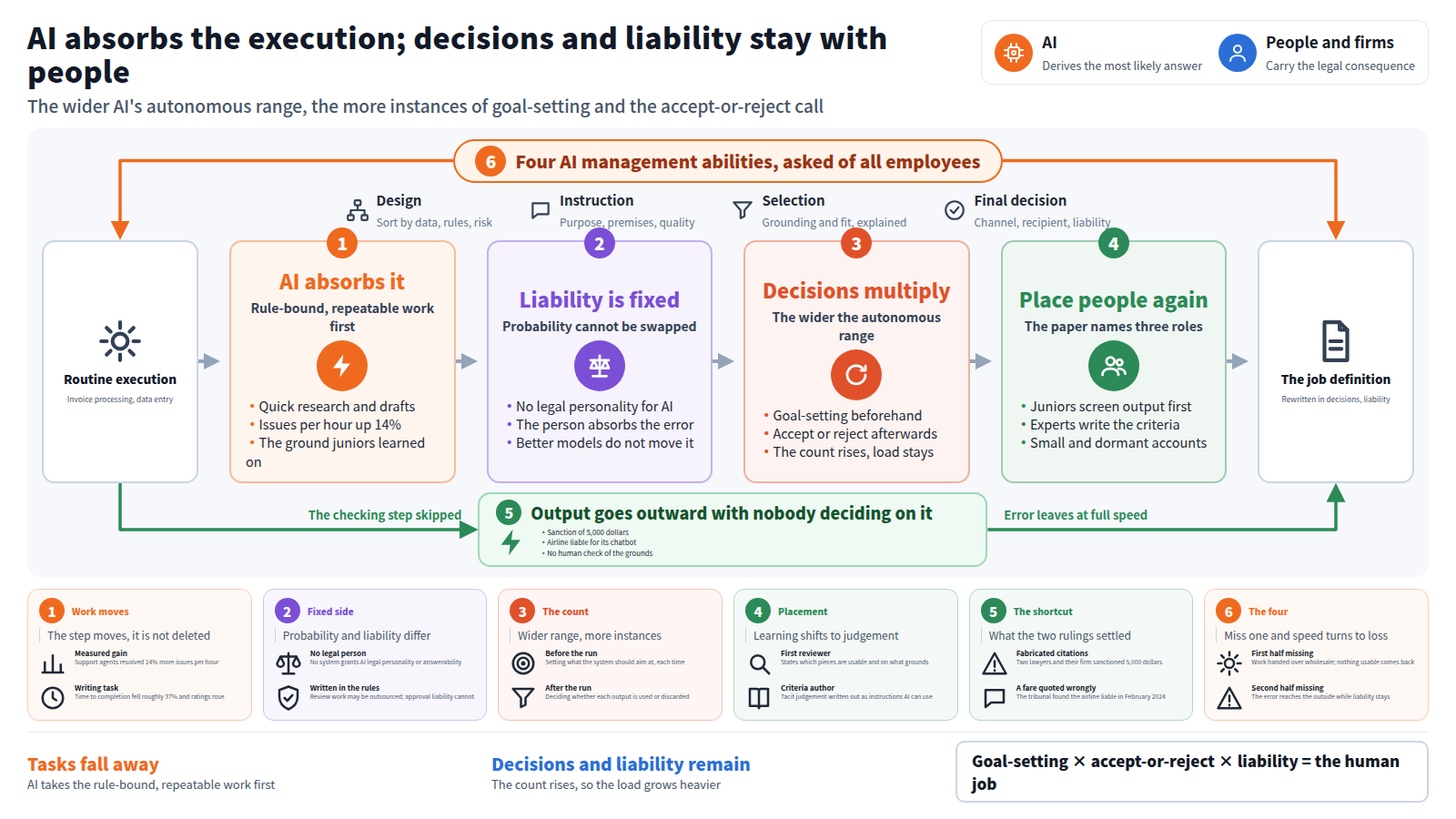
In April 2026, Ryo Fujinaka and Takahiro Nishino of Nomura Research Institute argued in the journal Chiteki Shisan Sozo that AI should be defined as a subordinate and that white-collar job definitions should be rewritten from tasks to decisions and liability. As AI takes on more of the work by itself, does the human job shrink? It does not. Tasks fall away, but goal-setting, the accept-or-reject call and liability for the result stay with people — and the further AI's autonomous range extends, the heavier that load becomes.
01Handing the work to AI makes each human decision weigh more
The argument is plain. The more of the execution AI absorbs, the more the human job narrows to three things: setting the goal the system is aimed at, deciding whether to accept or discard the output, and carrying liability for the consequence. So rewrite the job definition, the two researchers say — from a list of tasks performed to a list of decisions made and consequences owned.
The place this argument applies is not the procurement meeting. It is the page where job descriptions and evaluation criteria are written. Many organisations that adopted generative AI have not seen the efficiency they expected, and the paper's diagnosis is that the shortfall lies not in model quality but in the fact that nobody rewrote who decides what and who answers for it.
That is also the first thing a reader can move. Not the training catalogue, not the choice of vendor. Whether the job descriptions you and your reports work under can be written in decisions rather than tasks.
02Two NRI researchers define AI as a subordinate and ask all staff for four abilities
Start with the definition. Rather than treating AI as a tool, the authors reposition the human as a manager directing AI as a subordinate, and they split the work the human must run into four steps: design, instruction, selection, and final decision with liability. Together they call these the four AI management abilities.
Each names a different step. Design means surveying the whole process and sorting which parts go to AI and which stay with people, using the availability of data, the clarity of the rules, and the tolerance for risk as the criteria. Instruction means putting the purpose, the premises and the quality requirements into words. The paper is explicit that this is not prompt technique but something closer to the briefing a manager gives when handing work to a person. Selection means evaluating several outputs for factual grounding and fit with context, then choosing in a way that can be explained. Final decision and liability means deciding how the chosen output is edited, through which channel it reaches whom, and then standing behind the result.
The consequential part is who is asked to do this. Historically these were the acts expected of managers and project leads. The paper states flatly that they are now a requirement for every employee, including someone in their first year. The reasoning is that once AI absorbs the execution, whether each individual can run these four steps is what determines the organisation's output.
The boundary is worth drawing too. This is a proposal, not a controlled comparison between organisations that trained the four abilities and organisations that did not. What it offers is a line of reasoning assembled from labour-market statistics and published cases, not evidence that the training itself produces the gain.
03Postings move from clerical to technical, and the duty to approve stays inside the company
Behind a proposal aimed at every employee lies a movement in job categories. In the Japan Association of Job Information Media tally for July 2026, clerical postings were down 25.2 percent year on year, while specialist postings for IT engineers were up 206.6 percent. Two categories moved in opposite directions inside the same monthly count.
Hiring expectations point the same way. In an IDC study published in 2025, two in three organisations expected entry-level hiring to slow within three years. The posting figures are a single month's tally, though, and nothing in them licenses blaming the decline on AI alone.
| Point of comparison | Clerical and entry-level roles | Roles that direct AI |
|---|---|---|
| Job postings (July 2026, year on year) | Clerical: −25.2% | Specialist (IT engineers): +206.6% |
| Hiring outlook, next three years | Two in three organisations expect entry-level hiring to slow | AI and technical grounding enter the requirements at hiring |
| What the role retains | Routine execution | Goal-setting, the accept-or-reject call, liability for approval |
In some fields the split between execution and liability is already written into the rules. Japan's guideline on the provision of sales information for prescription medicines states that the review work may be outsourced to a body able to perform it properly, but that liability for approval rests with the supervising department and ultimately with management. The work can be outsourced. The liability cannot. That line was in force in writing before generative AI entered the process at all.
04AI can produce a likely answer, but no law lets it carry the consequence
Liability stays inside the company for reasons beyond one sector's rulebook. The paper explains it as an asymmetry between probability and liability. What AI can do is derive, from past data, the most likely answer on its own. What a person must do is carry the legal, social and economic consequence of that answer.
These two cannot be swapped. Until a legal system grants AI legal personality and the capacity to be held answerable, the party that absorbs the cost of an error remains the person and the organisation. That fixes two steps on the human side: setting what the system should aim at, and deciding whether its output is used. Better models do not move the fixed side.
Two rulings show how the asymmetry surfaced in actual disputes.
Citations that did not exist
After a brief cited fabricated cases produced by generative AI, the United States District Court for the Southern District of New York imposed a 5,000 dollar sanction on two lawyers and their firm on 22 June 2023, noting the gatekeeping role attorneys hold over the accuracy of their filings.
A fare quoted wrongly
After an airline's web chatbot described fare conditions incorrectly and a passenger lost money as a result, British Columbia's Civil Resolution Tribunal found the company liable in February 2024.
In neither case was the AI's error itself the thing punished. What settled liability was the absence, on the human side, of the step that checks the grounds and decides whether to use the output — and the fact that the output went outward unchanged. The first ruling sits under United States law and the second under Canadian law, so neither maps directly onto the Japanese system.
05A 14% gain in customer support stops at first drafts unless people are placed differently
If liability is fixed on the human side, the next thing to settle is where people stand. That generative AI shortens execution time is measured. In a study of a customer-support operation, agents with access to the tool resolved issues per hour at a rate 14 percent higher on average, with the largest gains among the least experienced. In an experiment using writing tasks, time to completion fell by roughly 37 percent and quality ratings rose. Both numbers were measured in specific occupations; neither is an average across all work.
Even so, in many organisations the value of generative AI stops at convenient first drafts. The complaint the paper reports runs: I had the AI write it, and rewrote most of it myself. The authors trace that rework not to model quality but to design and instruction having been treated carelessly. Throw work over without sorting what should be delegated or stating purpose and constraints, and the output sounds right in general and fits nothing in your own operation. The speed is real; the result is not.
So where should people be placed? The paper names three roles.
First reviewer
Junior staff screen AI output first and, before passing anything up, state which pieces are usable, which are not, and on what grounds.
Opener of neglected ground
Small accounts, dormant customers and shelved product ideas that never justified the hours become places where juniors can buy volume of attempts with AI.
Author of instructions and criteria
Experienced staff move from being the fastest and most accurate executor to writing their own judgement out as instructions and evaluation criteria.
The arrangement also does the training. A junior instructs the AI, screens several candidate outputs, lightly edits the chosen one and sends it up for review. Build those three into daily work and the object of learning shifts from how a task is performed to what separates a good result from a bad one. The paper describes this as a way to give people, early and in simulated form, the feel for judgement that previously took years. An expert whose criteria stay tacit has nothing that can be handed to AI.
06Miss one of the four abilities and speed turns into loss
From the definition, the range, the mechanism and the measurements above, three things follow that change a reader's decisions.
First, the four work only as a set. Training that teaches prompt writing alone builds an organisation that errs faster. That holds because a gap in the first half and a gap in the second half fail in different shapes. Without design, vague judgements and data-poor areas get handed over wholesale, and no number of regenerations produces anything usable. With weak instruction, a person ends up rewriting from scratch. Both are merely slow; the error stays inside. But when selection and final decision are missing, the error reaches the outside at full speed. The two rulings above are what that second kind of gap looks like.
Second, the disappearance of apprenticeship work can only be filled by relocating junior staff. A junior's job description has to be rewritten from "produce" to "choose and give reasons". The grounds are in the order automation proceeds. AI takes the rule-bound, repeatable work first — invoice processing, data entry, quick research, draft correspondence. That is exactly the ground juniors used to learn on. Once the floor where people learned by doing shrinks, a place to learn judgement has to be built deliberately or it does not come back.
Third, unless the job definition is rewritten, hiring and evaluation keep running on volume of work performed. A job advert still written as tasks reads badly to candidates who weigh a company's stance on AI. One survey reports that 46.7 percent of students already weighed whether a company uses generative AI when choosing where to apply, while two in three organisations expect entry-level hiring to slow. What that survey shows, though, reaches only as far as the share of students weighing AI adoption; it does not connect the wording of a posting to the number of applications. Evaluation behaves the same way: measure output by tasks completed and nobody spends time training the act of deciding.
07More autonomous agents mean a heavier load on the person who approves
Extend the set-only property into a future where AI acts on its own across a wider range, and the direction of the load becomes visible. One common reading holds that as agents handle tasks autonomously, instruction and selection will stop being needed. The paper answers the opposite. The wider the range in which AI can act by itself, the more instances there are of the step that sets the goal beforehand and the step that accepts or rejects afterwards. Less effort per instance, but where the count rises faster than the effort falls, the side that answers for the result is not relieved.
The paper sets the before and after of that wording side by side.
| Point of comparison | Defined as tasks | Defined as decisions and liability |
|---|---|---|
| Junior role | Produce documents and meeting minutes | Review AI output first and state the reasons for the choice |
| Experienced role | Execute faster and more accurately than anyone | Write out instructions and evaluation criteria AI can use |
| Object of evaluation | Volume of work completed | Decisions made and liability for their results |
Past this point, nothing is settled. The paper is a proposal, and it offers no comparison showing that organisations which trained the four abilities actually raised output. The posting figures are one month's tally. The two productivity measurements come from particular occupations. The two rulings sit under United States and Canadian law. What is certain is narrower: where execution moves to AI, the number of decisions rises, and the only parties that can currently answer for those decisions are people and the organisations they work in.
- Design, instruction, selection, and final decision with liability work only as a set; miss one and speed turns into error. Training that teaches prompt writing alone builds an organisation that errs faster.
- AI takes the routine work first, and that is the ground where juniors used to learn. The training floor returns only if juniors are placed as first reviewers of AI output.
- Clerical postings fall while specialist postings rise, and two in three organisations expect entry-level hiring to slow. An organisation that keeps posting job adverts written as tasks reads badly to candidates who weigh a company's stance on AI.
As AI's autonomous range widens, the human job does not shrink. Tasks fall away. What remains is goal-setting, the accept-or-reject call, and liability for the result.
Whether those three can be written into the definition of a job is what decides if AI's speed becomes output or loss. In organisations that never write them in, the work still gets faster. It is just that when speed arrives without a step that decides whether to accept the output, more goes outward with nobody having checked it.
Testing this is not hard. Open the job descriptions you and your reports work under and read what is in them. If all that appears is a list of tasks, that job has been written entirely out of the parts that can eventually be handed to AI.
- Ryo Fujinaka and Takahiro Nishino. Managing AI: developing and training a new white-collar role. Nomura Research Institute, Chiteki Shisan Sozo, April 2026. Article page (nri.com) · PDF(The four AI management abilities, their extension to all employees, the probability–liability asymmetry, rewriting the job definition)
- Japan Association of Job Information Media. Job advertisement volume tally, July 2026. zenkyukyo.or.jp(Clerical −25.2%, specialist IT engineers +206.6%, year on year)
- International Data Corporation (InfoBrief commissioned by Deel). AI at Work: The Role of AI in the Global Workforce. November 2025. deel.com(Two in three organisations expect entry-level hiring to slow within three years)
- Erik Brynjolfsson, Danielle Li, Lindsey R. Raymond. Generative AI at Work. NBER Working Paper No. 31161, April 2023. nber.org(Issues resolved per hour up 14% on average, largest gains among the least experienced)
- Shakked Noy, Whitney Zhang. Experimental Evidence on the Productivity Effects of Generative Artificial Intelligence. Working paper, March 2023 (peer-reviewed version in Science vol. 381, no. 6654, 13 July 2023). economics.mit.edu(Time on the writing task fell by roughly 37 percent)
- United States District Court, Southern District of New York. Mata v. Avianca, Inc. — Opinion and Order on Sanctions. 22 June 2023, 678 F. Supp. 3d 443. law.berkeley.edu(The gatekeeping role attorneys hold over filing accuracy; a 5,000 dollar sanction)
- Barry B. Sookman. Moffatt v. Air Canada: A Misrepresentation by an AI Chatbot. McCarthy Tétrault TechLex, 19 February 2024. mccarthy.ca(2024 BCCRT 149: the company held liable for its chatbot's misleading information)
- PR TIMES (Chapter Two Inc.). Survey on perceptions in the AI era: 46.7% of current students already weigh AI adoption when choosing employers. 5 August 2025. prtimes.jp(Students weighing a company's use of generative AI when choosing where to apply)
- Ministry of Health, Labour and Welfare, Pharmaceutical Safety and Environmental Health Bureau. Guideline on the provision of sales information for prescription medicines. 25 September 2018. mhlw.go.jp(Review work may be outsourced; liability for approval rests with the supervising department and management)