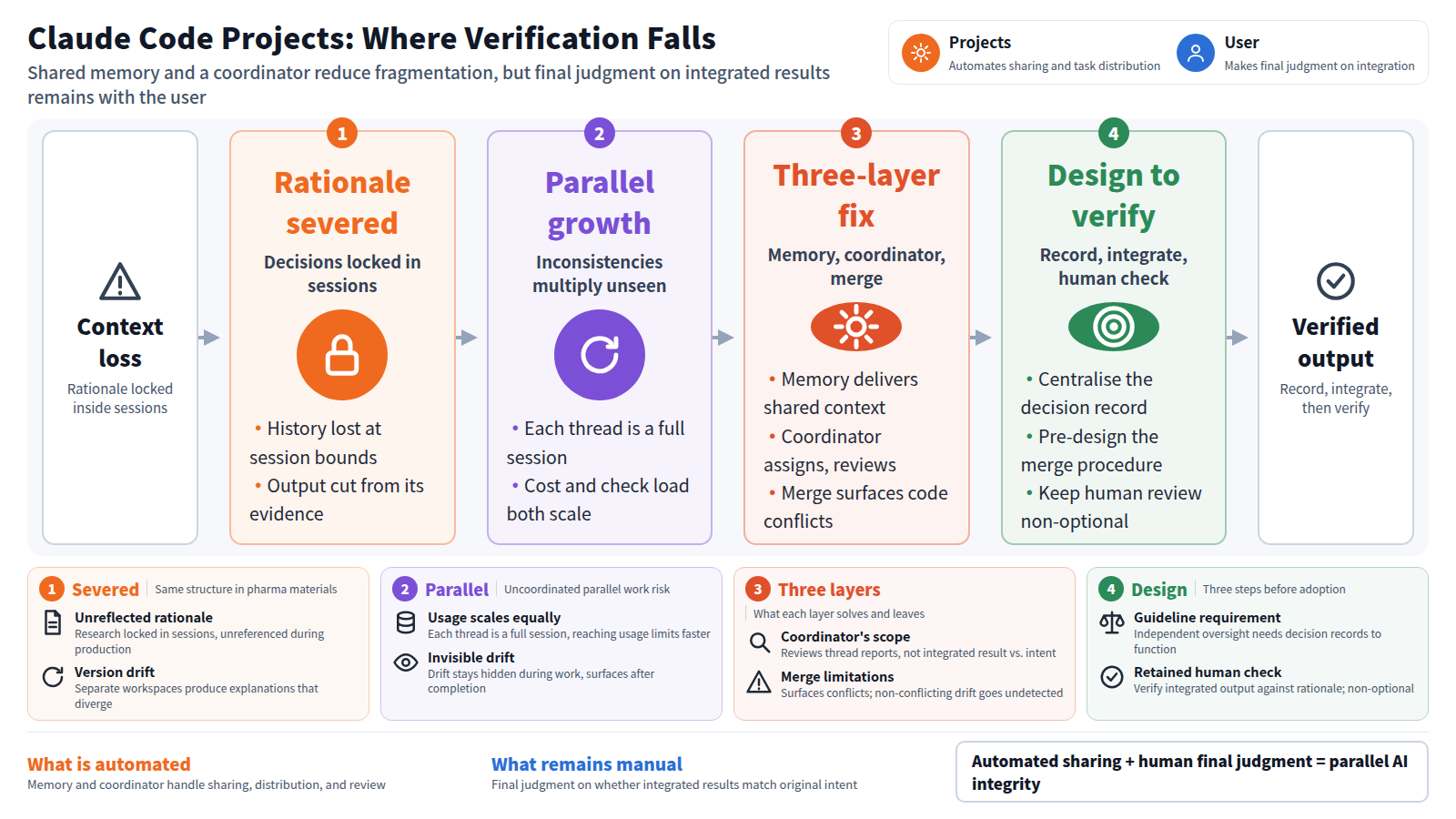
On September 17, 2026, Anthropic redesigned Claude Code Projects and launched three mechanisms in public beta: parallel threads, shared memory, and a coordinator thread. When AI automates context sharing and coordination across parallel work, where does the responsibility for verifying output consistency remain? Shared memory and a coordinator structurally reduce context fragmentation; the coordinator reviews outputs, and CI failures are auto-fixed. However, the final judgment on whether integrated outputs match the original intent remains with the user, who reviews the pull requests.
01Anthropic Tackles Session-Boundary Context Loss with Shared Memory and a Coordinator
The redesign centres on a shift from folder to conversation. Under the previous Claude Code model, running multiple sessions in parallel meant doing all the coordinating yourself. Anthropic's documentation describes the prior state plainly: "Without a project, running several sessions means doing the coordinating yourself: you decide what each one works on, repeat the same background at the start of each." The user decided what went where, restated context every time, and checked which session had finished.
In the redesigned Projects, the user describes the work, and Claude scopes it, delegates it to threads, runs them in parallel, and assembles the result. Each thread is an independent Claude Code session running in the cloud on its own branch, reporting back to a coordinator thread when it finishes. Context flows through the project's shared repositories, instructions, and memory. A rule stated once reaches every thread.
It is worth noting that Claude's chat-based Projects, available since June 2024, are a different feature entirely. The redesigned Claude Code Projects are in public beta for a subset of Pro and Max plan subscribers. Team and Enterprise plans do not yet have access. Local sessions cannot currently be added to a project.
02The Real Cost of Context Loss Is Not Rework but Rationale That Never Reaches the Output
When context disappears at a session boundary, the damage is not limited to duplicated effort. The facts investigated in one session, the judgment made, and the reasons behind it fail to travel to the next session, yet the output is produced regardless. That is the real cost.
Consider a common pattern: one session researches the rationale behind a specification, and a second session writes the code. If nothing carries context between them, the code gets written, but the reasoning behind the specification is gone. The output exists, severed from the evidence that justified it. The user discovers the break only when someone later asks why the specification reads the way it does.
This structure appears even when only one output is at stake. Research results that are never reflected in the deliverable. Documentation written in one workspace that contradicts the explanation in another. Behind each of these is the same root: context locked inside a session.
03Parallelism Without Coordination Multiplies Inconsistent Outputs Undetected
The failure of rationale to reach the output grows with the number of parallel streams. A single session producing a single deliverable creates one point of potential disconnect. Multiple sessions producing multiple deliverables simultaneously, each operating on different assumptions, increase the inconsistencies. And those inconsistencies remain invisible while the work is in progress.
Now that parallel sessions have reached a practical level of capability, the problem is becoming visible. The Register reported that "projects can run several threads at once, and each one is a full Claude Code session," and noted the risk of reaching usage limits faster. Techstrong.ai echoed that "Projects can consume usage allowances more quickly because each thread is a full Claude Code session." Parallelism speeds the work, but costs scale in parallel. The benefits of speed and the burden of consistency checking both expand at the same time.
This is the inflection point. Without a coordination mechanism, parallelism produces inconsistent outputs that no one detects. To gain the benefits of parallel execution, the coordination mechanism must be introduced alongside it.
04Each of the Three Layers Leaves a Gap That No Layer Fills
The coordination mechanism that Projects introduced can be broken into three layers. Shared memory automates context sharing. The coordinator thread automates task distribution. The branching and merging mechanism, in which each thread works on its own branch, surfaces code conflicts.
| What to look at | Conventional multi-session | Projects |
|---|---|---|
| Context sharing | User passes it each time | Shared memory passes it automatically |
| Task distribution | User assigns manually | Coordinator thread assigns |
| Code conflicts | User notices manually | Merge surfaces the conflict |
| Accuracy verification | User verifies | Coordinator reviews reports / CI failures auto-fixed / Final review by user |
The bottom row tells the story. The coordinator reviews what threads report back, and CI failures are auto-fixed. However, the coordinator sees thread reports, not every step they take; the final judgment on whether the integrated output matches the original rationale and intent remains with the user, who reviews the pull requests. Techstrong.ai reported that "If multiple sessions make conflicting changes, developers will still need to resolve any merge conflicts." Surfacing conflicts is progress, but discrepancies hidden in non-conflicting sections are ultimately for the user to judge.
05In Material Production the Same Three Failures Stem from Context Fragmentation
The gap between what the three layers solve and what they leave open is not confined to software development. In pharmaceutical promotional material production, the same structure of context fragmentation produces three equivalent problems.
Unreflected rationale
Information gathered during research remains locked in the session or the individual's memory, never referenced during production, and the material is completed without it.
Version drift in explanations
When explanations for the same product are created in separate workspaces, assumptions and wording diverge, and the materials end up contradicting each other.
Review burden concentrated on one person
Progress tracking and consistency verification across multiple materials running in parallel converge on a single reviewer.
These are not efficiency problems but accuracy problems. Japan's Guidelines on Sales Information Provision Activities for Prescription Drugs require that the information provided be "based on scientific and objective evidence and be accurate content whose evidence can be demonstrated." If the rationale never leaves the workspace, verifying compliance with this requirement after the fact becomes difficult.
The accompanying commentary on the guidelines further requires that the supervisory department for sales information provision activities be "established within the company in a form independent from the department responsible for sales information provision activities," and that it "conduct periodic monitoring and provide necessary supervisory guidance to the responsible departments and personnel." Independent oversight cannot function if the reasoning behind decisions has not been preserved as a record. Where records are fragmented, the supervisory department can examine only the surface of the deliverable.
06The Root Cause Is That Decisions and Reasons Are Not Recorded Outside the Session
Whether in material production or software development, context fragments for the same reason. Decisions and the reasons behind them are not recorded outside the workspace where they were made.
A judgment is reached inside a session. But the judgment lives in the session history. It sits in the individual's memory. It may be written in a file, but no mechanism directs the next worker or the next thread to look there. As Anthropic's documentation states, Projects' shared memory operates on the principle that "a rule you state once, such as which branch to target, reaches all of them," delivering recorded context to every thread. What this mechanism solves is the delivery. The coordinator reviews outputs and CI failures are auto-fixed. However, whether the integrated result matches the original rationale and intent is a final judgment that remains with the user, who reviews the pull requests.
Fragmentation begins with the absence of a record. Even where a record exists, it fragments if it does not reach the next task. Even where it reaches, whether the integrated result is consistent with the original record must be verified in a separate step. Of these three stages, Projects automates the first and part of the second. The third is left to the user's own design.
07Adopting Parallel AI Requires Pre-Designing Record, Integration, and Verification Steps
If the root cause of fragmentation lies in absent records and failed delivery, the steps to design before adopting parallel AI divide into three.
Centralise the record
Write decisions and their reasons in one place and build a mechanism that directs every worker and every thread to consult it.
Pre-design the integration procedure
Before work begins, define the procedure and sequence for merging outputs produced in parallel.
Retain a human verification step
Keep a step in which a person verifies that the integrated output is consistent with the original rationale, and make that step non-optional.
Projects' shared memory provides the first mechanism. The coordinator thread handles part of the second and also reviews outputs and auto-fixes CI failures. However, the final judgment on whether the integrated result matches the original intent remains with the user, who reviews the pull requests. To benefit from parallelism, the condition is not to let go of the final verification step.
This site is operated using Claude Code. As a beneficiary of parallelism, designing the verification step is not someone else's concern.
- Claude Code Projects' shared memory and coordinator thread automate context sharing across sessions; the coordinator reviews outputs and CI failures are auto-fixed, but the final judgment on whether integrated results match the original intent remains with the user, who reviews the pull requests.
- Unreflected rationale, version drift, and concentrated review burden in material production arise from context locked inside sessions or individual memory, and can be mitigated by centralizing records.
- Even with automated coordination in parallel AI, where the coordinator reviews outputs and auto-fixes CI failures, inconsistencies grow undetected unless the user designs a step to make the final judgment on whether integrated results match the original intent.
Shared memory and a coordinator thread structurally reduce context fragmentation. The problem of information disappearing across sessions is now smaller than it was.
The coordinator reviews outputs and CI failures are auto-fixed. But whether the integrated output matches the original intent is a final judgment that remains with the user, who reviews the pull requests. What Projects solves is delivery, distribution, and output review; the final judgment remains on the user's side. To benefit from parallelism, the final verification step must be designed on the user's side.
- Anthropic. Projects redesigned: from folder to conversation. September 17, 2026. (Redesign of Claude Code Projects. Introduction of parallel threads, shared memory, and coordinator thread)
- Anthropic. Let Claude coordinate ongoing work with Projects. September 17, 2026. (Official documentation. Shared memory mechanism, differences from prior model, beta availability)
- The Register. Claude Code revamps projects so you can work and pay in parallel. September 18, 2026. (Cost increase from parallel sessions and impact on usage limits)
- Techstrong.ai. Anthropic Brings Parallel Coding Workflows to Claude Projects. September 18, 2026. (Manual merge conflict resolution and accelerated usage consumption)
- Ministry of Health, Labour and Welfare (Japan). Guidelines on Sales Information Provision Activities for Prescription Drugs. September 25, 2018. (Requirements for accuracy and evidence in promotional materials)
- Japan Generic Medicines Association. Guidelines on Sales Information Provision Activities for Prescription Drugs (JGApedia commentary page). September 1, 2019. (Establishment of independent supervisory department and supervisory guidance)