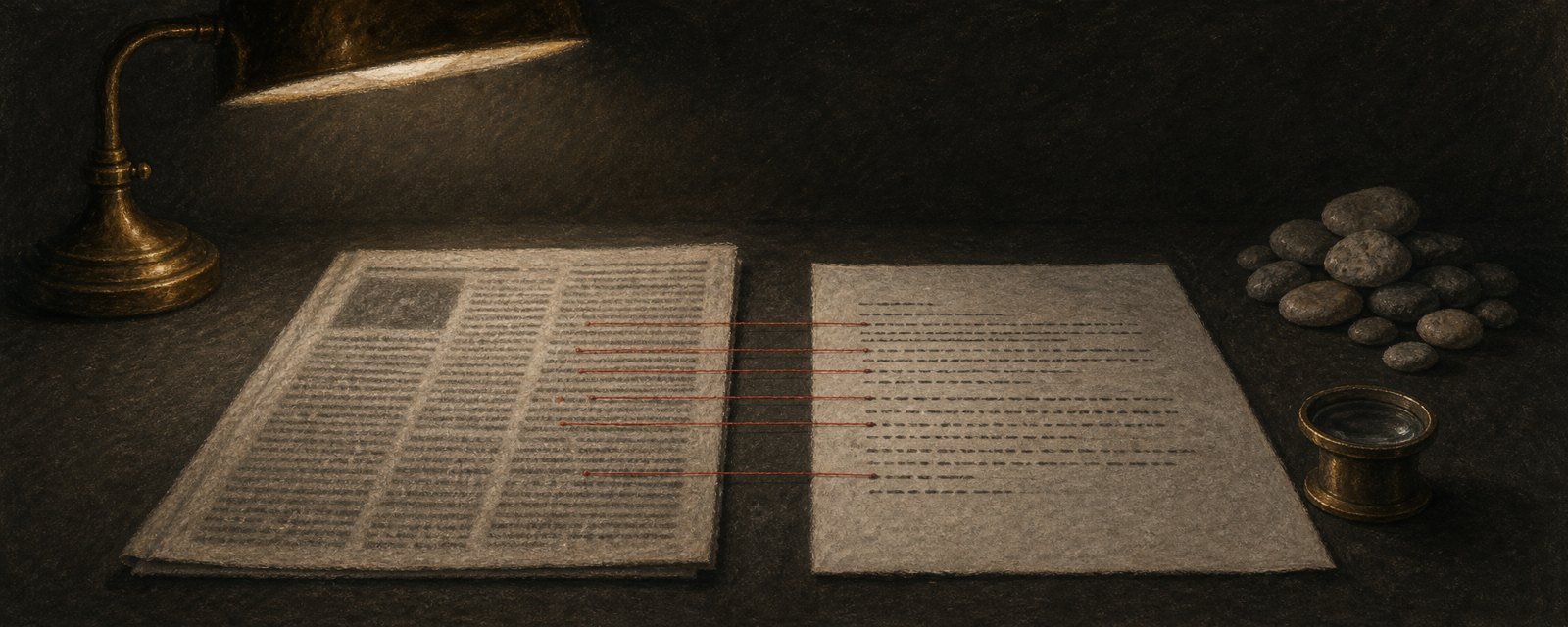
On 3 November 2026, Advocate General Maciej Szpunar advised the EU Court of Justice that answers produced by Google's AI, Gemini, from news articles may infringe the rights of press publishers. The case was brought by Like Company, a Hungarian publisher, against Google, and carries the number C-250/25. When an AI chatbot answers from news articles, does the rights problem arise at training or at the answer? The Advocate General located possible infringement at the answer, and only where an article's expression stays recognisable. Answers that pass on bare facts, and training itself, were placed outside the press publishers' right.
01The Advocate General drew the line at Gemini's answers, not its training
Szpunar's opinion puts the line in a specific place. An Advocate General is a member of the EU Court of Justice who, before judgment, sets out for the judges how he thinks a case should be decided. Szpunar placed the stage at which an AI model learns from articles outside the press publishers' right. What may infringe, in his view, is an answer that reproduces an article's expression in a way a reader can recognise.
This is an opinion, not a judgment. The judges are not bound by it and can reach a different result. According to AFP, a ruling is expected in around six months.
The opinion's test concerns Google's responsibility, but it still gives people who use AI answers at work a clue about where to look. A user has no way of checking what Gemini read when it was trained. A user can check, with their own eyes, whether an answer still carries the wording of a news article. In my view that is what the opinion means in practice: its test turns on something the user can actually see.
02The right protects an article's wording, not the facts it reports
What the press publishers' right protects is the way a journalist put the story into words. The right comes from Article 15 of the EU's 2019 copyright directive, usually called the DSM Directive. It lets newspaper and magazine publishers decide whether their articles may be used online by others.
Article 15 also lists, in its own text, what it does not cover. Private or non-commercial use by individual users is excluded. So is hyperlinking. The right does not apply to the use of individual words or very short extracts of a press publication.
The opinion follows the same line. AFP reports that Szpunar said the publisher's right does not protect the mere facts reported, but only the specific form of expression. The IPKat, a British intellectual property blog, describes his test as whether the reproduction is systematically recognisable. The question is whether someone reading the answer could see the article's own writing in it.
Take the magnitude of an earthquake on a given day. That number is a fact. Whichever newspaper reports it, the fact does not become the publisher's property. What could touch the publisher's right is the reporter's own sentences about that earthquake turning up, intact, inside a chatbot's answer.
03Article 15 targets the service provider; private use by individuals is exempt
If an answer does carry an article's wording, who answers for it? Article 15 is aimed at providers of online services. In this case that provider is Google, which offers Gemini.
The IPKat summarises the opinion as holding that a chatbot provider is responsible for its own acts. When Gemini writes an answer and shows it on screen, that is Google acting. A person who asks Gemini a question and reads the reply privately falls outside the right.
One situation is missing from the opinion. An employee may copy a Gemini answer into a press release, a research report or an internal briefing. Article 15 deals with a service provider's online use of press content. Copying an answer into a company's own documents is a different act, and the opinion does not address it.
My own view is that such copying would be a question for a different provision, the one on the right to make copies. That is a guess. Neither the opinion nor the reporting on it discusses the point. Anyone who copies AI answers into documents should not read this opinion as a finding that their own copying is permitted.
04Training fell outside because Article 15 covers only online use
The same company, Google, is answerable for the answers but not for the training. The reason lies in the scope of Article 15, which covers online use only. According to the IPKat, Szpunar took the view that training a large language model is not a form of online use. Article 15 therefore does not apply to training.
Training is governed by a different provision of the same directive, Article 4. Article 4 creates an exception for text and data mining, the automated reading and analysis of large amounts of text. Two conditions apply. The works must be lawfully accessible. And the rights holder must not have reserved them, in a machine-readable way, against such use.
| What to look at | Training stage | Answer stage |
|---|---|---|
| Is it online use? | No (Advocate General) | Yes |
| Main provision | Article 4, text and data mining exception | Article 15, press publishers' right |
| Condition for use, or for infringement | Lawful access and no reservation by the rights holder | Recognisable expression, or content obtained past a paywall |
| How the opinion treats it | Advised the Court not to answer here | Accepted possible infringement |
Szpunar advised the Court not to answer the questions about training in this case at all. AFP reports that there is no evidence Like Company's articles were used to train Gemini. Without that evidence, he treated the training questions as hypothetical.
05Possible infringement narrows to two cases, one being content taken past a paywall
With training placed outside Article 15, the infringement question under Article 15 in this case turns on the answers. Resultsense, summarising Reuters' report, says the Advocate General identified two cases. The first is an answer that reuses an article's expression in a recognisable way. The second is where the article was obtained by improperly getting around a paywall.
Resultsense adds that Szpunar did not say every chatbot answer infringes. An answer that passes on facts alone falls into neither case. Very short extracts are excluded by the text of Article 15 from the outset.
The procedural dates can be checked too. A court in Budapest referred the case to the EU Court of Justice on 3 April 2025. According to Hengeler Mueller, the law firm representing Google, the oral hearing took place before the Grand Chamber on 10 March 2026. The Grand Chamber is the formation the Court uses for its weightiest cases, with a larger bench of judges.
The test itself has already drawn questions. The IPKat asks who decides whether an answer is recognisable, and how. The opinion gives no figure for how closely an answer must match an article before it infringes.
06Three issues remain: the answer's wording, a vague test, and training left open
Narrowing infringement to two kinds of answer leaves people who use AI answers with three things to think about: how to check an answer's wording, where the line falls, and what happens to training.
Compare the answer's wording with the source
Possible infringement was limited to answers that reproduce expression, so the user checks the text of the answer.
How close is too close is not settled
No way to measure recognisability was given, and the Advocate General himself asked legislators to clarify it.
Training is unlikely to be decided in this case
There was no evidence the articles were used for training, and the Court was advised not to answer those questions.
The first issue changes what users do at their desks. AFP and Resultsense both report that the Advocate General confined the problem to answers that reproduce expression. Before an answer goes into a document, someone needs to open the source article and set the two texts side by side.
The second issue means users cannot know in advance where the line is. The IPKat questions how the test will work in practice, and Szpunar himself called for legislators to make it clear. Where a passage is doubtful, rewriting it in one's own words is quicker than arguing about it.
The third issue is likely to leave training out of this case altogether. AFP reports that the training questions were treated as hypothetical. Whether training on press content is lawful will be settled in another case, or by new EU legislation.
07The ruling is about six months away, and the Court may not follow the line
Of the three issues, only the first, the wording of answers, is likely to be answered by the judgment. The ruling is expected in about six months. Whether the Grand Chamber adopts Szpunar's line as it stands is not yet known, and the Court does sometimes depart from its Advocates General.
Even a judgment will not end the case. The EU Court of Justice answers only questions about how EU law should be read. The Budapest court will then take that answer and decide, on the facts, whether Gemini's answers copied Like Company's articles. This procedure, in which a national court asks the EU court how to read EU law, is called a preliminary ruling.
Hengeler Mueller described the case as the first in which the EU Court of Justice deals with generative AI and copyright. I expect the judgment's wording to be quoted by courts in other countries and by publishers negotiating with AI companies. That is my expectation, not a reported fact.
Will the Grand Chamber follow the opinion?
The opinion is not binding, and the ruling is expected in about six months.
Companies copying answers into documents
Article 15 is aimed at providers. Copying answers into materials or internal documents is outside this opinion.
Users do not have to wait for the judgment to act. When an AI answer is going into a document, open the source article. If the wording has survived, rewrite it in your own words. Text that restates checked facts in your own words stays outside the press publishers' right on the Advocate General's reading.
- The 3 November 2026 opinion found possible infringement where Gemini's answers recognisably reproduce an article's expression, so users should look at the wording of the answer.
- Article 15 does not reach reported facts, individual words or very short extracts, so restating checked facts in one's own words stays outside this right.
- The Court was advised not to answer the training questions; a ruling is expected in about six months, and if the Court follows that advice, the legality of training data is left to other cases and to legislators.
The Advocate General's answer is that the press publishers' right is engaged at the answer, not at training, and only where an article's expression stays recognisable. Whether the Court will draw the same line is still open. His line concerns Google's responsibility and does not address employees copying answers into documents. Until the Court rules, checking the wording against the source article is the check people who use AI answers at work can make for themselves.
- AFP (via The Post). Google AI chatbot may break press copyright rules: EU legal adviser. 2026-11-04. https://thepost.co.za/technology/big-tech/2026-11-04-google-ai-chatbot-may-break-press-copyright-rules-eu-legal-adviser/ (the opinion, facts not protected, no evidence of training use, timing of the ruling)
- The IPKat. AG Szpunar's Opinion in Like Company is here: a landmark take on several questions facing AI and copyright/related rights. 2026-11-03. https://ipkitten.blogspot.com/2026/11/ag-szpunars-opinion-in-like-company-is.html (training is not online use, provider responsibility, doubts about the recognisability test, call for legislative clarity)
- Resultsense (summary of Reuters). EU court adviser: Gemini answers may breach press rights. 2026-11-04. https://www.resultsense.com/news/2026-11-04-eu-adviser-gemini-press-copyright-like-company/ (the two cases of possible infringement; not every answer infringes)
- EU. Directive (EU) 2019/790, Article 15 Protection of press publications concerning online uses. 2019-04-17. https://www.legislation.gov.uk/eudr/2019/790/article/15 (scope of Article 15; exclusions for private use, hyperlinks, individual words and very short extracts)
- EU. Directive (EU) 2019/790, Article 4 Exception or limitation for text and data mining. 2019-04-17. https://www.legislation.gov.uk/eudr/2019/790/article/4 (text and data mining exception and the rights holder's reservation)
- Hengeler Mueller. Hengeler Mueller represents Google in landmark AI copyright case before CJEU. 2026-03-13. https://hengeler-news.com/en/articles/hengeler-mueller-represents-google-in-landmark-aicopyright-case-before-cjeu (date of the Grand Chamber hearing; first generative AI copyright case)
- Digital Policy Alert. Lawsuit on unauthorised use of press publications in AI chatbot outputs (Like Company v Google Ireland). 2025-04-03. https://digitalpolicyalert.org/change/14798-lawsuit-on-unauthorised-use-of-press-publications-in-ai-chatbot-outputs-like-company-v-google-ireland (referral by the Budapest court, case number C-250/25)