AI & Economy News — 2026-09-20 (Sun)

Source links point to the original outlet. The AI Integrated Analysis is auto-generated from the headlines below only and is not intended to add facts beyond them. Not investment advice.
Overview
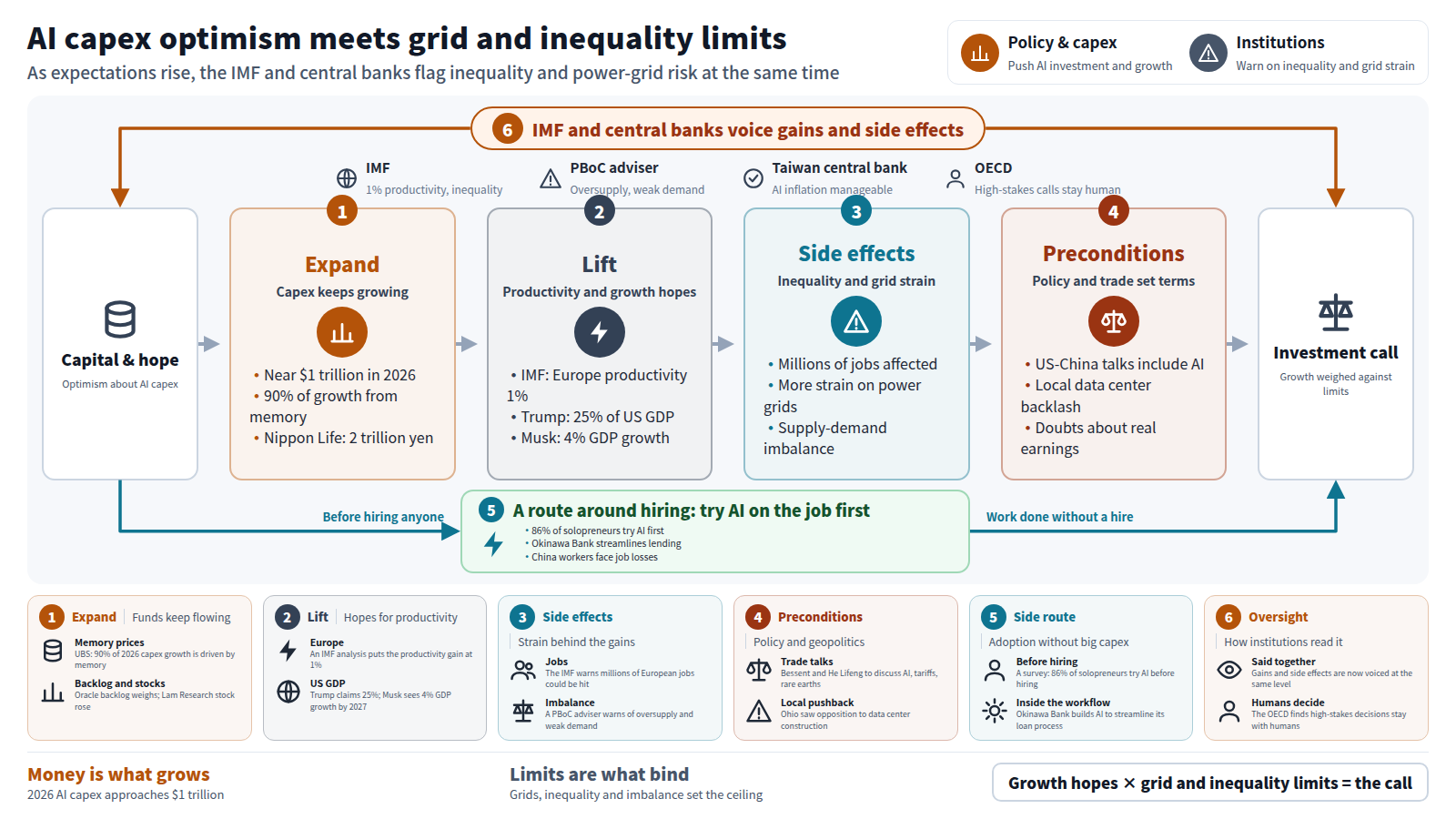
The IMF has warned of the effects of AI in boosting productivity in Europe, along with the risks of widening inequality and straining power grids, and an advisor to the People's Bank of China has expressed concerns about oversupply caused by AI. The Trump administration has created an "AI Force" and set a goal of contributing 25% to GDP, and both optimism and caution regarding the scale of capital investment are increasing at the same time.
Macroeconomic/growth trends
President Trump announced the creation of the AI Force and predicted that AI will account for 25% of US GDP (Seeking Alpha) (New York Post). Musk predicted that AI could increase the US GDP growth rate to 4% (The News International). Meanwhile, the People's Bank of China advisor warned that AI could deepen the imbalance between supply and demand (WTVB), and Taiwan's central bank assessed AI-driven inflation as manageable (focustaiwan.tw). CEPR pointed to the lack of policy debate around the AI bubble and government debt (cepr.net).
Productivity trends
The IMF has told EU finance ministers that while AI will boost productivity in Europe, it could widen inequality and put more strain on power grids (Reuters) (sana.sy). Another IMF analysis found it could boost productivity in Europe by 1%, but deepen inequality and power risks (Tekedia). There are reports that workers in China are facing job loss due to the accelerated introduction of AI (qz.com).
Trends in employment and labor market
The IMF has warned that millions of jobs in Europe could be affected (Sunatimes.com). A survey found that 86% of solopreneurs would try AI before hiring someone (Forbes). Trends in AI-native C-suite human resources are attracting attention (Bessemer Venture Partners). Job losses are said to be increasing in China due to the introduction of AI (qz.com).
Trends in energy/power demand
The IMF has repeatedly pointed out the risk of AI straining the power grid (Reuters) (Tekedia). In Ohio, opposition to data center construction was reported (The Columbus Dispatch). onsemi has positioned the recovery of its SiC business for AI data centers as a growth engine (Dr. Robert Castellano's Semiconductor Deep Dive Newsletter). Khazna and Siemens are developing an 800VDC AI data center (Inspenet).
Remarks by central banks, international organizations, and VIPs
- IMF: Explained to EU finance ministers that while AI will boost productivity, it comes with the risk of widening inequality and increasing stress on power grids (Reuters) (sana.sy). An analysis also showed that productivity would increase by 1% (Tekedia). - Advisor to the People's Bank of China (unnamed): warned that AI could deepen the imbalance between oversupply and insufficient demand (WTVB) (Межа. Новини України.). - Central Bank of Taiwan: Says AI-driven inflation is manageable (focustaiwan.tw). - OECD: Analyzed that companies are using AI agents in their work while maintaining a system in which high-risk decision-making is left to humans (The Policy Edge). - Headlines with direct statements regarding the tracked dignitaries (Lagarde, Ueda, Bailey, Georgieva, Cormann, Banga, Acemoglu, Brynjolfsson) were not observed at this time.
Trends in corporate capital investment
UBS predicts that AI capital investment will approach $1 trillion in 2026, with 90% of growth driven by rising memory prices (finance.biggo.com). Some analysis suggests that Oracle's order backlog will weigh on capital investment, while others view it as a contrarian buy (Seeking Alpha). US media has pointed out that the AI capital investment boom is masking the true state of S&P 500 corporate profits (businessinsider.com). Lam Research's stock price rose after analysts raised their capital investment outlook (timothysykes.com). It was reported that Nippon Life Insurance will provide a loan of 2 trillion yen to build AI infrastructure for data hubs in the United States (Nihon Keizai Shimbun).
Trade and industrial policy
The US-China trade team is expected to hold talks in New York on topics such as tariffs, AI, and Iran (The Straits Times). US Treasury Secretary Bessent will reportedly discuss AI and rare earths with China's He Lifeng (NDTV Profit). President Trump announced the creation of an "AI Force" and called concerns about superintelligence a "hoax" (New York Post). Egyptian President Sisi has ordered the expansion of AI, cloud, and 5G networks (Egypt Today).
Integrated analysis: What is happening now
The statements by the IMF and the People's Bank of China's advisors indicate that expectations for AI's productivity effects and concerns about its side effects, such as imbalances in supply and demand and widening disparities, are beginning to be expressed simultaneously at the level of international organizations and authorities. In terms of capital investment, funds continue to expand as shown by UBS's $1 trillion forecast and the actions of Oracle and Lam Research, but BusinessInsider's point suggests that there is growing skepticism about whether the actual profits are commensurate with the scale of investment. The tightening of the power grid (IMF) and regional opposition to the construction of data centers (Columbus Dispatch) reflect a picture in which expanding capital investment is beginning to face constraints from physical infrastructure. On the trade front, the US and China are treating AI as a topic of negotiation along with tariffs and rare earths, and industrial policy and geopolitics are becoming prerequisites for AI investment.
Future points of interest
- How will the IMF's AI analysis for Europe affect future policy discussions on measures to correct inequality and electricity infrastructure investment? - How will the market evaluate the discrepancy between the $1 trillion scale of capital investment in 2026 predicted by UBS and the actual corporate profits pointed out by BusinessInsider? - How will AI, tariffs, and rare earths be linked in the US-China trade talks (Mr. Bessent and Mr. He Lifeng, New York meeting) and whether there will be agreements or points of conflict?
- Trump to form “AI Force”; says AI will make up 25% of U.S. GDP — Seeking Alpha09/19 18:04 UTC
- The AI Bubble and Government Debt: Can Anyone Bring Logic to a Policy Debate? — cepr.net09/19 12:40 UTC
- China central bank adviser says AI could deepen supply-demand imbalance — WTVB09/19 15:37 UTC
- AI-driven inflation manageable: Central bank — focustaiwan.tw09/19 10:01 UTC
- Watch Trump LOSE TOUCH with public opinion on AI and the economy | Roll the Tape — Modern Ghana09/19 12:35 UTC
- IMF: AI could boost European productivity, risks widening inequality and grid strain — sana.sy09/19 17:12 UTC
- IMF tells EU ministers AI could boost growth but increase economic strains — Reuters09/19 12:23 UTC
- AI Made Execution Easier. It Also Changed the Founder’s Most Important Job. — entrepreneur.com09/19 18:32 UTC
- China workers face job losses as AI adoption accelerates — qz.com09/19 10:15 UTC
- IMF warns AI could boost Europe’s productivity while widening inequality and straining power grids — Межа. Новини України.09/19 12:32 UTC
- The turbulent AI era is here. The choices we make now are critical. — Gates Notes09/19 17:22 UTC
- Business Tech News: 86% Of Solopreneurs Try AI Before Hiring — Forbes09/19 19:57 UTC
- Talent trends for the AI-native C-suite — Bessemer Venture Partners09/19 16:06 UTC
- Don't blame AI for the data center backlash in Ohio | Three Thoughts Column — The Columbus Dispatch09/19 13:00 UTC
- Want to land more job interviews? Stop letting AI write your résumé. — MarketWatch09/19 15:20 UTC
- In Case You Missed It: A.I./Data Center Articles - NewClips From Last Week - September 21 — PA Environment Digest Blog09/19 17:39 UTC
- onsemi’s SiC Rebound Shows Why AI Data Centers Are Its Next Growth Engine — Dr. Robert Castellano's Semiconductor Deep Dive Newsletter09/19 14:46 UTC
- How to Earn $600 a Month From the Pipeline Stocks Powering AI Data Centers — The Globe and Mail09/19 20:59 UTC
- Why this Ann Arbor tech firm changed names as makes big bet on AI data centers — MLive.com09/19 11:30 UTC
- Khazna and Siemens prepare AI data centers with 800 VDC — Inspenet09/19 12:38 UTC
- US, China trade teams set to huddle in New York on tariffs, AI and Iran — The Straits Times09/19 13:51 UTC
- Trump announces creation of ‘AI Force’ — and calls fears of artificial superintelligence a ‘hoax’ — New York Post09/19 18:17 UTC
- President Sisi instructs expansion of AI, cloud computing, 5G networks — Egypt Today09/19 12:04 UTC
- China 2M robot boom reshapes AI race before Trump-Xi summit — Bankingnews09/19 13:39 UTC
- US Treasury Secretary Bessent To Discuss AI, Rare Earths With China's He: Report — NDTV Profit09/19 12:30 UTC
- IMF Warns AI Could Disrupt Millions of European Jobs — Sunatimes.com09/19 17:44 UTC
- Chinese Central Bank Adviser Warns AI Could Deepen Weak Demand and Oversupply | Ukraine news - #Mezha — Межа. Новини України.09/19 12:34 UTC
- IMF Says AI Could Lift Europe’s Productivity 1% But Deepen Inequality and Energy Strain — Tekedia09/19 15:56 UTC
- OECD: Companies Are Putting AI Agents to Work but Keeping High-Stakes Decisions Human — The Policy Edge09/19 18:19 UTC
- IMF paper says EU AI gains could lift productivity while raising inequality and energy risks — Traders Union09/19 11:39 UTC
- Oracle: Backlog Burden Implies More Capex Pains - Contrarian AI Buy Thesis (NYSE:ORCL) — Seeking Alpha09/19 18:21 UTC
- The AI capex boom masks an uncomfortable truth about S&P 500 earnings — businessinsider.com09/19 09:30 UTC
- Lam Research Stock Rises as Analysts Lift AI Capex Outlook — timothysykes.com09/19 14:06 UTC
- UBS: 2026 AI Capital Expenditure to Approach $1 Trillion, 90% of Growth Driven by Memory Price Surge — finance.biggo.com09/19 09:25 UTC
- Elon Musk’s 2027 AI forecast: US GDP growth could hit 4% — The News International09/19 10:38 UTC
- Nissei provides 2 trillion yen for data base, loans in US, builds AI infrastructure, Japanese companies provide funding — 日本経済新聞09/19 17:00 UTC
- Citi expects hawkish Fed to slow non-AI economy — Investing.com - FX | 株式市場 | ファイナンス | 金融ニュース09/19 19:46 UTC
- Okinawa Bank develops AI system infrastructure to streamline loan process — nikkinonline.com09/19 19:45 UTC
- U.S. and China clash over AI military use; U.S. administration promotes "acceleration strategy"; China also develops AI for economic growth — 西日本新聞me09/19 21:00 UTC
- Google's AI "Gemini" cyberattacks on other companies during exams US report [Age of AI] — asahi.com09/19 13:30 UTC

👥 Watchlist
Overview
Ahead of the US-China summit, talks over AI, tariffs, and rare earths are in focus (Reuters, CNBC). The relationship between the bursting of the AI bubble and interest rate hikes has become a major theme in Japanese media coverage (Nihon Keizai Shimbun, Mainichi Shimbun), and huge investments in electricity infrastructure are proceeding in parallel.
Macroeconomic/growth trends
While some analyzes suggest that AI could change the "speed limit" on economic growth (AFR), it is noteworthy that AI investment continues to expand as the Fed resumes interest rate hikes (BigGo Finance, news.futunn.com). The Nihon Keizai Shimbun points out the possibility that the AI bubble will end due to a ``cross of death'' where interest rate hikes and diminishing returns overlap (Nihon Keizai Shimbun). In the United States, there are reports of a conflict between those who want to strengthen AI regulations and those who are wary of the collapse of the bubble (Mainichi Shimbun).
Productivity trends
McKinsey reports that 30% of companies that introduced agent-based AI experienced a drop in productivity (The Times of India). In Australia, a disconnect was pointed out between the finance minister's hopes for "heroic" AI productivity improvements and the Fed's interest rate hikes (AFR). There are also reports that in Malaysia, workers are ahead of employers in introducing AI (The Vibes).
Trends in employment and labor market
Analysis (ndtvprofit.com) shows that adoption in the tech industry is being suppressed, even though the adoption rate remains at 20% in four countries. In South Korea, job seekers are said to be rushing to AI boot camps (Korea JoongAng Daily). Anthropic CEO called for stronger AI regulation (ABC News).
Trends in energy/power demand
Nvidia announces partnership to increase power flexibility for AI data centers (Yahoo Finance). Bloom Energy reportedly raised $25 billion for data center power (Dealroom). EVE Energy enters the AI data center market by signing a large 206GWh energy storage contract via Fluence (BigGo Finance). Debate continues in North Carolina over AI and data center regulations (thegazette.com).
Remarks by central banks, international organizations, and VIPs
- Direct statements by the tracked persons (Christine Lagarde, Kazuo Ueda, Andrew Bailey, Kristalina Georgieva, Mathias Cormann, Ajay Banga, Daron Acemoglu, Erik Brynjolfsson) cannot be found in the headings of this list. - The Mainichi Shimbun correspondent's column reported that the Fed chairman's "personal opinion" drew attention in relation to AI and interest rate cuts, but the individual name of the chairman and details of what he said were not listed in the headline.
Trends in corporate capital investment
A comparison of AI-related capital investment and cash flow between Microsoft and Amazon was reported (techi.com). Micron stock is reported to have fallen due to concerns about a slowdown in AI demand (equiti.com). An analysis of the next high-growth field that will generate "10x stocks" related to AI was published in Chinese media (36Kr). Some commentators argue that it will be difficult to slow down AI investment amidst geopolitical competition (tbsnews.net).
Trade and industrial policy
US Treasury Secretary Bessent and China's He Lifeng will hold talks over AI, trade and critical minerals, Reuters reported (Reuters, CNBC). Tariffs, rare earths, and AI regulations are said to be the focus of the Washington meeting between President Trump and President Xi Jinping (ThePrint). The talks will focus on $30 billion worth of products and the future of AI (Vietnam.vn). Mr. Trump announced the creation of an "AI Force" and the upcoming appointment of an AI representative (AI czar) (KABB, Asahi Shimbun).
Integrated analysis: What is happening now
Several headlines suggest that AI-related capital investment and power infrastructure investment will continue to expand even amidst the rate hike phase (BigGo Finance, Bloom Energy-related). On the other hand, there are also factors that call into question the impact of investment on the real economy, such as McKinsey's report on productivity decline and Micron's concerns about a slowdown in demand, which is consistent with the deadly intersection theory of ``interest rate hikes and diminishing returns'' pointed out by the Nihon Keizai Shimbun. On the employment front, it has been reported that unemployment among young people is increasing and there is a rush to attend AI boot camps at the same time, and there is a possibility that the polarization of the labor market (the gap between those who have AI utilization skills and those who do not) is progressing. On the trade front, the U.S.-China talks have a framework that deals with AI, tariffs, and rare earths all at once, and it appears that AI policy is being incorporated as part of geopolitical and trade negotiations rather than as a stand-alone technology policy.
Future points of interest
- To what extent will AI regulations and export controls be materialized at the US-China summit? - Will the Fed's continued interest rate hikes and increased bond issuance by AI companies become new risk factors for financial markets (``new pressures'' as pointed out by news.futunn.com)? - Will the productivity decline (30%) pointed out by McKinsey be confirmed by other studies and the debate over the legitimacy of AI investment will expand?
- ‘There is something you can do’: How to slow down AI without crashing the economy — The Boston Globe09/20 00:01 UTC
- Trump announces he is forming 'AI Force,' will name 'AI czar' soon — KABB09/19 21:10 UTC
- AI could change the speed limit of economic growth — AFR09/19 23:00 UTC
- Weekly Market Wrap: Nvidia revived the AI trade, but inflation put rate hikes back in focus — Mitrade09/20 03:07 UTC
- Trump Wants an AI Force and a Czar Who Meets One Key Bar — CryptoRank09/20 08:25 UTC
- Productivity decline in 30% of companies using agentic AI: McKinsey report — The Times of India09/20 06:37 UTC
- AI Office: The First "Down Payment" for Self-Funded Salaried Employees in Modern Workplaces — 36Kr09/20 03:23 UTC
- Malaysian workers race ahead of employers in AI adoption — The Vibes09/20 05:40 UTC
- Fed’s rate rise shows up Chalmers’ ‘heroic’ belief in AI productivity — AFR09/19 23:03 UTC
- Warning for brain health over offloading deep-thinking skills to AI — ABC News & Headlines – Australian Broadcasting Corporation09/20 00:15 UTC
- ERICKSON: Against AI regulatory capture — heraldextra.com09/20 04:47 UTC
- More than 1m young people are out of work, and AI is about to wipe out millions more jobs. What should we do? — The Independent09/20 07:19 UTC
- AI’s Hiring Freeze? Why 20% Adoption In Just Four Nations Is Dragging Tech Headcount — ndtvprofit.com09/20 05:03 UTC
- Cramming in some extra coding: Job seekers turn to AI boot camps as hiring gets tougher — Korea JoongAng Daily09/19 22:03 UTC
- Exclusive: Anthropic CEO calls for stronger regulation of AI — ABC News - Breaking News, Latest News and Videos09/20 00:21 UTC
- Nvidia (NVDA) Forms Alliance To Build A Power Flexible AI Data Center — Yahoo Finance09/19 23:09 UTC
- Bloom Energy lines up $25B to power AI data centers — Dealroom09/19 23:14 UTC
- Guardrails or global race? NC in focus as AI faces crossroads — thegazette.com09/19 22:03 UTC
- Videos - Data Center Insights — Low-Carbon Power for the AI Boom — JD Supra09/20 04:38 UTC
- EVE Energy Signs 206GWh Energy Storage Megadeal, Gaining Entry to AI Data Center Market via Fluence — finance.biggo.com09/20 03:36 UTC
- U.S. Treasury's Bessent, China's He to hold talks on AI, trade, critical minerals: Reuters — cnbc.com09/20 06:17 UTC
- US, China set for talks on AI, tariffs and critical minerals ahead of summit — Investing.com09/20 06:44 UTC
- The U.S. and China to discuss artificial intelligence, tariffs, and critical minerals — 1News.az09/20 08:28 UTC
- Trump, Xi set for pivotal Washington talks; tariffs, rare earths and AI controls in focus — ThePrint09/20 04:51 UTC
- $30 billion worth of goods and the future of AI are anticipated at the US-China summit. — Vietnam.vn09/20 08:00 UTC
- IMF: AI Could Boost EU Growth But Increase Economic Strains — ASHARQ AL-AWSAT English09/20 07:02 UTC
- AI Investment Expands Despite Rate Hikes—Repayment Capacity 'Sorting' Begins in Earnest — finance.biggo.com09/20 02:05 UTC
- Canadian AI pioneer warns of human extinction threat — Yeni Safak English09/20 07:15 UTC
- The Federal Reserve has resumed interest rate hikes, but corporate bonds may not repeat the 2022 scenario. The true new pressure stems from the surge in debt issuance by AI giants. — news.futunn.com09/20 03:24 UTC
- Weekend Crypto Reset: Bitcoin Retakes $80K as VOIDTRACE AI Tracks the Next Rotation Across Ethereum, Solana and XRP — StreetInsider09/20 05:48 UTC
- Microsoft vs. Amazon stock: AI spending and cash flow — techi.com09/20 07:05 UTC
- CapEx per share of 1 Finanx AI Technologies, Inc. – OTC:FUXAD — TradingView09/20 00:02 UTC
- Micron Stock Falls as AI Slowdown Debate Tests Memory Demand Outlook — equiti.com09/20 04:14 UTC
- The Next High-Growth Track Set to Spawn 10-Bagger Stocks: Who Is Actually Making Real Money from AI? — 36Kr09/20 05:33 UTC
- AI is too big to slow in a geopolitical race — tbsnews.net09/20 05:21 UTC
- Economic plus: AI regulation theory in the US is cracking. Should we be more wary of the bursting of the "bubble" than competition with China? — 毎日新聞09/20 02:00 UTC
- Correspondent's eyes>Is AI a factor in lowering interest rates? Shadows flickering over the FRB chairman's "personal opinion" = Daiki Asakawa (Mainichi Shimbun) — Yahoo!ニュース09/20 07:00 UTC
- This is how the AI bubble will end: High interest rates and diminishing returns “death intersection” — nikkei.com09/20 02:00 UTC
- Trump ``Creates AI Force'', emphasizes superiority over China ahead of summit [US midterm elections] [Trump's return] [AI era] — 朝日新聞09/19 22:30 UTC
- AI investment expands despite interest rate hikes... "Selection" regarding repayment ability is in full swing — BigGo ファイナンス09/20 02:05 UTC