
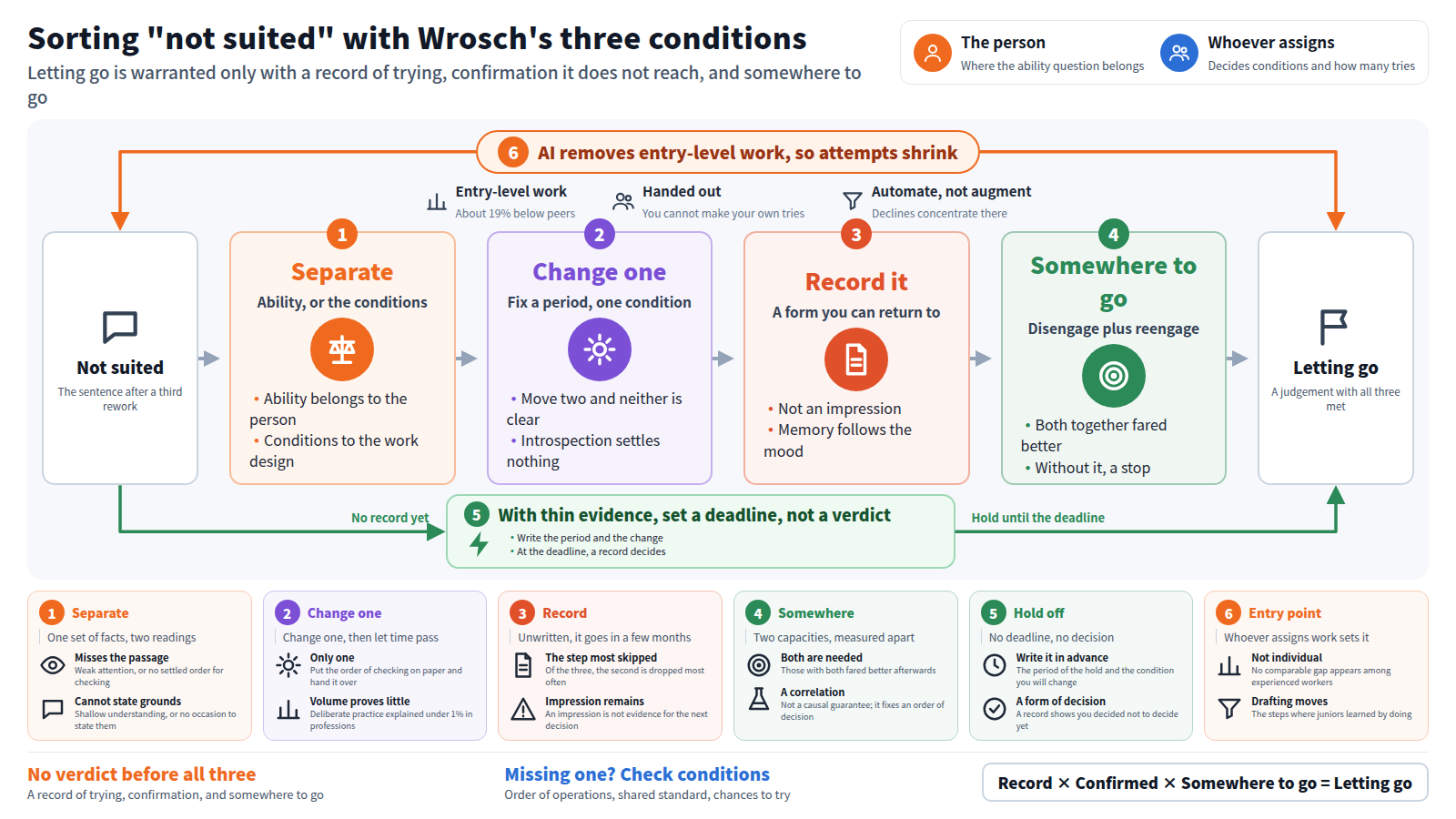
A draft written with generative AI comes back for a third round of rework on the same step, and the sentence arrives: I am not suited to this work. When is that judgement legitimate? When you have a record of trying under changed conditions, evidence that it still does not reach, and somewhere to move next. Before those three, the judgement has not separated ability from conditions.
01"I am not suited" is used without separating talent from conditions
Take the answer first. The conditions under which letting go is warranted come to three. That it has been confirmed the work does not reach. That there is a record of having tried under changed conditions. And that there is somewhere to go. Without the second, you cannot say you confirmed that it does not reach. Without the third, nothing is left on the far side of letting go.
A verdict delivered before those three are in place does not necessarily point at the limits of ability. What it points at may be how the work is set up. No settled order of operations. No shared standard. No occasion to be taught. From the inside, conditions like these register as a shortfall in ability. The difficulty is not that the person is dull; it is that from the inside the two look identical.
So when the sentence is spoken — by a colleague or by you — the first move is neither to deny it nor to accept it. It is to count which of the three is missing. What follows looks at what the phrase fuses together, how it shows up in the work, why people reach a verdict early, what to decide on instead, and the change now underway.
02The phrase fuses two different judgements into one
To claim that the phrase is used without separating talent from conditions, its contents have to be separated. "I am not suited" holds two judgements at once: that ability does not reach, and that the present conditions do not fit. The first belongs to the person. The second belongs to the design of the work. Different owners mean different people can move them.
Spoken without separating them, things that could be changed get treated as fixed. Once a question about conditions is restated as a question about ability, the available moves disappear. Reset the order of operations. Write the standard down. Increase how often someone is taught. All of these sit on the side of conditions, and none requires the person to become someone else.
Looking only at conditions is not accurate either. There are areas that do not come within reach however many conditions you change. Wrzesniewski and Dutton described how people reshape the boundaries and relationships of their own jobs, but the room to reshape is not unlimited. So separating the two is not about settling on one; it is about seeing whether any untried move is left.
03The same confusion shows up in promotional material review
From the inside, ability and conditions look alike. In the actual work the overlap takes more specific shapes. Unable to state the grounds for an objection in their own words. Missing the same passage repeatedly. Sending something back for a different reason each time. Every one of those reads as a reviewer whose judgement is not strong enough. Every one also reads as a shortfall in procedure and instruction.
| What is visible | Read as a problem of ability | Read as a problem of conditions |
|---|---|---|
| Misses the same passage | Attention is not strong enough | No settled order for checking |
| Cannot state the grounds | Understanding is shallow | No occasion to state grounds |
| Different reason each time | Judgement is unstable | The standard is not shared |
Neither reading contradicts what was observed. Because neither contradicts it, the outcome is settled by the preconception of whoever is watching. A demanding manager reads the middle column; an attentive one reads the right. The reading differs; the evidence is the same.
The only way to tell them apart is to change one condition. Put the order of checking on paper and hand it over. Require one sentence of grounds with every objection. Share the standard for sending work back before it is applied. Change one of them, let time pass, then look at whether the same behaviour remains. If it remains, the case moves a step toward ability. If it goes, the condition you changed was the one at work. A verdict issued without that move is a verdict with the evidence missing.
04People cannot name their own fit by introspection alone
If they cannot be told apart until a condition changes, why do people reach a verdict first? One reason is that they look for evidence inside their own heads. Ibarra wrote that the effective route to change runs through action rather than analysis, and through learning from experience rather than introspection. What suits you is not the kind of question that sitting still resolves.
The other reason is volume. "I have put in this much and still cannot do it" assumes that the amount of practice determines the result. The meta-analysis by Macnamara and colleagues showed how much that assumption varies by domain. Deliberate practice explained 26% of the variance in performance for games, 21% for music, 18% for sports, 4% for education — and less than 1% for professions.
Reading that figure as "practice is pointless" would be a mistake. What it shows is that in professional work a great deal besides practice volume moves the result. Which tasks you are handed, who teaches you, the procedures of the workplace, the difficulty of the cases you get. All of them sit outside the person. So an argument from volume to fitness is least reliable exactly where professional work lives.
05Let go only when the three conditions are met
If neither introspection nor volume settles it, what does? Wrosch and colleagues measured disengagement from unattainable goals separately from reengagement elsewhere, and reported that people who had both fared better afterwards. Letting go alone is not enough. For those who let go with nowhere to move next, no comparable improvement was reported.
That report is a correlation, not a guarantee that meeting the three produces a good outcome. It is still enough to fix an order of decision. In practice it comes to three steps.
Change exactly one condition
Fix a period, and hold the change to a single condition. Move two at once and you cannot tell which one worked.
Keep the result on record
In a form you can return to, not as an impression. Memory is shaped by the mood it was formed in.
Secure somewhere to go first
Only with both the capacity to disengage and somewhere to reengage does the judgement hold. Releasing without that is not a decision; it is a stop.
The step most often skipped is the second. The feeling of having tried survives; what was changed, by how much, and what followed does not survive a few months unwritten. What is left afterwards is the impression that it did not work. An impression is not evidence for the next decision.
06As AI removes entry-level work, missing conditions look like missing ability
Try, record, secure somewhere to go. A condition is now emerging that makes the first of those harder to satisfy. There are three points here.
First, entry-level work is genuinely shrinking. The Stanford Digital Economy Lab reports that employment among workers aged 22 to 25 in highly AI-exposed occupations stands about 19% below where it would be had it kept pace with similarly aged workers in less-exposed occupations. Since no comparable gap appears among experienced workers, the cause cannot be located in the individual alone. The grounds: individual aptitude is unlikely to have shifted by age band over so short a period.
Second, fewer entry-level tasks means fewer attempts. Since a person cannot manufacture their own chances to try, supplying them becomes the job of whoever assigns the work. Whoever assigns the cases decides how many attempts there are. The same research notes that declines concentrate in occupations where AI is more likely to automate than to augment, which indicates which entry points disappear first. The steps where generative AI takes over the drafting are the same ground on which juniors learned by doing.
Third, too few attempts registers from the inside as too little aptitude. When the evidence is thin, setting a deadline rather than issuing a verdict is the more accurate move. The grounds are the three conditions above. Without a record, you cannot say you confirmed that it does not reach. Issue a verdict you never confirmed, and a question about conditions becomes a statement about fitness.
The young workers' gap is not individual
With no comparable gap among experienced workers, the cause does not sit in the person alone.
Attempts are handed out
A person cannot manufacture chances to try. That falls to whoever assigns the cases.
Thin evidence means holding off
When the evidence is thin, set a deadline instead of issuing a verdict.
07Set the deadline for holding off, and you can check it later
If the number of attempts is falling, what is left to settle is how to hold off well. Write the period of the hold, and the condition you will change during it, on a single page in advance. Three months. Hand over the order of checking on paper. Keep the count and the reasons for work sent back. With those three written down, what decides at the deadline is a record rather than a feeling.
Writing it has a second effect. A hold without a deadline slides into being another word for not deciding. With a deadline, holding off becomes a form of decision, because a record exists showing that you decided not to decide yet.
What is unsettled should be stated. How far the three conditions can be met in an environment with fewer attempts available is not yet known. The employment figure is a relative level, not evidence about whether any individual fits a job. The Wrosch report is a correlation, not a causal claim. What is certain is narrow: a verdict of "not suited" issued before the three are in place cannot rule out that what it is looking at is the setup of the work rather than the person.
- Wrosch and colleagues reported that people who had both the capacity to disengage from an unreachable goal and the capacity to reengage elsewhere fared better afterwards. Letting go alone is not enough.
- In the meta-analysis by Macnamara and colleagues, deliberate practice explained less than 1% of performance variance in professions. Volume cannot settle a question of fit.
- Employment among workers aged 22 to 25 in highly AI-exposed occupations sits about 19% below where it would have been had it kept pace with their less-exposed peers, with no comparable gap among experienced workers. The gap concentrates at the entry point.
The judgement that you are not suited is legitimate only when there is a record of trying under changed conditions, confirmation that it still does not reach, and somewhere to go next.
A sentence spoken before those three are in place does not necessarily point at the person: an order of operations never settled, a standard never shared, too few chances to try. It points at how the work is set up.
So the response is fixed. Neither deny it nor accept it. Ask, in order, when a condition was last changed, what happened when it was, and whether a record survives. If none of the three produces an answer, that person is not yet standing anywhere a verdict can be issued from.
- Carsten Wrosch, Michael F. Scheier, Charles S. Carver, Richard Schulz. Adaptive Self-Regulation of Unattainable Goals: Goal Disengagement, Goal Reengagement, and Subjective Well-Being. Personality and Social Psychology Bulletin, December 2003. journals.sagepub.com(Disengagement from unattainable goals paired with reengagement elsewhere)
- Brooke N. Macnamara, David Z. Hambrick, Frederick L. Oswald. Deliberate Practice and Performance in Music, Games, Sports, Education, and Professions: A Meta-Analysis. Psychological Science, July 2014. journals.sagepub.com(Variance explained by deliberate practice: 26% games, 21% music, 18% sports, 4% education, under 1% professions)
- Herminia Ibarra. Working Identity: Unconventional Strategies for Reinventing Your Career. Harvard Business Review Press. herminiaibarra.com(Change comes through action rather than analysis, and experience rather than introspection)
- Amy Wrzesniewski, Jane E. Dutton. Crafting a Job: Revisioning Employees as Active Crafters of Their Work. Academy of Management Review, April 2001. journals.aom.org(People reshape the cognitive, task and relational boundaries of their own jobs)
- Stanford Digital Economy Lab. No Widespread Displacement, but the AI Employment Gap for Young Workers Has Widened to 19%. 12 August 2026. digitaleconomy.stanford.edu(Employment for workers aged 22–25 in highly AI-exposed occupations about 19% below less-exposed peers)
- Stanford Digital Economy Lab. Canaries in the Coal Mine? Six Facts about the Recent Employment Effects of Artificial Intelligence. August 2026. digitaleconomy.stanford.edu(Declines concentrate where AI is more likely to automate than to augment)