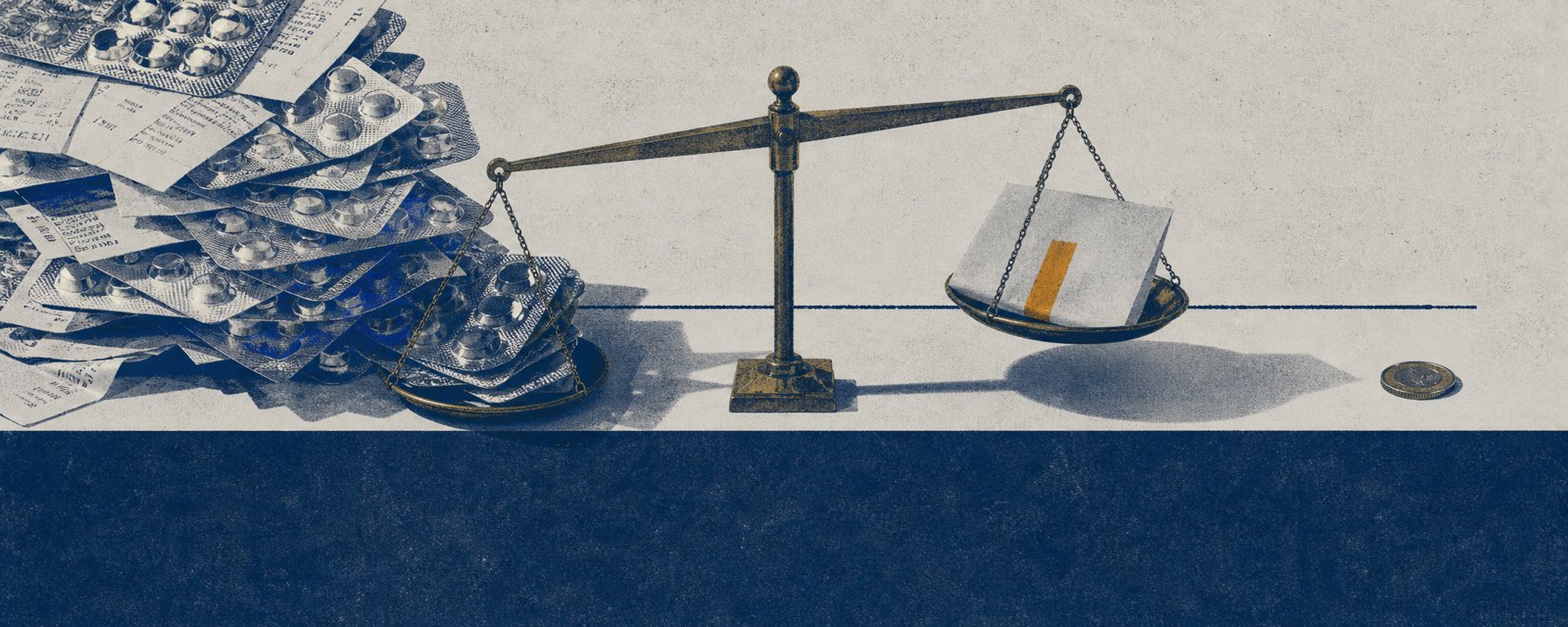
Quit the job, or shut down the generative AI pilot? The economist Steven Levitt asked people stuck on major life decisions, such as whether to quit a job, to flip a coin, then followed what happened to them. Those who made a change reported being happier six months later. How does the courage to end something differ from the courage to begin? Ending differs from beginning because it means giving up what you have already paid and the state you are in. Both pull judgement toward carrying on, so the call to stop is best made against a standard set on the day you start.
01Ending weighs more because it gives up past costs and the present state
Ending is a heavier decision than beginning because there are two things to let go of. One is the money, time and effort already spent. The other is the present shape of one's life or work. A decision to begin carries neither.
Both weights have been measured, in psychology and in economics. A 1985 study using theatre season tickets showed that money already paid pulls people toward carrying on. A 1988 study showed that people keep choosing the state they are already in.
These weights are not confined to private life. A team that has brought generative AI into the workplace on trial will sooner or later face the day it decides whether to continue or stop. My view is that the standard for stopping should be written down on the day the trial begins. Once things are under way, both weights pull judgement toward carrying on.
02Theatre-goers who paid more for season tickets went to more plays over six months
Take the first weight, money already spent. In 1985 the psychologists Hal Arkes and Catherine Blumer gave it a name, the sunk cost effect: once money, effort or time has been invested in something, people show a greater tendency to keep going with it.
A sunk cost is one that has been paid and cannot be recovered. Since it is gone whether you stop or continue, it has no proper bearing on what to do next. People are pulled by it all the same.
Arkes and Blumer tested the effect with theatre season tickets. Customers who had paid a higher price for their tickets went to more plays over the following six months.
The second box in the figure is the one to look at. The moment the money was paid, it was settled that it would not come back. Even so, the customers who had paid more kept turning up at the theatre more often.
03AI pilots face the same call: Gartner expected 30% to be dropped after proof of concept
Decisions pulled by past spending do not happen only in theatre seats. In many workplaces, whether to continue a generative AI trial has become an everyday decision. The stage at which an organisation tries something on a small scale, before full rollout, to see whether it works is called a proof of concept. The research firm Gartner forecast how many projects would be dropped after that stage.
Generative AI projects
In July 2024, Gartner forecast that at least 30% would be abandoned after proof of concept. The reasons given were data quality, risk controls, cost and unclear value.
Agentic AI projects
In June 2025, Gartner forecast that more than 40% would be cancelled by the end of 2027. The reasons given were rising costs and unclear value.
Both figures are forecasts, not counts of projects actually abandoned. Still, they show an expectation that many workplaces that start a trial will reach the day of deciding whether to stop.
A trial costs effort to prepare data, staff time and contract fees. By the day a decision to stop is on the table, all of that has been spent. The same force that pulled the theatre customers can pull this decision too.
04People keep the current state far more often than standard models predict
Past spending is not the only thing that makes a trial hard to end. The second weight lies in the present state itself. In 1988 the economists William Samuelson and Richard Zeckhauser described it as status quo bias.
In a series of experiments they found that people stick with the status quo disproportionately. They also looked at records from outside the laboratory: how university faculty chose their health plans and retirement plans, and how rarely they changed those choices.
A decision to end something removes the default option. A decision to begin leaves the present state in place and adds one new thing. If the default is chosen disproportionately, a decision that removes it has to work against that bias, and is heavier by that much.
The two weights were measured in separate studies. No single study has shown that both act at the same moment in the same decision. Still, both pull judgement the same way, toward carrying on.
05Those who changed course after the coin toss reported more happiness six months later
If people keep the state they are in, the natural next question concerns those who changed anyway. Levitt's study looked at exactly that, in a form that can be counted. Levitt, an economist at the University of Chicago, published the paper in 2016 through the National Bureau of Economic Research (NBER) in the United States.
The participants were people struggling with a major life decision, such as whether to quit a job or end a relationship. They flipped a coin on a website, and heads or tails gave them a nudge toward changing or staying.
Those whose coin came up "change" were more likely to actually make the change. And those who made a change reported being substantially happier two months later and again six months later. A coin toss is decided by chance. Because chance splits people into those nudged toward changing and those who were not, the effect of changing itself becomes easier to see.
The study was later published in the economics journal Review of Economic Studies. But the participants were people who volunteered for the study, and their happiness was what they reported themselves. That limit has to stay in view when reading the result.
06Write down the standard for stopping on the day you begin
From the research so far, three things follow for deciding when to stop.
Leave out what is paid
Keep unrecoverable costs out of the decision and compare only future costs and future benefits.
Carrying on is a choice
Put the option of continuing in the same table as the option of stopping, and compare them.
Set the standard first
On the day you begin, write down a deadline and the number needed to continue.
The ground for the first card is the theatre study. Arkes and Blumer read the higher attendance of those who paid more as unrecoverable cost entering the decision. Taking the amount paid out of the decision weakens that pull.
The ground for the second is status quo bias. The present state gets chosen too often. Treating the option of continuing as "doing nothing" tilts the decision toward it before any comparison begins. The option of continuing should carry its own future costs, written in.
The ground for the third is that both weights grow after you start. On the first day, little has been spent and the present arrangement is still new. Since the theatre customers who had paid more were pulled harder toward carrying on, the weight of past spending is larger once costs have piled up. Among the reasons Gartner gave for abandoned projects were cost and unclear value. Start without a measure of value, and there will be nothing to decide by when the day to stop arrives.
Following the steps in the figure makes it harder for past spending to enter the decision on the deadline. For a generative AI trial, that means writing on the first day something like: "If staff time has not fallen by the agreed amount by the deadline, we stop." For a personal decision the content is the same: a date and a number.
07A 2021 replication found no escalation of commitment
The three conclusions about writing the standard on day one rest on research, and that research has limits. It helps to separate, study by study, what was found from what cannot be said.
In 1976 the organisational researcher Barry Staw showed in an experiment that people put more resources into a course of action after it had failed. The result came to be treated as an extreme form of the pull of past spending. Yet a 2021 replication found no evidence of escalation among its 365 participants. Another replication produced mixed results.
| Study | Question examined | Finding | Limits |
|---|---|---|---|
| Arkes and Blumer (1985) | Money paid and the tendency to continue | Those who paid more attended more plays | Whether the effect is equally strong everywhere |
| Samuelson and Zeckhauser (1988) | Experiments and health and pension choices | The status quo is chosen disproportionately | Whether not changing is a loss |
| Levitt (2016-2021) | Later lives of people who used a coin to decide | Those who changed reported more happiness at six months | Whether it applies to people who did not volunteer |
| Replication of Staw (1976), 2021 | Adding resources after failure | Not replicated with 365 people | That the tendency never exists |
Levitt's result has limits too, as the right-hand column shows. The participants volunteered, and their happiness was self-reported. Whether the same would hold for people who never signed up is unknown. So the study does not show that quitting makes people happy.
What has been established is that, in the settings studied, such as theatre tickets and health and pension choices, money already paid and the present state pulled judgement toward carrying on, and no more. In my view that alone is reason enough to write the standard down first. Once the standard is on paper, the pull may still act, but the basis for the decision becomes harder to shift after the fact.
- Customers who paid more went to more plays, showing that unrecoverable costs pull judgement toward carrying on. Only future costs and benefits belong in the decision.
- People keep the current state more than models predict. That is where the weight of ending comes from, so carrying on should be listed and compared as one option.
- Gartner expected at least 30% of generative AI projects to be dropped after proof of concept. At work or at home, the standard for stopping can be written down, with a date and a number, on the day you start.
The courage to end differs from the courage to begin because it must let go of two weights that beginning never carries: what has been paid and the state you are in. At least the weight of past spending grows as more is paid after you start. Writing the standard for stopping on the first day means the decision on the deadline is made by that standard rather than by what has been paid.
- THE Journal (reporting Gartner). Gartner: 30% of Gen AI Projects Will Be Abandoned. 2024-08-06. https://thejournal.com/articles/2024/08/06/gartner-30-of-gen-ai-projects-will-be-abandoned.aspx (forecast that at least 30% of generative AI projects will be abandoned after proof of concept, and the reasons)
- The Star (Reuters). Over 40% of agentic AI projects will be scrapped by 2027, Gartner says. 2025-06-25. https://www.thestar.com.my/tech/tech-news/2025/06/25/over-40-of-agentic-ai-projects-will-be-scrapped-by-2027-gartner-says (forecast that more than 40% of agentic AI projects will be cancelled by the end of 2027, and the reasons)
- Hal R. Arkes, Catherine Blumer. The psychology of sunk cost. Organizational Behavior and Human Decision Processes 35(1). 1985. https://doi.org/10.1016/0749-5978(85)90049-4 (definition of the sunk cost effect; theatre season ticket result)
- William Samuelson, Richard Zeckhauser. Status quo bias in decision making. Journal of Risk and Uncertainty 1(1). 1988. https://ideas.repec.org/a/kap/jrisku/v1y1988i1p7-59.html (disproportionate adherence to the status quo; faculty health plan and retirement choices)
- Steven D. Levitt. Heads or Tails: The Impact of a Coin Toss on Major Life Decisions and Subsequent Happiness. NBER Working Paper 22487. 2016. https://www.nber.org/papers/w22487 (coin outcome raised the rate of change; those who changed reported being happier at two and six months; later published in the Review of Economic Studies)
- FORRT Replication Atlas. Replication record for Staw (1976), "Knee-deep in the big muddy". https://forrt.org/flora-replication-atlas/doi/10.1016/0030-5073(76)90005-2/ (2021 replication found no escalation among 365 participants; another replication was mixed)