AI, Economy & Finance News — 2026-09-22 (Tue)
Source links point to the original outlet. The AI Integrated Analysis is auto-generated from the headlines below only and is not intended to add facts beyond them. Not investment advice.
Today's AI Integrated Analysis is being prepared and will be published shortly.
- When AI is part of the inflation problem — Axios09/21 16:02 UTC
- Kevin Mahn's 'Air 7' AI stock picks, Neel Kashkari's inflation warnings and Fed rate decisions — Fox Business09/21 14:14 UTC
- IDB Report: AI May Grow Latin America GDP 5.1%, Wages Risk 20.9% Drop - News and Statistics — IndexBox09/21 19:10 UTC
- ETF Investors Should Watch As AI Inflation Alarms Fed - State Street Utilities Select Sector SPDR ETF (AR — Benzinga09/21 15:54 UTC
- IBM Study: AI May Be Eroding the Very Skills Employers Need Most — Virtualization Review09/21 18:21 UTC
- New accountability concerns emerge with increased AI use — The Business Journals09/21 16:08 UTC
- AI could boost LatAm, Caribbean economy 5.1% but wages may fall, IDB says — Charlotte Observer09/21 18:19 UTC
- AI Workplace Legislation: State Laws on Employee Monitoring & Hiring — MultiState09/21 19:19 UTC
- AI in Healthcare: Innovation, Workforce Transformation + the Path Forward — Jackson Lewis09/21 17:26 UTC
- AI Job Fears Grow, Tech Leaders Say Reskilling Can’t Wait — WSJ09/21 19:18 UTC
- COMMENTARY: These workers say an AI hiring platform discriminated against them. But who should pay? — Reuters09/21 10:07 UTC
- Facial Recognition and AI in Hiring: A Reminder for Maryland Employers — The National Law Review09/21 16:49 UTC
- California tightens rules on AI data center energy and water use — The Verge09/21 20:29 UTC
- AI’s data center boom comes with a cost — Supply Chain Management Review09/21 14:49 UTC
- Artificial intelligence data centers could reach one percent of global electricity demand by 2030 — Nature09/21 11:04 UTC
- UPS, BESS, and Generators Are Not Interchangeable: The Three-Layer Power Architecture of an AI Data Center — Microgrid Knowledge09/21 20:21 UTC
- Europe’s AI race has a new bottleneck: electricity — 150sec.com09/21 20:07 UTC
- Automotive Inbound Logistics Survey 2026: AI, tariffs and cost pressures reshape supply chains — Automotive Logistics09/21 20:21 UTC
- Trump-Xi White House summit: AI, tariffs, and minerals on agenda — qz.com09/21 13:07 UTC
- China and the US are Competing for AI Dominance but Have Shared Concerns Over Safety — Broadband Breakfast09/21 13:14 UTC
- BOE’s Breeden Says Time Running Out to Stop AI Crashing Markets — Bloomberg.com09/21 15:55 UTC
- IMF urges Europe to accelerate AI push as market and labour risks mount — INSIGHT EU MONITORING09/21 10:38 UTC
- Stocktwits Tech Watch: Anthropic's AI Slowdown Row, Salesforce And Snap Events, And A Central Bank Rate Call In Focus This Week — Stocktwits09/21 10:16 UTC
- AI boom hides potential correction risks? ECB board member: If expectations fall short, the market will be fragile — Bitget09/21 19:35 UTC
- U.S. Broadband Capex Hits $92.6B in 2025 as Fiber Fuels AI-Era Networks — Broadband Breakfast09/21 17:57 UTC
- Azure, AI Capex, and What to Expect Out of Microsoft Through The End of 2026 — 24/7 Wall St.09/21 13:10 UTC
- Power constraints reinforce the case for AI infrastructure spending, Wells Fargo says — Seeking Alpha09/21 15:27 UTC
- AMD Surpasses US$1 Trillion in Value as AI Demand Fuels Growth — Mexico Business News09/21 17:26 UTC
- Cloud Infrastructure Earnings Put AI Spending and Premium Valuations to the Test — ChartMill09/21 12:35 UTC
- The truth behind AI's ``employment loss theory,'' July data shows the ``reality of collaboration'' and ``returning to hiring'' (Shigenobu Kokubo) - Expert — Yahoo!ニュース09/21 15:05 UTC
- Meta and Google have discovered a "super battery" to meet AI's power needs. — Vietnam.vn09/21 09:22 UTC
- Joint report by WEF and others as AI spread hits women's employment — SmartNews09/21 10:09 UTC
- IMF fears global economic shock if artificial intelligence fails to meet expectations — Laodong.vn09/21 09:30 UTC


- How AI Adoption Might Affect Bank Lending — Federal Reserve Bank of San Francisco09/21 17:00 UTC
- Bank of America Bankrolls AI Ventures After Initial Skepticism — PYMNTS.com09/21 17:27 UTC
- Digital Mortgage 2026 showcase: 20 lender AI solutions — National Mortgage News09/21 19:07 UTC
- Bank text scams and AI-driven fraud on the rise, experts warn — wafb.com09/21 11:11 UTC
- The National Observer: Banks take unique approaches to AI — The Business Journals09/21 14:45 UTC
- How V7 gives AI agents institutional memory — OpenAI09/21 13:18 UTC
- Cyber reinsurance market offers buyers greater choice as AI reshapes risk: Marsh Re — Reinsurance News09/21 16:10 UTC
- Tech Update: Mosaic Launches AI-Enabled Digital Underwriting System for SMEs — Insurance Journal09/21 09:47 UTC
- AXA taps BytePlus to scale AI across insurance — fintech.global09/21 13:17 UTC
- Is That a Prospective Client or an AI Deepfake? An Emerging Threat for Financial Advisors. — Barron's09/21 15:09 UTC
- DeFi Technologies' Subsidiary Valour Launches Valour Funds SPC, a New Business Line, and Introduces Its First Hedge Fund, Smart Crypto Fund SP, Powered by Neuronomics' Proprietary AI Strategy — PR Newswire09/21 11:30 UTC
- DeFi Technologies' Valour launches AI-run crypto hedge fund with Neuronomics — Dealroom09/21 12:24 UTC
- Aaron Richards on AI and Human Judgment in Wealth Management — TechBullion09/21 16:35 UTC
- Valour launches hedge fund business with AI-driven crypto strategy — Investing.com09/21 12:11 UTC
- Wall Street ends sharply higher as AI optimism reignites and Treasury yields retreat — Reuters09/21 20:01 UTC
- U.S. Stocks Rise, Nasdaq Hits Record, as Oil Slides, AI Bets Surge — WSJ09/21 20:20 UTC
- Update: Nasdaq Composite Rallies to Record as AI Trade Lifts Chipmakers — Yahoo! Finance Canada09/21 20:38 UTC
- AI stocks lift Wall Street as oil falls, Treasury yields decline — The Detroit News09/21 15:46 UTC
- DigitalOcean DOCN Stock Rallies On AI Buildout, Bullish Wall Street Call — timothysykes.com09/21 19:02 UTC
- Mastercard Helps Danske Bank With Denmark-First Agentic Transaction — PYMNTS.com09/21 17:41 UTC
- Agentic Commerce Is Here: Salesforce Introduces the Next Generation of AI Shopping Agents — Loyalty36009/21 19:46 UTC
- Fintech Pioneer Bill Harris Launches AI-Powered Financial Advice App, Evergreen.ai — Rutland Herald09/21 16:08 UTC
- Amazon Blocks Meta’s AI Shopping Agent — PaymentsJournal09/21 19:07 UTC
- Mastercard, Flybits and Rogers establish benchmark for secure, consumer-controlled agentic commerce in Canada — Yahoo Finance09/21 13:36 UTC
- AMD hits a major milestone as AI stocks blaze higher — MarketWatch09/21 20:19 UTC
- Beyond AI Stocks: As Markets Broaden, Look to Active ETFs — ETF Database09/21 15:15 UTC
- Chesterbrook AI Startup Cornelis Networks Raises $205M in Funding — VISTA.Today09/21 14:00 UTC
- Nvidia: One Of 5 AI Stocks Down Big (Relative To Earnings) (NASDAQ:NVDA) — Seeking Alpha09/21 16:46 UTC
- If OpenAI Goes Public, Will That Validate Or Burst The AI Bubble? — TechRound09/21 10:18 UTC
- Myseum.AI Reassigns ATM Sales Agreement to StoneX Financial via Second Amendment — TradingView09/21 20:23 UTC
- Finosec Announces AI Governance for Banks and Credit Unions — einnews.com09/21 17:15 UTC
- Trading Central Launches MCP Server to Power Financial AI Agents & Chatbots with Trusted Research — Business Wire09/21 13:00 UTC
- A chatbot told a mortgage borrower a payment holiday wouldn't hit their credit score. It can. — mpamag.com09/21 10:15 UTC
- The top four companies by market capitalization are in a fierce battle. AI and banks are in hot pursuit of Toyota, and they are actively identifying the next leader. — 日本経済新聞09/21 17:00 UTC
- [Snowflake World Tour Tokyo 2026 Report 1] Things to consider before “entrusting” it to AI – Development Bank of Japan takes on the challenge of inheriting thinking skills for credit decisions — グッドウェイ09/21 19:15 UTC
- Success or failure of AI utilization becomes important for banks' credit ratings - Strategy and governance are key (Bloomberg) — Yahoo!ニュース09/21 17:12 UTC
- Huawei launches Fintelligent AI Solution to help global financial institutions "own the AI and control the intelligence" — PR Newswire09/21 19:37 UTC
- China's Ant Group reorganizes its Alipay business group and focuses on AI agent commerce by integrating three businesses — BigGo ファイナンス09/21 14:25 UTC
- AI is real, and it will pay off, just as the Internet did, says JPMorganChase CEO Jamie Dimon — The Economic Times09/21 19:18 UTCJamie Dimon / JPMorgan Chase CEO
👥 Watchlist
AI and Economy Latest News
Overview
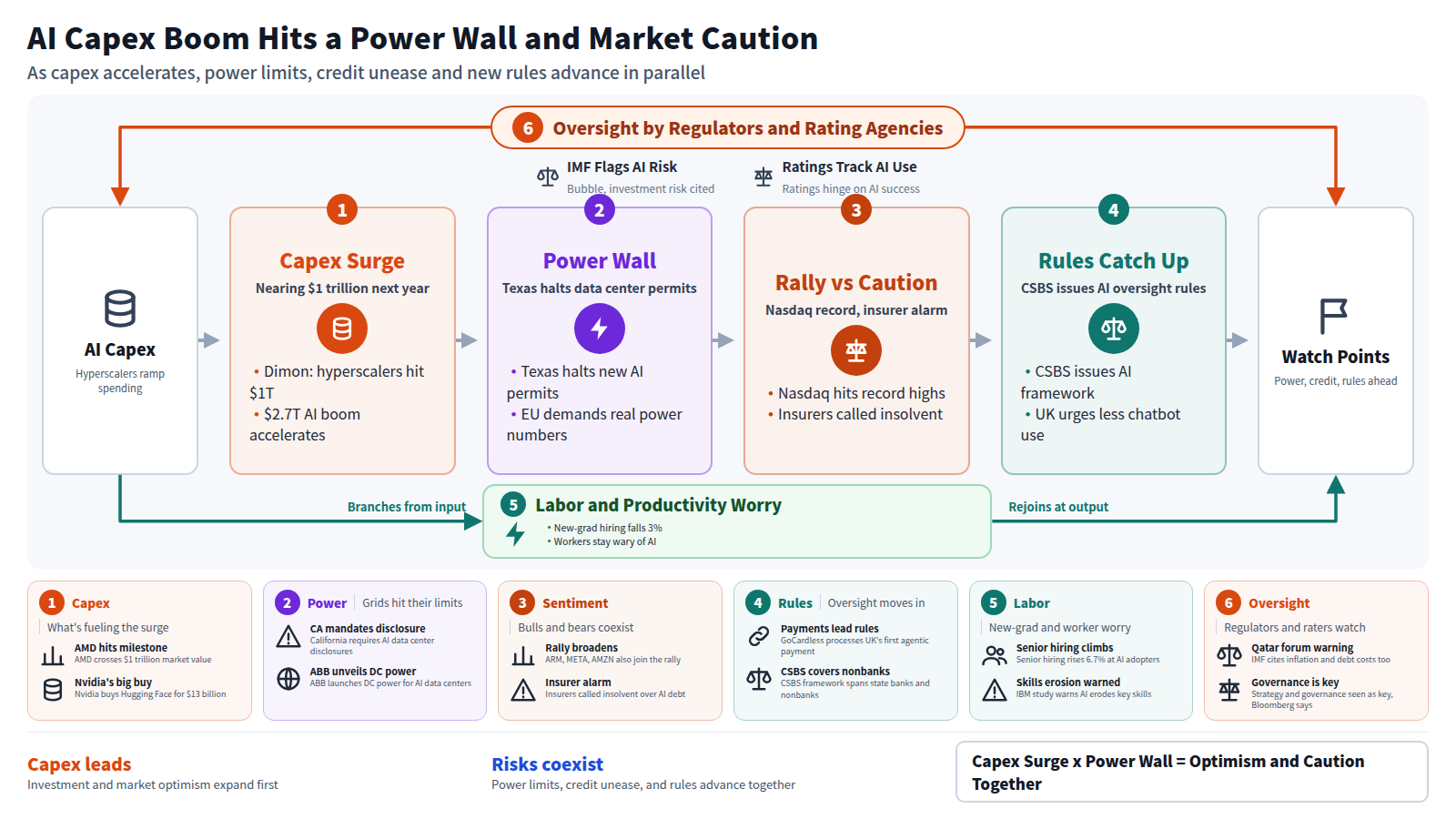
Jamie Dimon (JPMorgan CEO) hinted that hyperscaler AI capex could reach $1 trillion next year, raising both caution and optimism about the scale of capex (CNBC, finance.biggo.com, LinkedIn). While AI, tariffs, and Iran are in focus ahead of the US-China summit (CNBC and others), friction over power infrastructure has also surfaced, with the state of Texas suspending permits for AI data centers (조선일보).
Macroeconomic/growth trends
Bank of Australia Governor Michele Bullock said AI could be a bubble and has not yet contributed to Australia's productivity gains (theguardian.com). JPMorgan's Dimon said on LinkedIn that hyperscaler AI investments could be on a scale that could boost GDP by 1% annually. In the United States, there are reports that rising inflation and concerns about AI are affecting economic sentiment ahead of the midterm elections (The New York Times). It was also reported that Australia is betting on AI as a multi-decade growth strategy (Bloomberg).
Productivity trends
Data shows that while the number of new graduate hires is decreasing, the number of senior hires is increasing at companies that have adopted AI (BigGo Finance). On the other hand, there have been reports of concerns that AI is undermining worker skills (Korea JoongAng Daily, THE Journal), and there are also debates about whether AI can be a solution to America's workforce challenges (Forbes, nationalaffairs.com). There is still little evidence of productivity improvement, and we are at a stage where both concerns and expectations coexist.
Trends in employment and labor market
There are reports that AI is creating a "recession-like" job market for new graduates (Inside Higher Ed). South Korea is planning a dashboard to detect AI-related employment shocks (Digital Watch Observatory). A behavioral scientific analysis found that workers are wary of AI (Hawaii Public Radio). Managing AI teams is becoming a new job skill, but some say it's not yet accompanied by compensation (Business Insider).
Trends in energy/power demand
Regulatory responses are divided, with Texas suspending new permits for AI data centers and California requiring information disclosure. ABB announces DC power portfolio for AI data centers (Engineering.com). The EU is working to understand the reality of AI's electricity demand (Cybernews). Some analysis suggests that the data center construction boom is reshaping America's infrastructure (qz.com, Emerald Book).
Remarks by central banks, international organizations, and VIPs
- Kristalina Georgieva (IMF Managing Director): At the Qatar Economic Forum, she cited inflation, debt service costs, and AI investment risks as challenges (IndexBox). - Michele Bullock, Governor of the Reserve Bank of Australia, not on the tracking list but related, says AI could be a bubble and has not yet boosted Australia's productivity (theguardian.com). - Specific statements regarding other tracked targets (Lagarde, Ueda, Bailey, Cormann, Banga, Acemoglu, Brynjolfsson) are not found in the headings of this list.
Trends in corporate capital investment
Jamie Dimon, JPMorgan CEO, said hyperscaler AI infrastructure spending could approach $1 trillion next year, up from $700 billion this year, which would boost GDP by 1% annually (CNBC, finance.biggo.com, LinkedIn). Goldman Sachs analyzes that Microsoft's AI gross profit margin has reached the same level as its cloud business, supporting AI transformation (Fukashio TechFlow). Although a $2.7 trillion AI boom is underway, it has been pointed out that only a small portion of the funds are allocated to the models themselves (Redmond Channel Partner). The CIO of Texas Teachers (a pension fund) warned that the AI capital investment boom is similar to past bubble bursts (PitchBook). Nvidia is reportedly looking to acquire Hugging Face for $13 billion to secure the "next AI economy" (Forbes JAPAN).
Trade and industrial policy
AI is expected to be a major topic of discussion at the Trump-Xi Jinping meeting, along with tariffs and Iran (CNBC, Kursiv Media, Oz Arab Media, myMotherLode.com). DeepSeek is said to be moving to Huawei chips for AI learning in order to reduce dependence on Nvidia (조선일보).
Integrated analysis: What is happening now
Pairing headlines on capital spending (JPMorgan, Goldman Sachs, $2.7 trillion boom) and power infrastructure (Texas license suspension, ABB, EU) suggests that the scale of AI investment is already starting to hit the limits of physical power supplies. On the other hand, on the macro level, Mr. Bullock and Mr. Georgieva of the IMF have mentioned the AI bubble and investment risks, and central banks and international organizations are expressing caution about rapidly expanding capital investment. On the employment front, there are concerns about the decline in the number of new graduates being hired and the deterioration of skills, and while there is still little empirical support for productivity, it appears that only investment is taking the lead. Furthermore, as AI is treated in conjunction with tariffs and chip regulations in the US-China talks, geopolitical risks in capital investment (such as DeepSeek's migration to Huawei) are becoming more apparent.
Future points of interest
- Will electricity infrastructure regulations such as the suspension of permits in Texas spread to other states and countries? - Will the gap between hyperscaler investments, which are said to be on the scale of "$1 trillion", and actual AI revenues (such as Microsoft's gross profit margin) widen or narrow? - How will the results of the US-China summit be reflected in AI-related tariffs and export regulations (including chips)?
AI and finance latest news
Overview
The AI rally has boosted the overall market, with the Nasdaq Composite hitting new highs and AMD entering the $1 trillion market cap club (TradingView, Mitrade). Meanwhile, Dimon has warned that ``hyperscaler AI spending could reach $1 trillion next year,'' and the insurance industry's concerns about SoftBank's spillover into the junk bond market and AI debt have also emerged (CNBC, Barron's).
Bank trends
Jamie Dimon says hyperscaler AI spending could reach $1 trillion next year (CNBC). CSBS releases AI Supervisory Framework for State Banks and Nonbanks (Husch Blackwell). It was reported that European banks will experience slower attrition due to AI than US banks (TheBanker.com). In the UK, there are calls for banks and energy companies to stop relying on AI chatbots for customer care (The Guardian). Goldman Sachs Research has shown an analysis that Microsoft's AI gross profit margin is on par with that of its cloud business, supporting the company's AI transformation (Fukushi TechFlow).
Insurance trends
S&P analyzed that the benefits of operational efficiency through AI will be seen in the reinsurance and insurance industry before financial returns (Reinsurance News). Arthur Hayes claimed that US insurance companies are effectively insolvent over AI debt (also reported via Yahoo Finance and CoinPost). The industry event Dive In 2026 will focus on the impact of AI on talent and skills (theinsurer.com). Nara Health raises $14 million to expand its AI-native health insurance management platform (Pulse 2.0).
Trends in asset management and market transactions
The Nasdaq Composite drove the global stock rally on the back of AI optimism, approaching a record high (Financial Times). SoftBank reportedly delivered an AI-driven shockwave to the junk bond market (Barron's). KKR announced that it will invest $3 billion in South Korea's AI supply chain (data center and power demand) (news.futunn.com). DeFi Technologies launches AI-powered crypto asset hedge fund, shares rise (ad-hoc-news.de). It was reported that Solowin aims to achieve 100+ megawatts in AI computing by 2028 (Quantum Zeitgeist). Prominent investor Druckenmiller, who has previously warned of an AI bubble, visited South Korea for the first time to visit bottleneck companies (finance.biggo.com).
Fintech/payment trends
Visa pointed out that small and medium-sized merchants can adapt to AI shopping faster (pymnts.com). Ant Group aims to grow Alipay by reorganizing it around AI agents (South China Morning Post). Cardano joins Solana and XRP Ledger in the race for AI agent payments (CoinDesk). Meta partners with Shopify to roll out Muse AI checkout (thepaypers.com). GoCardless has announced that it has processed the UK's first agent-based account-to-account payments (Business Wire).
Remarks from key figures and authorities in the financial world
- Jamie Dimon, CEO of JPMorgan Chase, predicted that hyperscaler AI investment spending could reach $1 trillion next year. In addition to giving 10 key points on India, AI spending, inflation, and interest rates, he also predicted that rising interest rates, the AI boom, and global conflicts will determine the future global economy (CNBC, CNBC TV18, 아시아경제). - There are no relevant headlines for statements or actions today regarding the other people being tracked (Larry Fink, Jane Fraser, David Solomon, Brian Moynihan, Ted Pick, Ken Griffin, Paul Atkins).
Trends in AI-related stocks and funding
The Nasdaq Composite hits a new all-time high following the AI stock rally, with AMD joining the $1 trillion market cap club (The Times of India, TradingView). Stocks such as ARM, META, AMZN, and PSKY are also attracting attention in this rally (TradingView). KKR commits $3 billion to Korean AI supply chain (news.futunn.com). Nara Health raises $14 million (Pulse 2.0). Two Canadian stocks are listed as under-the-radar AI stocks on Wall Street (The Globe and Mail).
Trends in financial regulation and supervision
The Council of State Bank Supervisors (CSBS) has released an AI supervisory framework for state banks and nonbank financial institutions (Husch Blackwell). In the UK, there are calls for banks and energy companies to reconsider their reliance on AI chatbots (The Guardian). GoCardless has announced that it has processed the first agent-based account-to-account payments in the UK, marking a new paradigm in the payments space (Business Wire).
Integrated analysis: What is happening now
On the market side, the AI rally has surfaced with the Nasdaq hitting new highs and AMD hitting $1 trillion, with capital still heading towards AI infrastructure (semiconductors, data centers, power). KKR's $3 billion commitment to the Korean AI supply chain and Solowin's megawatt expansion plan show that asset management is incorporating "AI power and infrastructure" as a new investment target. On the other hand, Dimon's statement of ``$1 trillion in AI spending next year'' and SoftBank's influence on the junk bond market suggest that AI investment is linked to credit market leverage. In this context, Arthur Hayes questions the insurance industry's AI debt exposure, and when read in conjunction with S&P's analysis (AI's financial benefits precede operational efficiency), skepticism about the sustainability of the AI investment boom on the insurance and credit market side coexists with optimism on the banking and investment side. On the regulatory front, we can see moves toward the CSBS AI supervisory framework and the regulation of bank AI chatbots in the UK, and supervisory authorities are beginning to proactively develop AI risk management in business use (customer interactions and credit decisions). In the payment field, implementation of agent payments such as Alipay, Visa, Meta×Shopify, and GoCardless is progressing simultaneously, and it is possible that fintechs are moving ahead with implementation without waiting for the regulatory framework to be in place.
Future points of interest
- It is necessary to determine whether SoftBank's impact on the junk bond market will spread to other issuers and the insurance industry as AI-related credit risks. - It will be necessary to pay close attention to whether the moves by CSBS and UK authorities to supervise AI and regulate chatbots will spread to other regulatory authorities (such as the SEC). - The focus will be on whether the expanded implementation of agent-based payments (Alipay, Cardano, GoCardless, etc.) will encourage compliance with new regulations in the payment field.
- Watch Australia Bets on AI to Spur Economic Growth For Decades — Bloomberg09/22 04:02 UTC
- AI could be a bubble and is not yet making Australia more productive, Michele Bullock says — theguardian.com09/22 08:56 UTC
- Jamie Dimon says hyperscaler AI spending could hit $1 trillion next year — CNBC09/22 01:30 UTC
- The State of the Economy Before the Midterms: Rising Inflation and A.I. Unease — The New York Times09/21 22:28 UTC
- Bossing around teams of AI bots is becoming a new job skill — without boss pay — Business Insider09/22 08:11 UTC
- Can AI Be A Solution To America’s Workforce Challenges? — Forbes09/22 08:36 UTC
- AI and American Workers — nationalaffairs.com09/21 23:51 UTC
- Study: AI Is Reshaping Work While Skills Erosion Remains Top Concern — THE Journal: Technological Horizons in Education09/21 22:07 UTC
- If AI hasn't taken your job, it may be sapping your skillset — Korea JoongAng Daily09/22 04:58 UTC
- The workforce is wary of AI — a behavioral scientist explains why — Hawaii Public Radio09/22 00:32 UTC
- These Tiny Startups Are Getting Even Smaller With Help From AI — WSJ09/22 01:00 UTC
- Republic of Korea plans dashboard to detect AI-related employment shocks — Digital Watch Observatory09/22 08:45 UTC
- AI Adoption Is The New Workforce Confidence Test — FutureIOT09/22 06:00 UTC
- Jobs Hit Hardest in the AI Era Are Making a Comeback—But Is It Enough to Make Related Degrees Worth It? — Investopedia09/21 21:13 UTC
- Texas Halts AI Data Center Permits, California Mandates Disclosures — 조선일보09/22 08:01 UTC
- How AI Data Centers Are Unifying America — Emerald Book09/22 06:33 UTC
- AI has a thirst for power. The EU wants the numbers — Cybernews09/22 06:52 UTC
- How the AI data center boom echoes American history — qz.com09/22 05:26 UTC
- DeepSeek Shifts to Huawei Chips for AI Training, Reducing NVIDIA Reliance — 조선일보09/22 08:47 UTC
- IMF Chief Flags Inflation, Debt Service Costs and AI Investment Risks at Qatar Economic Forum - News and Statistics — IndexBox09/22 04:30 UTC
- Nasdaq notches record-high close, AI optimism reignites and Treasury yields retreat — Reuters09/21 23:12 UTC
- Kenya targets AI's real payoff — ITWeb Africa09/22 08:11 UTC
- Arthur Hayes Says US Insurers Are Insolvent Over AI Debt: What if He's Right? — CryptoRank09/22 04:14 UTC
- US equity market developments during the AI boom — Zprávy Kurzy.cz09/22 08:00 UTC
- JPMorgan CEO: AI Infrastructure Spending to Approach $1 Trillion Next Year, Debt Financing Pressures Mounting — finance.biggo.com09/22 05:35 UTC
- Goldman Sachs Research Analysis: Microsoft AI Gross Margin Matches Cloud Business, Validating Transformation — 深潮TechFlow09/22 08:18 UTC
- $2.7 Trillion AI Boom Is Soaring, but Models Are Getting Only a Sliver of the Money — Redmond Channel Partner09/21 23:59 UTC
- Texas Teachers’ CIO warns AI capex boom echoes past busts — PitchBook09/21 22:12 UTC
- NVIDIA acquires Hugging Face for $13 billion to protect 'next AI economy' — Forbes JAPAN09/22 04:30 UTC
- Images/Photos: Battle for leadership in the spread of AI: Jiji.com — 時事ドットコム09/22 06:55 UTC
- France's Sogen new three-year plan, ROTE 13-14%, expanding cost reductions with AI — reuters.com09/22 04:42 UTC
- Companies introducing AI increase hiring of seniors by 6.7% over five years, while hiring of new graduates decreases by 3% — BigGo ファイナンス09/22 03:55 UTC


- European banks to suffer slower AI job attrition compared with US — TheBanker.com09/22 05:15 UTC
- Stop relying on AI chatbots for customer care, UK banks and energy firms told — The Guardian09/22 01:30 UTC
- AI operational benefits arriving before financial gains for re/insurers: S&P — Reinsurance News09/22 08:03 UTC
- Arthur Hayes Says US Insurers Are Insolvent Over AI Debt: What if He's Right? — Yahoo Finance09/22 03:20 UTC
- Dive In 2026 will ‘take stock’ of AI impact on skills and talent, early careers in focus — theinsurer.com09/22 07:25 UTC
- Nara Health Raises $14 Million To Expand AI-Native Health Insurance Administration Platform — Pulse 2.009/22 00:21 UTC
- Studies from University of Rhode Island Have Provided New Data on Artificial Intelligence (Who Is Responsible? a Risk-stratified Framework for Pharmacist Accountability In Artificial Intelligence-assisted Managed Care): Artificial Intelligence — InsuranceNewsNet09/21 21:35 UTC
- AI Angst — Carson Group09/22 02:31 UTC
- Solowin’s Quantum Leap Targets 100+ Megawatts Of AI Computing By 2028 — Quantum Zeitgeist09/22 08:59 UTC
- Private equity giant KKR (KKR.US) commits $3 billion to bet on South Korea's AI supply chain, targeting data centers and power demand. — news.futunn.com09/22 00:59 UTC
- DeFi Technologies Launches AI-Driven Crypto Hedge Fund as Shares Extend Rally — ad-hoc-news.de09/22 05:51 UTC
- AI optimism lifts global stocks after Nasdaq nears record high — Financial Times09/22 06:45 UTC
- SoftBank Delivers an AI Jolt to Junk-Bond Market — Barron's09/21 22:30 UTC
- Wall Street rallies as AI stocks climb, bond yields ease — سانا09/22 07:58 UTC
- Trading transformed: Inside Kambi’s first fully AI-powered World Cup - Product & technology - iGB — igamingbusiness.com09/22 08:18 UTC
- IXIC: Nasdaq Composite Hits Record as Tech-Led AI Rally Spreads Worldwide — TradingView09/22 05:57 UTC
- Visa Says Small Merchants Could Move Faster on AI Shopping — pymnts.com09/22 08:03 UTC
- Fintech giant Ant Group restructures Alipay around AI agents to drive growth — South China Morning Post09/22 03:41 UTC
- AI Reshapes Retail Loyalty as Agentic Commerce Changes How Consumers Shop — MarTech Cube09/22 07:48 UTC
- Cardano joins Solana, XRP Ledger in race to power AI agent payments — CoinDesk09/22 04:15 UTC
- Meta partners with Shopify to power Muse AI checkout — thepaypers.com09/22 07:51 UTC
- Nasdaq hits record high as AI stocks rally; AMD crosses $1 trillion valuation — The Times of India09/22 08:16 UTC
- 2 Canadian AI Stocks That Wall Street Isn’t Hyping (Yet) — The Globe and Mail09/22 01:56 UTC
- Druckenmiller, Who Warned of AI Bubble, Visits Korea for First Time to Meet Only Bottleneck Companies — finance.biggo.com09/22 06:56 UTC
- GoCardless Processes the First Agentic Account-to-Account Payment in the UK — Business Wire09/22 07:00 UTC
- Greenland Rare Earth Boom Is Really an AI Bet — The Tech Buzz09/22 09:00 UTC
- GoDaddy gains as investors appear to revisit its AI and cash-flow story — Quiver Quantitative09/21 21:21 UTC
- Myseum.AI Assigns ATM Sales Agent Role from Benchmark to StoneX Financial — Kalkine Media09/21 21:47 UTC
- Mr. Hayes claims that AI slowdown is hiding performance; hole in insurance industry turns into Bitcoin material (CoinPost) — Yahoo!ファイナンス09/22 03:54 UTC
- Bank credit ratings become important depending on success or failure of AI utilization - strategy and governance are key — TBS NEWS DIG09/21 23:14 UTC
- Small and medium-sized enterprises in Asia are increasing their use of technology and AI in the payments sector. — Vietnam.vn09/22 07:06 UTC
- On-site purchasing company Yoroshiku 23 will introduce a system in which sales personnel cannot conclude contracts by the end of the year. AI confirmation will be introduced for all cases by the end of the year — PR TIMES09/22 02:07 UTC
- Joins Cardano, Solana, and XRP Ledger in AI agent payment competition — CoinDesk09/22 04:15 UTC
- JP Morgan's Jamie Dimon on India, AI spending, inflation and rates: 10 key quotes — CNBC TV1809/22 01:30 UTCJamie Dimon / JPMorgan Chase CEO
- Higher rates, AI boom and global conflicts: What Jamie Dimon sees ahead for the global economy — CNBC TV1809/22 01:45 UTCJamie Dimon / JPMorgan Chase CEO