The gap between what AI is said to do and what it has actually delivered
Every day we receive numbers and announcements about what AI can do. On the other hand, the extent to which results are actually achieved by entrusting work and judgment to others has not been confirmed at the same rate. Kroger in the US is reported to be cutting 3,000 head office employees over three years, but the ``scope of responsibility'' that is the basis for this prospect and the ``scope of responsibility that has produced results'' are not the same size. In this half-day, we will discuss how the differences between these two ranges manifest themselves in different situations such as employment, investment, relationships with people, and standard-setting, and who measures these differences and how. Do you decide based on the size of the pattern, or do you decide based only on what you can confirm? The way you choose will change the judgment in each scene.
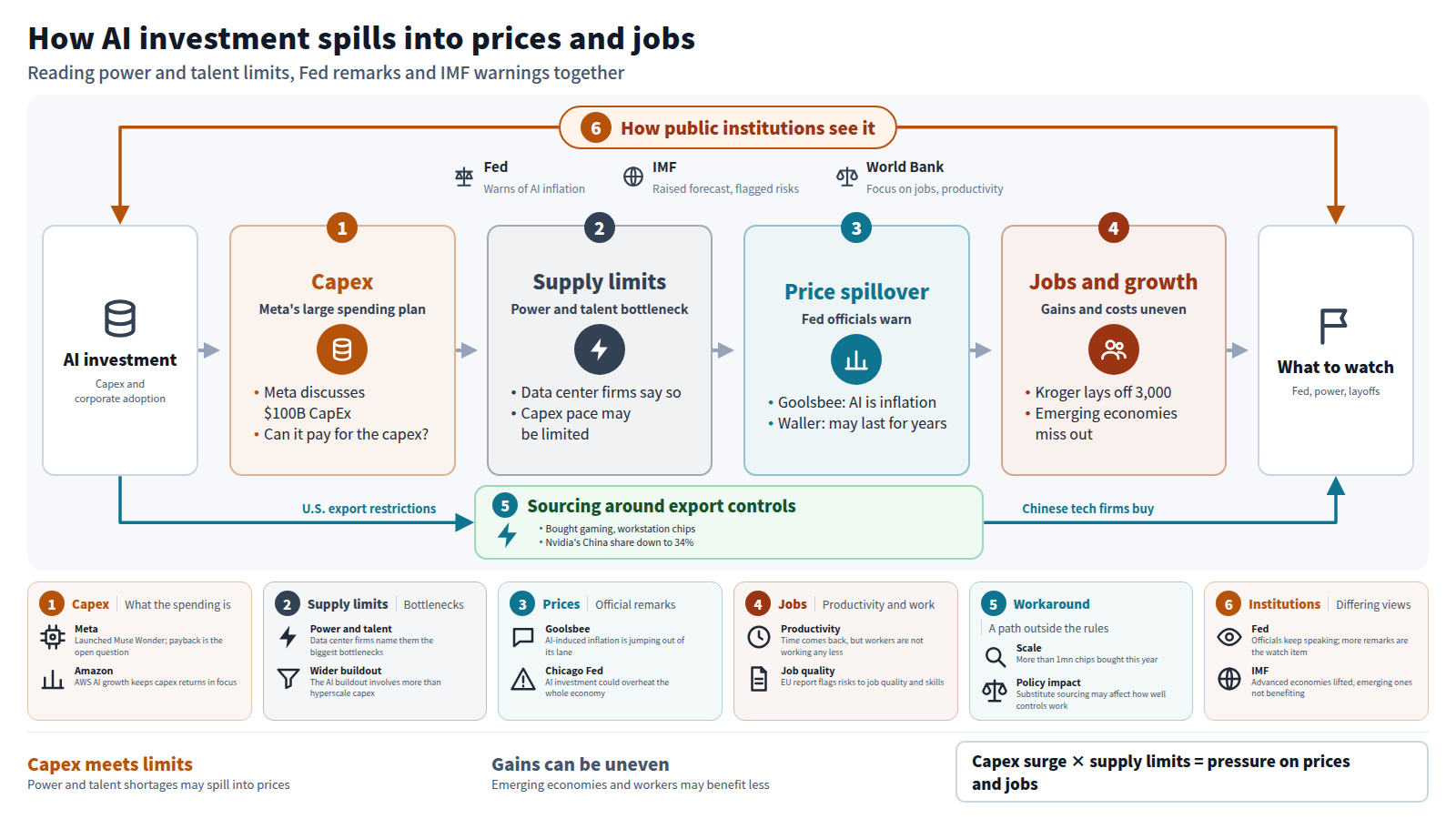
Kroger is reported to be cutting 3,000 head office employees over three years while promoting the use of AI (Pittsburgh Post-Gazette). Another article states that 40% of the world's jobs are at risk due to AI and lists the top 10 riskiest jobs (Pulse Ghana). The numbers are large and give both management and workers the assumption that ``replacement will proceed''. However, these two numbers indicate the scope of what AI is supposed to be able to handle, not the scope of what actually results when left to it.
Reports that attempt to measure the difference do not honestly support the assumption. Broad claims surrounding radiology talent and AI have been found to be unsupported by evidence (AuntMinnie, HPI). The job of reading images has long been talked about as a typical example of a job that could easily be replaced by AI. In this area, the fact that broad claims about supply and demand for human resources do not match the evidence leaves us with the question of whether a list of ``at-risk jobs'' can be used as the basis for employment decisions. The list shows the parts of the job that can be imitated by machines, and the parts that can be assumed with responsibility need to be confirmed separately.
Agent research is also pointing in the same direction. If a practice environment is automatically created in order to train an AI agent who performs specialized tasks at a terminal with long records of work, the investigation, implementation, and verification that should have been done by the agent may end up being completed at the environment creation stage. The authors proposed TerminalHorizon, a system that runs the created environment independently, finds missing work, and rebuilds it (preprint on their own site, arXiv, not yet peer-reviewed). In other words, some of what is shown as AI completing long tasks may be due to proactive settings rather than the task itself.