
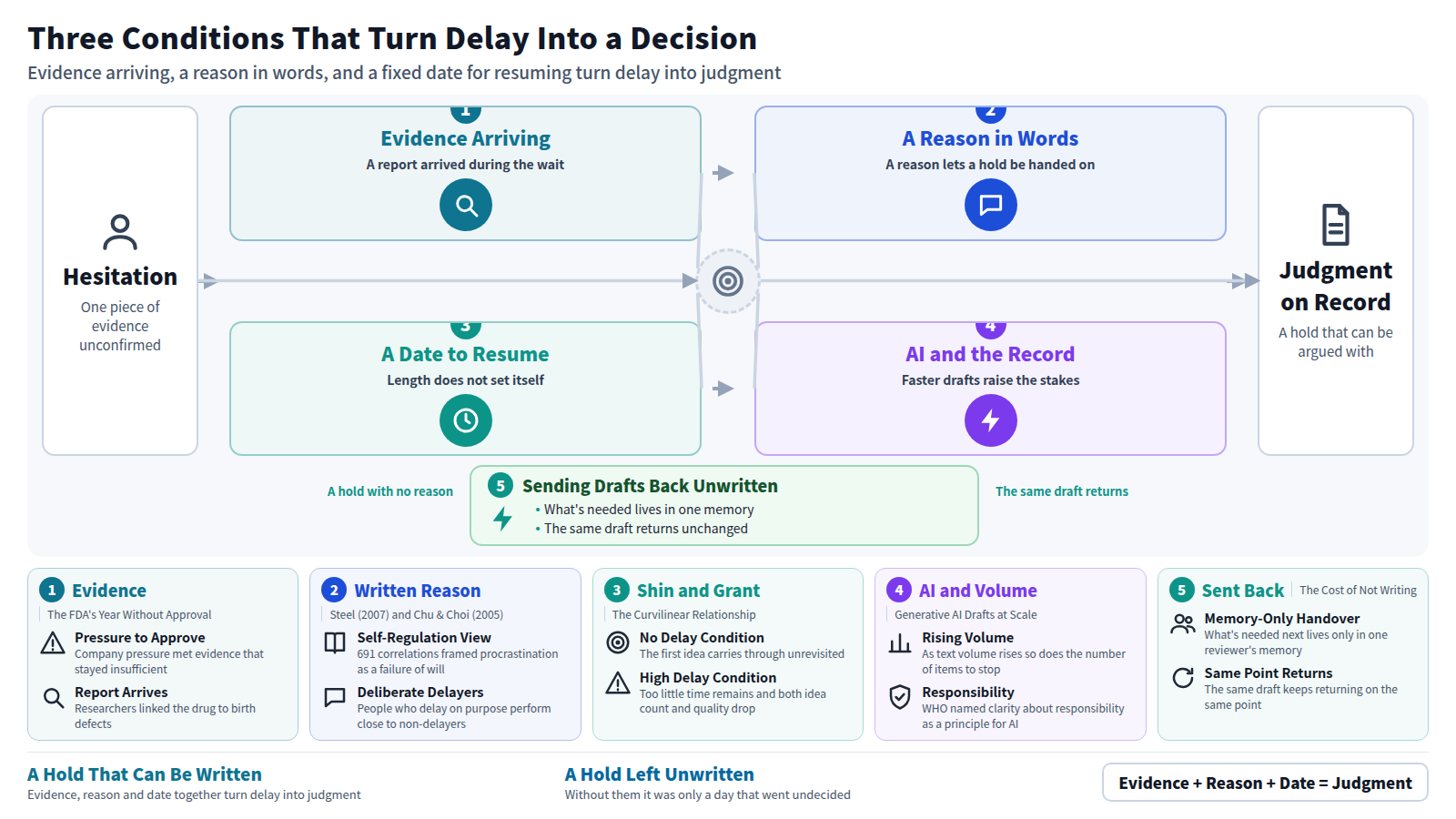
Your hand stops over the approval box because one piece of the evidence has not yet been confirmed. Is there a situation where putting off a decision is the best decision? Delay becomes the best decision when new evidence is genuinely on its way, and when the reason for waiting and the date for resuming are both written down.
01Waiting is best only when the reason for waiting can be written down
Turn that moment of hesitation into conditions and you get three. Evidence will arrive while you wait. The reason for waiting can be put into words. A date for returning to the decision has been fixed. Only with all three does waiting become a judgment.
Remove any one and waiting collapses into not deciding. The two look alike from outside. On the day itself, nothing moves in either case.
Evidence on its way
Can you say what is arriving, and from where, during the wait?
A reason you can write
Can you put why you are not deciding now into one sentence another person can read?
A date for resuming
Have you fixed, as a date, when you will come back to the decision?
The sections below take the three in turn: how psychology has divided delay, what arrived during a year of waiting, and how the length of a delay gets set.
02Psychology has long split delay into two different things
The condition about writing down a reason falls almost exactly along the line research has drawn through delay.
In 2007 Steel published a review pooling 691 correlations. Procrastination was framed there as a failure of self-regulation, with task aversiveness and impulsiveness emerging as strong predictors. Being unable to start as the deadline closes in was described as a problem of will.
The same behaviour has been reported from the other side. In 2005 Chu and Choi found that people who delay on purpose resemble non-delayers in how they use and control their time, and in their performance. The delay is the same length; the outcome is not.
What separates the two is not duration. The line the reports draw is whether the delay was chosen. Someone who can call it chosen can say, in their own words, why they are not doing this now. A delay with a reason is one the person decided on.
03In promotional-material review, a hold becomes a judgment the moment its reason is written
Delay divides in two according to whether the reason can be stated. The same line runs through review work.
When a reviewer holds a decision and writes into the record why it is held and what would have to appear for it to resume, that hold is a judgment rather than an absence of one. Send the draft back without writing any of it, and the same draft returns on the same point again and again.
| What you look at later | A hold with a written reason | A rejection sent back unwritten |
|---|---|---|
| What is needed next | It is in the record | It is in one reviewer's memory |
| The same point recurring | It does not return once the written condition is met | The same draft keeps coming back |
| Handover | Passes straight to the next person | Everything is asked again from the start |
Writing it takes a line or two. For that much effort, the hold belongs to the organisation. Unwritten, it exists only inside one reviewer's head, and it disappears when that reviewer moves on.
On the floor, a hold you can write and a hold you cannot look nearly identical. The difference is whether you can say what would have to appear for the draft to pass. Are you waiting for additional data, for an internal reading of a rule, or simply because you do not feel like signing? Even the third can be written down. The moment it is written, it becomes something another person can argue with. Being arguable is what separates a judgment from a hold.
04The value of waiting is set by the evidence that arrives while you wait
Being able to write a reason rests on the expectation that something worth writing about is coming. If nothing is coming, there is no reason to write.
A medical reviewer at the US Food and Drug Administration left an application unapproved on the grounds that the evidence was insufficient. Pressure came from the company. The application stayed unapproved for roughly a year.
During that year, researchers in Germany and Australia linked the drug to clusters of severe birth defects. What changed the decision was not the time spent waiting. It was the report that arrived during it.
Read this as a story about one person's strength of will and nothing usable survives. Will cannot be copied. What can be copied is the work of estimating, in advance, what will arrive while you wait. Whether endurance with nothing on its way would have produced the same result cannot be said from this one case.
05Shin and Grant showed that too little delay and too much both cut down new ideas
Even granting that arriving evidence changes decisions, waiting longer does not keep making things better.
Shin and Grant reported that the relationship between putting work off and creative output is curved rather than straight. Participants in the moderate-delay condition produced the most ideas; both the low-delay and the high-delay conditions produced fewer.
What sat in the middle was time to reframe the problem. While a task is untouched, room opens to question how it was first set up. When the clock runs out before that questioning finishes, both the number and the quality of ideas fall.
No delay
The first idea carries straight through, and the framing of the problem is never revisited.
Moderate delay
Time to reframe enters, and in the experiments this condition produced the most ideas.
Too much delay
Too little time remains, and both the number and the quality of ideas drop.
These experiments used work tasks, and it has not been established that they transfer to review decisions. One thing does read across. The right length does not set itself. Someone has to fix it as a date.
06Evidence, wording and a date for resuming turn waiting into judgment
The curve showed that somebody has to choose the length of a delay. The three conditions each do a different job.
1. Evidence on its way
It makes the value of waiting measurable. The year without approval meant something because a report arrived inside it. A year with nothing arriving yields nothing, however long it runs.
2. A reason in words
It splits one delay into two. That people who delay deliberately perform close to those who do not can be read as a consequence of their being able to explain the delay. An explained delay can be handed to someone else.
3. A date for resuming
It fixes the length. A curve with a peak also has room to fall on either side. Without a date, you cannot tell which side of the peak you have fallen on.
All three apply to sending back a draft written by generative AI. AI drafts come back quickly. When a draft that returns quickly is stopped and the reason for stopping goes unwritten, the next version stops at the same place.
07The faster generative AI produces drafts, the more the written reason for waiting matters
The three conditions were formed when people wrote one draft at a time. Change where drafts come from and the conditions work differently.
Generative AI has been reported to return unsafe answers to medical questions posed by patients. As the volume of text produced rises, so does the number of items that ought to be stopped. The act of stopping does not change. Its frequency does.
One a day and memory covers the reason. Ten a day and it exceeds what memory covers. The cost of not writing accumulates in proportion to the count. When the same error returns inside a different draft, nobody can produce the reason it was stopped before.
The World Health Organization named clarity about where responsibility lies as a principle for AI outputs. Responsibility can be located after the fact only where the decision to stop was recorded.
The speed itself does not need stopping. Drafts returning quickly is a question of volume, not of correctness. The trouble starts when the human record thins to match the speed. As the time available per item shrinks, the first thing cut is the line giving the reason. Decide in advance that this line will not be cut, and the three conditions keep working however the drafts are produced.
- Steel pooled 691 correlations and framed procrastination as self-regulatory failure, yet those who delay on purpose perform much like those who do not delay at all: delay is not one thing.
- During roughly a year without approval, researchers in Germany and Australia linked the drug to severe birth defects; it was not the waiting but what arrived during it that changed the decision.
- In Shin and Grant's experiments, moderate delay produced the most new ideas; the right length of delay does not set itself, someone has to fix it as a date.
Putting a decision off is the best decision only when evidence is genuinely on its way and both the reason and the date for resuming are written down. If they cannot be written, it was not judgment, only a day that went undecided.
When your hand stops over the approval box, one question is enough. What am I waiting for? If no answer comes, you are not waiting, you simply do not want to decide. If an answer does come, write it in the record and fix the day you return.
That one line is the difference between two identical weeks.
- U.S. Food and Drug Administration. Frances Oldham Kelsey: Medical reviewer famous for averting a public health tragedy. 1 February 2018.(Withholding approval for insufficient evidence, pressure from the company, and the link to birth defects about a year later)
- Psychological Bulletin. The nature of procrastination: a meta-analytic and theoretical review of quintessential self-regulatory failure. 2007.(A review pooling 691 correlations; task aversiveness and impulsiveness as strong predictors)
- The Journal of Social Psychology. Rethinking Procrastination: Positive Effects of "Active" Procrastination Behavior on Attitudes and Performance. June 2005.(Deliberate delayers and passive delayers reaching different outcomes)
- Academy of Management Journal. When Putting Work Off Pays Off: The Curvilinear Relationship between Procrastination and Creativity. August 2020.(The curved relationship between delay and creative output)
- arXiv. Large language models provide unsafe answers to patient-posed medical questions. 25 July 2025.(Unsafe outputs from generative AI in medical settings)
- World Health Organization. Ethics and governance of artificial intelligence for health: large multi-modal models. WHO guidance, 18 January 2024.(Clarity about where responsibility lies, named as a principle for AI outputs)