AI, Economy & Finance News — 2026-09-25 (Fri)
Source links point to the original outlet. The AI Integrated Analysis is auto-generated from the headlines below only and is not intended to add facts beyond them. Not investment advice.
AI and Economy Latest News
Overview
At the US-China summit, AI is on the agenda along with trade and tariffs, and rapprochement with China and competition for AI supremacy are progressing simultaneously (Fox Business, PBS, CNBC). On the other hand, Wells Fargo and UBS have sounded the alarm about the sustainability of AI capital investment, making it clear that electricity demand and data center investment will continue to expand (24/7 Wall St., Yahoo Finance).
Macroeconomic/growth trends
Brookings estimates the scale of AI buildout to be $10.3T, exceeding the GDP ratio of railways and highways (IndexBox). The US GDP growth rate is higher than that of the G7 countries, and the AI boom is cited as one reason for this (Harici). On CNBC, Payne Capital's Courtney Garcia says AI buildout justifies economic growth and rising yields (CNBC). On the other hand, Reuters reported that researchers have pointed out that AI buildout funding poses systemic risks to the US, and Investopedia has positioned 2027 as the test for an AI spending boom (Reuters, Investopedia).
Productivity trends
Fortune contrasted this with Japanese companies paying older employees to "do nothing," while Western companies are pressing them to improve productivity through AI (Fortune). Microsoft Source reported that Rockwell Automation is combining AI and field expertise to help workers resolve issues faster. At CFO Dive, Gartner urged CFOs to have realistic expectations about the return on investment of AI (CFO Dive). In Japan, Yayoi reports that there is a team that achieved better results than a team that simply used AI, and was able to reduce development man-hours by 80% (atmarkit.itmedia.co.jp). Spiceworks pointed out that companies may be easily blaming AI for factors other than AI (Spiceworks).
Trends in employment and labor market
Fast Company reported that the AI boom has cut new hires in tech in New York City by half (Fast Company). layoffs.fyi continues to track AI layoffs (layoffs.fyi). GovInfoSecurity reports that AI is changing, not eliminating, cybersecurity jobs, and ExecutiveGov questions federal employees' readiness to handle AI agents (GovInfoSecurity, ExecutiveGov). Bloomberg has proposed "7 big ideas" to address the AI jobs crisis (Bloomberg.com). Alabama Daily News reports state needs partners to implement AI talent development plan (Alabama Daily News)
Trends in energy/power demand
The New York Times reported that Google is trying to send an AI data center to space (The New York Times). Data Center Frontier reported that Amazon and Generac's partnership is drawing attention to backup power for AI infrastructure, and Morningstar reported that UL Solutions has launched a certification program for emerging power technologies for AI data centers (Data Center Frontier, Morningstar). Yahoo Finance reported that Berkshire Hathaway's Greg Abel called the demand for AI data centers a huge opportunity for Berkshire Energy (Yahoo Finance). Axios reported on the conflict between AI demand for electricity and the promotion of clean energy, and Nikkei Business reported that AI demand has caused electricity prices to soar in the United States, and that big tech companies such as Google have ``pledged'' to shoulder the burden of the increase (Axios, Nikkei Business online version).
Remarks by central banks, international organizations, and VIPs
None of the headlines collected this time were confirmed to have been made by the key figures being tracked (Lagarde, Ueda, Bailey, Georgieva, Cormann, Banga, Acemoglu, Brynjolfsson). On an institutional level, the IMF has reportedly pointed out that AI can transform productivity and economic policy (Vanguard News). The EU financial regulator has indicated that it will make AI and tokenization a supervisory priority in 2027 (Cryptonews.net). At the Philadelphia Fed's FinTech conference, AI was cited as one reason why underlying inflation, excluding oil and tariffs, remained at 2.5% to 3% and has not improved (TradingView). Breakingviews published a commentary stating that Europe has room to avoid the "Dark Ages" of AI (Breakingviews).
Trends in corporate capital investment
qz.com reported that AI buildout is becoming one of the biggest economic bets in U.S. history, and Global Macro Monitor called it a "$10 Trillion Bet," pointing out that AI capital investment has become the central macroeconomic story (qz.com, Global Macro Monitor). 24/7 Wall St. reported that Wells Fargo has lowered its S&P 500 target to 7,700 after analyzing that AI spending will break even in 2028. Yahoo Finance and Investing.com both reported that UBS views increased reliance on AI capital investment as a key growth risk (Yahoo Finance, Investing.com). michaelparekh.substack.com discussed capital investment trends including Gemini and DeepSeek (michaelparekh.substack.com). jbpress analyzed that Nvidia's acquisition of Hugging Face was aimed at defending the "open AI economic zone" (jbpress.ismedia.jp).
Trade and industrial policy
Fox Business, PBS, aol.com reported that President Trump and President Xi Jinping will hold a meeting at the White House to discuss trade and tariffs, as well as AI.(Fox Business, PBS, aol.com) CNBC reported that the Chinese side has confirmed that the first AI talks between the US and China have been held and has hinted at extending the trade truce. TV Tokyo's Morning Satellite featured the period of explosive spread of AI and the US-China summit (tv-tokyo.co.jp).
Integrated analysis: What is happening now
The fact that AI became a negotiating topic along with tariffs at the US-China summit shows that AI has become a central variable in trade policy, not just a technology competition (Fox Business, CNBC). At the same time, Wells Fargo and UBS's warnings about the sustainability of AI capital investment (24/7 Wall St., Yahoo Finance), the $10.3T buildout estimated by Brookings (IndexBox), and the systemic risks pointed out by Reuters (Reuters) suggest that while the AI investment boom supports macroeconomic growth, it is accumulating financial vulnerabilities. This expansion in capital investment is inextricably linked to the surge in electricity demand, and investments in backup power sources for data centers (Data Center Frontier) and Big Tech's pledge to pay for rising electricity rates (Nikkei Business Online Edition) show that the external costs of AI buildout are beginning to be passed on to electricity infrastructure and consumers. On the employment front, while progress is being made in reducing the number of new graduate hires (Fast Company) and continuously tracking layoffs (layoffs.fyi) through AI, there are also reports of demonstrations of improved productivity (atmarkit.itmedia.co.jp), and it appears that we are at the stage where the impact of AI on employment and its contribution to productivity can be observed simultaneously. The fact that the IMF and EU regulators are beginning to develop policy frameworks may indicate that we are at a stage where the economic impact of AI is beginning to be recognized as a supervisory issue at the level of central banks and international institutions (Vanguard News, Cryptonews.net).
Future points of interest
- How will AI-related export controls, tariffs, and investment regulations be adjusted as a result of the US-China summit? - How will the profitability risks of AI capital investment pointed out by Wells Fargo and UBS affect the stock market and credit market towards 2027-2028? - The impact of the rapid increase in power demand caused by AI on electricity prices, power grid investment, and employment structure may further expand in the future.
AI and finance latest news
Overview
As AI agents enter the implementation stage in payments, transactions, and insurance underwriting, banks are acting on both security concerns and legacy renewal. In the insurance field, increased costs and appraisal conflicts due to AI have surfaced, and BlackRock is expanding investment in AI infrastructure.
Bank trends
Banks are warning that AI shopping agents increase the risk of fraud, abuse, and data leaks (Fox Business). It was reported that fintech companies tend to be preferred over traditional banks based on AI models (American Banker). According to an analysis (PYMNTS.com), AI is expanding the options for upgrading banks' core systems. Cyera, which helps secure AI agents, raises $400m from Goldman Sachs (FinTech Global).
Insurance trends
The NYTimes reported that an appraisal battle between hospital AI and insurance company AI is pushing up medical costs. Vox points out that AI is already involved in determining whether or not to receive medical benefits. Reuters reports that AI tools have resulted in approximately $1 billion in additional costs for Blue Cross insurers. Misinformation and deepfakes are the most commonly reported AI coverage risks for insurance companies, Risk & Insurance reported. InsuranceNewsNet also reported concerns that AI could lower employee morale.
Trends in asset management and market transactions
It was reported that BlackRock is evolving its AI-related investment stance by reorganizing its model portfolio (Bloomberg). Yahoo Finance reports that BlackRock has invested $25 billion in AI data centers in Asia. BlackRock has expressed the view that stablecoins can become an AI payment layer that connects commerce and computational resources (AI Insider). Wealth Management has introduced a new AI agent. On the trading side, Public is linking AI trading agents with prediction market Kalshi (Fortune, Barron's), and FirstMark and Chemistry have invested in a startup building a dedicated exchange for AI computational resources (WSJ). Bloomberg analyzes that the IPO of new cloud company Nscale shows that it is more than an AI intermediary.
Fintech/payment trends
Stripe's AI executive introduced the growth of the AI company, with a growth rate of 175% and 48% of sales outside of its home country (saastr.com). Cleverbridge announced that it has implemented the first AI agent-driven payment in France with Visa and Revolt (Business Wire). Mastercard is working to connect SME growth, AI, and cybersecurity (FinTech Magazine). Kredete acquires agent stablecoin infrastructure Gravv (FinTech Futures).
Remarks from key figures and authorities in the financial world
No specific statements or actions by the key figures tracked in this report (Jamie Dimon, Larry Fink, Jane Fraser, David Solomon, Brian Moynihan, Ted Pick, Ken Griffin, and Paul Atkins) were identified in the headlines. There have been reports about BlackRock (model portfolio restructuring, $25 billion investment in Asia AI data center, stablecoin positioning), but Larry Fink himself has not mentioned anything. It was reported that Franklin Templeton's CEO gave a "seven-word opinion" to AI stock investors, but details of his name and title and the content of his remarks were not listed in the headline (thestreet.com).
Trends in AI-related stocks and funding
Cybersecurity company Island reaches valuation of $6.4 billion (Reuters, WHTC). OpenEvidence, dubbed "ChatGPT for doctors," has raised a new round of funding at a valuation of $15 billion (Business Insider). Spanish AI startup Reply Next has raised €400,000 pre-seed (Dealroom). Cyera raised $400m from Goldman Sachs (FinTech Global, supra).
Trends in financial regulation and supervision
A review of the current legal system regarding AI financial services has been published (Center for Democracy and Technology). New York state may be able to share Frontier AI safety reports across the U.S. without new legislation, Lawfare reported. The EU Securities and Markets Authority (ESMA) has put AI and tokenization on the regulator’s agenda for 2027, reports unchainedcrypto. In Japan, the Australian government revealed that AI had illegally infiltrated the public health insurance system, and that an AI developed by OpenAI was involved, and it was reported that notification to the government was delayed by three months (TBS NEWS DIG).
Integrated analysis: What is happening now
As for the flow of funds, it appears that major financial institutions themselves are investing capital in both AI infrastructure and AI security, such as BlackRock investing $25 billion in AI data infrastructure in Asia and Goldman Sachs investing $400 million in Cyera, an AI agent security company. On the other hand, risks are shifting to the payment and insurance side, with banks wary of the risk of fraud from AI shopping agents and insurance companies wary of increased costs ($1 billion for Blue Cross companies) due to appraisal battles with hospital AI. In the payments field, we are at the stage where AI agents are actually initiating transactions and payments, as seen in the cases of Cleverbridge, Visa, and Revolut, and the collaboration between Public and Kalshi, and this is consistent with Stripe's 175% growth rate. Regulators are currently in the process of developing frameworks following the likes of New York State and the EU (ESMA, set to be on the agenda in 2027), and the case of unauthorized AI intrusion into Japan's public health insurance system and delayed notification can be said to be a symbolic case that shows that the actual operation of AI agents is ahead of the development of supervisory and reporting systems.
Future points of interest
- To what extent will the assessment conflicts between insurance companies and medical institutions' AIs affect medical costs and insurance premiums? - How far will AI agent-based payments (Visa, Revolut, Kalshi, etc.) expand across major payment networks? - How will the New York State/EU AI safety reporting framework be implemented in AI supervision of financial institutions?
- Slowing Frontier AI Won’t Hold Back the AI Economy — Yale Insights09/24 16:42 UTC
- AI buildout is justifying economic growth and rising yields, says Payne Capital's Courtney Garcia — CNBC09/24 19:54 UTC
- Financing of historic AI buildout raises systemic risks in US, researcher says — Reuters09/24 10:07 UTC
- The AI Spending Boom Faces a Crucial Test in 2027 — Investopedia09/24 20:07 UTC
- Brookings: AI Buildout at $10.3T to Exceed Railroads and Highways as Share of GDP - News and Statistics — IndexBox09/24 17:40 UTC
- Japanese bosses are paying older workers to do nothing—while Western CEOs demand AI productivity — Fortune09/24 15:58 UTC
- Rockwell Automation pairs AI with decades of shop floor know-how so workers can solve glitches faster — Microsoft Source09/24 16:43 UTC
- Seven Big Ideas for Responding to an AI Jobs Crisis — Bloomberg.com09/24 11:00 UTC
- CFOs need realistic AI time-to-value expectations: Gartner — CFO Dive09/24 20:17 UTC
- Are companies blaming layoffs on AI too quickly? — Spiceworks09/24 16:00 UTC
- AI Layoffs Tracker — layoffs.fyi09/24 09:44 UTC
- Is the Federal Workforce Ready for AI Agents? — ExecutiveGov09/24 20:55 UTC
- AI Is Changing Cybersecurity Jobs, Not Erasing Them — GovInfoSecurity09/24 20:26 UTC
- Building Alabama’s AI Powerhouse: We Have the Workforce Blueprint, Now We Need Partners to Scale It — Alabama Daily News09/24 12:45 UTC
- Entry-level tech jobs in NYC are being cut in half by the AI boom — Fast Company09/24 20:06 UTC
- Google Is Sending an A.I. Data Center to Outer Space — The New York Times09/24 13:48 UTC
- UL Solutions Launches Certification Program for Emerging Power Technology Supporting AI Data Centers — Morningstar09/24 20:05 UTC
- Berkshire Hathaway CEO Greg Abel Calls AI Data Center Demand a Significant Opportunity for Berkshire Energy. Here's What That Means for the Stock. — Yahoo Finance09/24 19:20 UTC
- Amazon-Generac Deal Puts Backup Power in the AI Infrastructure Spotlight — Data Center Frontier09/24 20:42 UTC
- Axios House: AI's energy appetite meets the clean-energy push — Axios09/24 19:04 UTC
- Trump, Xi put AI race center stage as US-China trade truce extends to ease tariffs — Fox Business09/24 17:21 UTC
- PHILLY FED'S PAULSON/FINETCH CONF:UNDERLYING INFLATION, WITHOUT OIL AND TARIFFS, RUNNING 2.5% TO 3%, NOT IMPROVING BOOSTED BY A.I. — TradingView09/24 14:11 UTC
- Europe has some scope to swerve an AI dark age — Breakingviews09/24 09:37 UTC
- US economic growth outpaces G7 peers amid artificial intelligence boom — Harici09/24 14:04 UTC
- EU's financial regulator to make AI and tokenization a supervisory priority in 2027 — Cryptonews.net09/24 12:51 UTC
- ‘Bigger than a Breadbox’ in AI. Capex, Gemini & DeepSeek. ARD #170 — michaelparekh.substack.com09/24 20:02 UTC
- UBS sees rising reliance on AI capex as a key growth risk — Yahoo Finance09/24 13:40 UTC
- The $10 Trillion Bet: AI Capex Is Now the Macro Story — Global Macro Monitor09/24 17:00 UTC
- Wells Fargo Says the AI Spending Math Breaks in 2028 and Just Cut Its S&P 500 Target to 7,700 — 24/7 Wall St.09/24 13:45 UTC
- NVIDIA aims to defend the "open AI economic zone" with acquisition of Hugging Face — jbpress.ismedia.jp09/24 21:00 UTC
- Electricity prices soar due to AI demand The US has pledged to share the rising costs with Google and other big tech companies — 日経ビジネス電子版09/24 20:00 UTC
- Which team achieved more results than "a team that simply used AI"? Yayoi noticed a fork in the road in AI-driven development after reducing development man-hours by 80% — atmarkit.itmedia.co.jp09/24 20:00 UTC
- News Morning Satellite [When will the explosive spread of AI occur? Detailed report on the US-China summit] — tv-tokyo.co.jp09/24 10:14 UTC



- Meta is banking its future on its Muse AI agent — and winning user trust — Yahoo Finance09/24 18:29 UTC
- Why AI models favor fintechs over traditional banks — American Banker09/24 18:53 UTC
- AI Expands Banks’ Options for Modernizing Legacy Cores — PYMNTS.com09/24 15:56 UTC
- Cyera lands $400m from Goldman Sachs to secure AI agents — FinTech Global09/24 15:39 UTC
- Battle of Hospital A.I. vs. Insurer A.I. Is Pushing Medical Costs Higher — nytimes.com09/24 10:00 UTC
- AI is already deciding whether or not people receive medical care — vox.com09/24 20:00 UTC
- AI tools generated nearly $1 billion in extra costs, Blue Cross insurers say — Reuters09/24 12:22 UTC
- Insurers Split Over AI Coverage As Misinformation And Deepfakes Drive Most Reported Harms — Risk & Insurance09/24 19:52 UTC
- Could AI in insurance drag employee morale down? — InsuranceNewsNet09/24 18:53 UTC
- AI-Powered Asset Management, Robotics, and Digital Twins Drive Innovation at the Aramark Facilities Management Forum — Aramark09/24 16:16 UTC
- Wealth Management Launches AI Agent — Wealth Management09/24 13:35 UTC
- BlackRock Just Made a $25 Billion Bet on Asia's AI Data Centers — Yahoo Finance09/24 12:15 UTC
- Public brings AI trading agents to prediction markets with Kalshi tie-up — Fortune09/24 11:30 UTC
- Ride The Momentum: 3 Top AI Stocks Trading Above 50-Day Moving Averages — Seeking Alpha09/24 17:00 UTC
- Stripe’s AI CRO on the Fastest-Growing AI Companies: 175% Growth, 48% of Revenue From Outside the Home Market, and Agents About to Read More Stripe Docs Than Human — saastr.com09/24 21:00 UTC
- Oktane '26 - Fintech Equals went from no AI to AI everywhere, then got selective — diginomica09/24 15:25 UTC
- Cleverbridge Completes First Live AI Agent-Initiated Payment in France with Visa and Revolut — Business Wire09/24 12:02 UTC
- How Mastercard is Linking SME Growth, AI and Cybersecurity — FinTech Magazine09/24 14:56 UTC
- Kredete acquires agentic stablecoin infrastructure platform Gravv — FinTech Futures09/24 10:58 UTC
- Cybersecurity startup Island valued at $6.4 billion amid AI agent security risks — Reuters09/24 11:38 UTC
- The 'ChatGPT for doctors,' OpenEvidence, was valued at $15 billion in a new funding round — Business Insider09/24 17:35 UTC
- AI startup Island valued at $6.4 billion in latest funding round — WHTC09/24 10:59 UTC
- Spanish AI startup Reply Next raises €400,000 pre-seed — Dealroom09/24 11:32 UTC
- Franklin Templeton CEO drops 7-word verdict for AI stock investors — thestreet.com09/24 17:07 UTC
- AI in Financial Services: Current Legal Landscape — Center for Democracy and Technology09/24 18:46 UTC
- New York Could Share Frontier AI Safety Reports Nationwide Without New Legislation — Lawfare09/24 14:09 UTC
- Data Annotation Services in Finance: 5 Reasons AI Models Fail Compliance Audits — finchannel09/24 13:21 UTC
- OneSeven Launches AdvisorGrowth IQ, an AI-Powered Financial Advisor Growth Engine — PR Newswire09/24 10:00 UTC
- AI data center: Dangerous alchemy: Funding becomes complicated due to GPU collateral and securitization — 日本経済新聞09/24 20:00 UTC
- Who will pay for the damage caused by "AI runaway"? Pitfalls and countermeasures for cyber insurance 《Unauthorized AI billing → Loss of about 7 million yen per day...》 — Yahoo!ファイナンス09/24 21:00 UTC
- CPU related stocks rise due to Meta's AI gadget announcement, Nikkei average rises — アラブニュース09/24 12:44 UTC
- Utilization of AI becomes the main focus for new developments in the financial business model “World with interest rates” (Wedge) — Yahoo!ニュース09/24 20:15 UTC
👥 Watchlist
AI and Economy Latest News
Overview
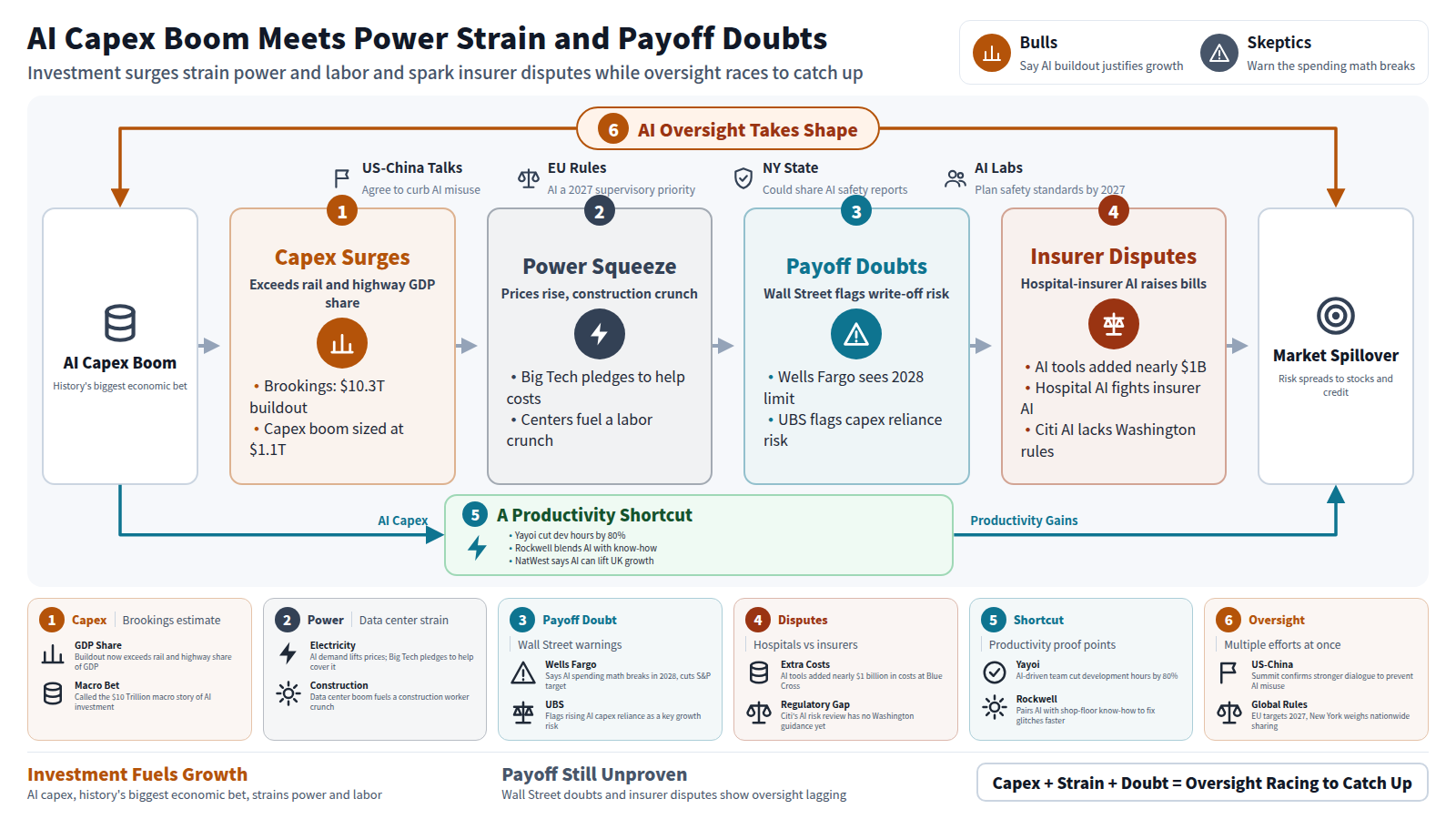
The expansion of AI-related capital investment and its side effects on profitability, electricity procurement, and employment are becoming a focus at the same time. Wariness about the risk of write-downs announced by Burry et al. and the tightening of power and labor due to data center construction are progressing in parallel. At the U.S.-China summit meeting, it was also announced that the two countries would strengthen dialogue to prevent the misuse of AI (Jiji Press, Fukui Keizai Shimbun, etc.).
Macroeconomic/growth trends
While the AI boom has been described as the ``biggest economic bet in history'' (US, research report), AFR points out that ``the AI boom may end in a severe global recession,'' and there are both optimistic and pessimistic opinions (KTLA) (AFR). NatWest Group claims to contribute to UK economic growth through the use of AI (NatWest Group). Axios reports on an “unprecedented battle for capital” driven by AI (Axios). A panel was also held to discuss incorporating AI into inflation and interest rate forecasts (Stacking Benjamins).
Productivity trends
It is reported (Universul.net) that large companies will take the lead in the AI competition, which will spread to the real economy. MIT and Suffolk University publish study on productivity impact in construction (bdcnetwork.com). The EU's AI advisory committee urges the European Commissioner to rebuild the region's economy through the use of AI (politico.eu). Meanwhile, AFR warns that the "layoff trap" could be the biggest threat to AI (AFR). New York City is considering AI regulation legislation while aiming to become the "AI capital of the world" (Fortune).
Trends in employment and labor market
IBM survey points out skill gap in AI talent (eenewseurope.com). Verizon reportedly spent $71 million to avert the "threat of job losses due to AI" (Telecoms). In the HR field, the need to build AI literacy by role was discussed (HRTech Series), and DHL called for response to AI-based transformation in the logistics field (DHL). ECU (East Carolina University) in the US introduces a new AI strategy for students (WITN).
Trends in energy/power demand
Data center construction is straining power, power grids, and construction labor (The Verge, KPAX News). Diraq claims the possibility of reducing power consumption for AI learning using quantum computers (Quantum Zeitgeist). DarkHorse (NASDAQ: DRK) announces strategic partnership to expand AI data center in TVA region (marketscreener.com). A US public opinion poll shows wariness about AI-driven data center expansion (energynow.com). In Malaysia, it was reported that Japanese regulators are stepping up oversight of loans for AI data centers (The Edge Malaysia).
Remarks by central banks, international organizations, and VIPs
Regarding Lagarde, Ueda, Bailey, Georgieva, Cormann, Banga, Acemoglu, and Brynjolfsson on this list, we could not confirm any specific statements or actions in the headings. Regarding international organizations, Lesotho is reported to be the first country in the world to apply the UN's AI Blueprint (iAfrica.com).
Trends in corporate capital investment
It is reported that AI-related capital investment is at the stage where the results of the "Capex Boom" of "$1.1 Trillion" are being questioned (The Dark Side Of The Boom). An article was published (Insider Monkey) comparing Microsoft and Amazon's ability to convert capital investment into profits in their AI cloud businesses. Burry warns of write-offs risk as hyperscalers expand AI investment (Seeking Alpha). While Meta's stock price has plummeted due to concerns about capital investment, analysts and individual investors say it is the ``most undervalued AI stock in the Mag 7'' (Stocktwits). Akamai was reportedly recognized as a "genuine AI cloud company" (Money Morning).
Trade and industrial policy
Chinese cities compete to attract AI filmmakers by offering subsidies and cheap computing resources (Technology Org, Reuters, Межа. Новини України.) Anthropic presents “2028: Two Scenarios for Global AI Leadership” (Anthropic). NVIDIA is reported to have a gross profit margin of 71.1%, and Jensen Huang is said to have commented on the state of AI regulation (tradingview.com). Regarding Japan, it was confirmed at the U.S.-China summit meeting that there will be stronger dialogue to prevent the misuse of AI (Fukui Keizai Shimbun).
Integrated analysis: What is happening now
Looking across the headlines, the AI investment cycle emerges as a series of structures: ``expansion of capital investment'' → ``stress on electricity and construction labor'' → ``skepticism about monetization (burry, meta stock price drop).'' The focus is on whether capital investments on the scale of $1.1 Trillion (The Dark Side Of The Boom) can be converted into actual profits, and the comparison of Microsoft and Amazon's capital investment efficiency (Insider Monkey) is also in this context. At the same time, expectations for AI to improve productivity (recommendations to the construction industry, the UK economy, and the European Commission) coexist with concerns about job losses and layoffs (AFR "layoff trap," Verizon's huge investment), and divergences of optimism and pessimism regarding the economic effects of AI are appearing simultaneously in multiple sections. In the electric power sector, the construction boom has emerged as a constraint on the power grid and construction labor force, and there are also ripple effects on policy and finance in the form of public wariness (energynow.com) and regulatory authorities' increased monitoring of loans (related to Malaysia and Japan). Direct statements from the heads of central banks and international organizations were not included in this collection, and the focus was on developments at the practical and institutional level, such as the application of the United Nations Blueprint to Lesotho and statements from the EU's AI advisory committee.
Future points of interest
- In the next financial results of hyperscalers (Microsoft, Amazon, Meta, etc.), whether the capital investment estimated at $1.1 trillion has turned into actual profits (including whether the risk of valuation losses pointed out by Burry has materialized). - How will the tightening of electricity and power grids for data centers affect policy and regulatory responses (such as strengthening loan monitoring by financial authorities in Japan and elsewhere) through construction labor shortages and public backlash in the United States (energynow.com)? - Will central bank governors and heads of international organizations (Lagarde, Ueda, Bailey, Georgieva, etc.) refer to AI-related prices, growth, and financial stability in future press conferences and statements?
AI and finance latest news
Overview
While Citi has introduced AI in risk screening, a regulatory gap has emerged in which guidelines from authorities are not yet developed (Forbes). In the insurance industry, it has been pointed out that the use of AI is intensifying disputes with hospitals and increasing the burden on patients (Common Dreams). Google, OpenAI, and Anthropic are considering establishing an AI safety standards organization by 2027 (The Times of India, finance.biggo.com).
Bank trends
Citi has introduced a system in which AI reviews risk at the beginning of the loan appraisal process, but Washington (US authorities) has no corresponding guidelines, Forbes reported. BNP Paribas has partnered with Google Cloud in the field of agent AI and cloud (Markets Media). Illumio discussed the relationship between EU banking resilience and frontier AI, and Pinnacle Financial Partners pointed to the opportunities and growing risks of AI in financial management (Illumio, Pinnacle Financial Partners). Barclays follows HSBC and Tom Lee in raising its S&P 500 target based on AI results (Stocktwits).
Insurance trends
Although insurance companies are bullish on the use of AI, a survey has revealed that policyholders still prefer human assistance (Insurance Business). Life Insurance International points out that AI can be both a threat and an opportunity for insurance companies in terms of dispute resolution. S&P Global Ratings found that good AI governance separates insurance companies from winners and losers (Insurance Business). There are also reports that the battle over AI between insurance companies and hospitals has pushed up patient prices by about $1 billion (Common Dreams). Oracle has sent a “force majeure” notice over its troubled AI data center (Impakter).
Trends in asset management and market transactions
Stocktwits reported that BlackRock has joined Meta's $14 billion data center business (Stocktwits). BNP Paribas Asset Management discussed the climate challenges and opportunities of AI (BNP Paribas Asset Management). PE funds are progressing with individual optimization of strategies using AI amidst intensifying competition (Law360). Reuters opined that AI challenges are forcing the trading industry's legacy forces to change (Reuters). Stocktwits reported that Dow, S&P 500, and Nasdaq futures rose as momentum in AI-related trading revived following the financial results of big tech companies such as Amazon and Apple. FXEmpire points out that the decline in Oracle stock is testing the resilience of AI-related investments and long-term interest rates (highest since 2007). In the Japanese market, the Nikkei average rose 1.2% due to purchases of AI-related stocks and purchases aimed at dividends (The Economic Times).
Fintech/payment trends
Block has added support for Bitcoin Lightning Network to its payment protocol “x402” (bloomingbit, BigGo Finance). AxLabs has released “Simple Agent Wallet” for autonomous AI payments on EVM, Solana, and Hedera (Neo News Today). LoanPro announced a new payment, loan execution, and AI servicing tool (Finovate). PYMNTS.com commented that building an AI agent is "no longer the most difficult challenge" in agent-based commerce (PYMNTS.com).
Remarks from key figures and authorities in the financial world
We were unable to confirm any of the headlines reporting direct statements or actions by the key figures being tracked (Jamie Dimon, Larry Fink, Jane Fraser, David Solomon, Brian Moynihan, Ted Pick, Ken Griffin, and Paul Atkins).
Trends in AI-related stocks and funding
An analysis by Yahoo Finance shows that three Canadian AI-related stocks have room for up to 85% upside relative to fair value. An article explaining AI investment in Wayve, a British AI company that operates a self-driving taxi business in London, has been published (Morningstar). AlphaGo co-developer raises funding for AI startup (Briefs Finance). Meta's AI "Muse" could become a new multi-billion dollar revenue stream, according to an analysis (Seeking Alpha). At Dealroom, Lemkin and O'Driscoll discussed the AI bubble, Muse, and new seed-stage funding formulas (Dealroom).
Trends in financial regulation and supervision
The Financial Times discussed how AI can address financial risks (Financial Times). It has been reported that Google, OpenAI, and Anthropic may jointly come up with AI safety standards by early 2027, and there are also reports that the establishment of an independent AI safety standards organization is being considered as early as this year (The Times of India, finance.biggo.com). As mentioned above, it has also been pointed out that there are no guidelines from the US authorities regarding Citi's AI-based risk assessment that has been raised as a regulatory issue (Forbes).
Japan-related supplement
Daiwa Securities has fully adopted LayerX's "Ai Workforce" at its inheritance business bases, expanding AI-based support for determining heirs and creating inheritance relationship diagrams to its bases nationwide (PR TIMES, bizzine.jp). Dai-ichi Life Asset Management Economic Research Institute discussed whether AI stocks will be more selective in Japan's 3% long-term interest rate environment (Dai-ichi Life Asset Management Economic Research Institute). WSJ reported that even in the age of AI, "cash is king" (WSJ).
Integrated analysis: What is happening now
AI is being implemented first in banking and insurance, and AI is being incorporated into the core of decision-making processes, such as Citi's risk screening AI (Forbes) and Daiwa Securities' introduction of inheritance business AI (PR TIMES). On the other hand, the regulatory gaps pointed out by Forbes and the increase in patient costs due to intensifying disputes between insurance and hospitals (Common Dreams) indicate a structure in which governance and regulatory responses have not kept up with the speed of implementation. On the market side, funds are still flowing heavily into the AI infrastructure and data centers of major tech companies, as seen in BlackRock's investment in Meta data center and Barclays' bullish forecast for AI earnings (Stocktwits), but Oracle's "force majeure" notice and the combination of Oracle's stock decline and long-term interest rates rising (Impakter, FXEmpire) suggest that the cost of financing AI investments and the risk of implementing infrastructure are rising at the same time. In the field of payments, the development of infrastructure that allows autonomous AI agents to directly make payments, such as x402 and Simple Agent Wallet, is progressing (bloomingbit, Neo News Today), and this may become a new frontier where regulatory gaps will expand. On the regulatory side, while the private sector-led safety standards group initiative by Google, OpenAI, and Anthropic (The Times of India) is making progress, the response from the financial authorities (Citi case) appears to be lagging behind, and the disconnect between industry and authorities may become a point of contention in the future.
Future points of interest
- Whether US authorities (Federal Reserve, OCC, etc.) will provide specific supervisory guidance for AI-driven risk reviews like Citi. - The concrete image of the AI safety standards organization envisioned by Google, OpenAI, and Anthropic, and whether it will have any impact on the financial industry. - The impact of Oracle's data center problems and high interest rate environment on the sustainability of major tech companies' AI infrastructure investments (including investments by BlackRock and others).
- Is "This Time Different"? A FinCon Panel on AI, Inflation, and Interest Rates SB1902 — Stacking Benjamins09/25 07:05 UTC
- AI boom could end in nasty global recession — AFR09/25 08:34 UTC
- How business adoption of AI can power UK economic growth — NatWest Group09/25 08:59 UTC
- AI's never-before-seen capital grab — Axios09/24 23:33 UTC
- The AI race hits the real economy, and big business is already pulling ahead — Universul.net09/25 08:00 UTC
- EU’s top AI adviser urges commissioners to use the technology to fix bloc’s economy — politico.eu09/24 22:46 UTC
- MIT and Suffolk release study on how AI is reshaping construction productivity — bdcnetwork.com09/24 22:32 UTC
- New York City writes bill to rein in AI while insisting it wants to be the ‘AI capital of the world’ — Fortune09/25 09:00 UTC
- Forget rogue robots; AI’s biggest threat is the ‘lay-off trap’ — AFR09/25 02:11 UTC
- IBM study finds AI workforce skills gap ... — eenewseurope.com09/25 07:53 UTC
- Verizon coughs up $71m to stave off the AI jobs apocalypse — Telecoms09/25 08:59 UTC
- Workforce AI Literacy: Why HR Must Build Role-Based Skills for Human-AI Work — HRTech Series09/25 07:11 UTC
- AI is rewiring logistics. Are you ready to lead the change? — DHL09/25 03:36 UTC
- All the latest updates on AI data centers — The Verge09/25 06:23 UTC
- Diraq Says Quantum Computers Could Cut AI’s Energy Use For Data Training — Quantum Zeitgeist09/25 09:00 UTC
- AI data center boom fueling a construction worker crunch — KPAX News09/24 23:17 UTC
- DarkHorse (NASDAQ: DRK) Strategic Partners Power Up AI Data Center Expansion Across TVA Region — marketscreener.com09/25 08:19 UTC
- Americans Wary of AI-Driven Data Center Boom Poll Shows — energynow.com09/24 22:41 UTC
- China’s Cities Race to Lure AI Filmmakers With Subsidies and Cheap Compute — Technology Org09/25 08:36 UTC
- China fuels rush to turn AI video into an industry — Reuters09/25 01:01 UTC
- 2028: Two scenarios for global AI leadership — Anthropic09/25 00:50 UTC
- Key facts: NVIDIA (NVDA) 71.1% gross margin; Huang urges AI controls — tradingview.com09/25 07:00 UTC
- How can AI enhance human progress? — GZERO Media09/25 04:53 UTC
- Japan regulator is boosting scrutiny of AI data centre financing — The Edge Malaysia09/25 08:09 UTC
- The real risk of AI is how humans use it — GZERO Media09/24 23:28 UTC
- Rising yields, oil prices put Asian equities in ‘tug of war’ with AI boom: HSBC — The Business Times09/25 04:27 UTC
- Lesotho Is First to Apply UN AI Blueprint, Starting With What It Needs Before What It Builds — iAfrica.com09/25 08:29 UTC
- AI’s $1.1 Trillion Capex Boom Now Has to Earn Its Keep — The Dark Side Of The Boom09/25 07:15 UTC
- Microsoft vs. Amazon: Which AI Cloud Stock Converts Capex Into Profits Better? — Insider Monkey09/25 03:52 UTC
- META Stock Rout Deepens Overnight On Capex Woes — Analysts, Retail Bulls Still Back Mag 7’s Cheapest AI Bet — Stocktwits09/25 03:27 UTC
- Akamai Just Got Paid Like a Real AI Cloud Company — Money Morning09/25 06:28 UTC
- Expanding the use of AI also requires data preparation, result verification and adjustment, and systematic operation is required [Society] — VIETJOベトナムニュース09/25 08:33 UTC
- Suzuki cuts development time for new cars in half = 24 months, improves efficiency with AI — 時事通信ニュース09/25 08:34 UTC
- Study session “Engawa AI×XR” at Motoyawata Announcement of AI application development results (Minna no Keizai Shimbun Network) — Yahoo!ニュース09/25 07:00 UTC
- US-China summit to strengthen dialogue to prevent AI misuse — 福井経済新聞09/25 05:21 UTC
- What are the winners and losers in the new "AI agent economy" and its stock market? Interesting areas cited by investment professionals — Business Insider Japan09/25 03:00 UTC
- Frontier AI and EU Banking Resilience — Illumio09/25 01:57 UTC
- AI and Treasury Management: More Opportunity, More Risk — Pinnacle Financial Partners09/25 06:47 UTC
- At Citi, An AI Now Reviews Risk First. Washington Has No Guidance For That — Forbes09/25 01:13 UTC
- S&P 500 Targets Keep Rising: Barclays Joins HSBC, Tom Lee In AI-Earnings Bullish Chorus — Stocktwits09/25 05:25 UTC
- BNP Paribas, Google Cloud Partner on Agentic AI & Cloud — Markets Media09/25 08:06 UTC
- Insurers are bullish on AI, but policyholders want a human on standby - study — Insurance Business09/25 07:57 UTC
- Threat and opportunity for insurers as AI will drive disputes — Life Insurance International09/25 07:31 UTC
- Oracle Sends ‘Force Majeure’ Notice Over Troubled AI Data Center — Impakter09/25 06:44 UTC
- AI Battle Between Insurers and Hospitals Jacked Up Patient Prices by Nearly $1 Billion — Common Dreams09/24 21:49 UTC
- AI’s climate challenges and the potential opportunities — BNP Paribas Asset Management09/25 04:21 UTC
- Meta’s Latest AI Bet Comes A Day Before Q2 Earnings: BlackRock Joins $14B Data Center Venture — Stocktwits09/25 02:11 UTC
- How AI vulnerability discovery is rapidly reshaping SOC reporting — EY09/25 03:57 UTC
- PE Funds Use AI To Tailor Strategies Amid Heavy Competition — Law36009/25 00:19 UTC
- Unlocking the power of AI in water — kpmg.com09/25 07:26 UTC
- COMMENTARY: AI challenges fuel trading's old guard — Reuters09/25 06:20 UTC
- AI Could Open Fuel Trading to New Players by Turning Data Into Trade Ideas — Межа. Новини України.09/25 06:41 UTC
- Dow, S&P 500, Nasdaq Futures Extend Rally As Big Tech Earnings Revive AI Trade: AMZN, AAPL, NBIS, RDDT In Focus — Stocktwits09/25 04:40 UTC
- Meta: Muse AI Set To Create New Multibillion-Dollar Revenue Stream (NASDAQ:META) — Seeking Alpha09/24 22:13 UTC
- Nasdaq Index: Oracle Plunge Tests AI Spending as Yields Hit 2007 High — FXEmpire09/25 00:02 UTC
- Why Building AI Agents Is No Longer the Hardest Part of Agentic Commerce — PYMNTS.com09/25 08:06 UTC
- Block Adds Bitcoin Lightning Support to AI Agent Payments Protocol x402 — bloomingbit09/25 05:34 UTC
- AxLabs releases Simple Agent Wallet for autonomous AI payments across EVM, Solana, Hedera — Neo News Today09/25 03:28 UTC
- India is not just ahead in UPI and digital payments but is also building one of the world’s most advanced credit infrastructures. How are AI, technology, and digital public infrastructure reshaping the lending ecosystem and expanding access to credit? Watch Bh — LinkedIn09/25 08:01 UTC
- LoanPro Launches New Payments, Disbursement, and AI Servicing Tools — Finovate09/24 21:33 UTC
- AI Bubble, Muse and the New Seed Math: Lemkin & O'Driscoll Weigh In — Dealroom09/25 07:47 UTC
- 3 Canadian AI Stocks With Up To 85% Fair Value Upside — Yahoo Finance09/25 03:14 UTC
- How to Invest in Wayve, the UK AI Firm Behind London’s Robotaxis — Morningstar09/25 05:08 UTC
- AlphaGo Co-Creator Raises Funds for AI Startup — Briefs Finance09/25 03:11 UTC
- Global Market: Japanese shares rise on AI stocks, dividend buying; Nikkei up 1.2% — The Economic Times09/25 04:12 UTC
- How can we tackle AI’s financial risks? — Financial Times09/25 04:00 UTC
- Why ATGL's Small Scale Could Become an Advantage in Enterprise AI — tradingview.com09/25 01:00 UTC
- Google, OpenAI and Anthropic may launch AI safety standard by early 2027 — The Times of India09/25 01:56 UTC
- Sharon AI appoints EY as new auditor, drops HoganTaylor — Capital Brief09/24 22:43 UTC
- Will AI stocks fall with Japan's long-term interest rate of 3%? - Selecting AI stocks as high interest rates approach - | Yu Kashiwamura | Dai-ichi Life Asset Management Economics Research Institute — 第一ライフ資産運用経済研究所09/25 02:12 UTC
- Daiwa Securities fully adopts LayerX's "Ai Workforce" at its inheritance business base to support heir determination with AI — bizzine.jp09/25 02:15 UTC
- Even in the age of AI, “cash is king” — WSJ09/25 01:13 UTC