
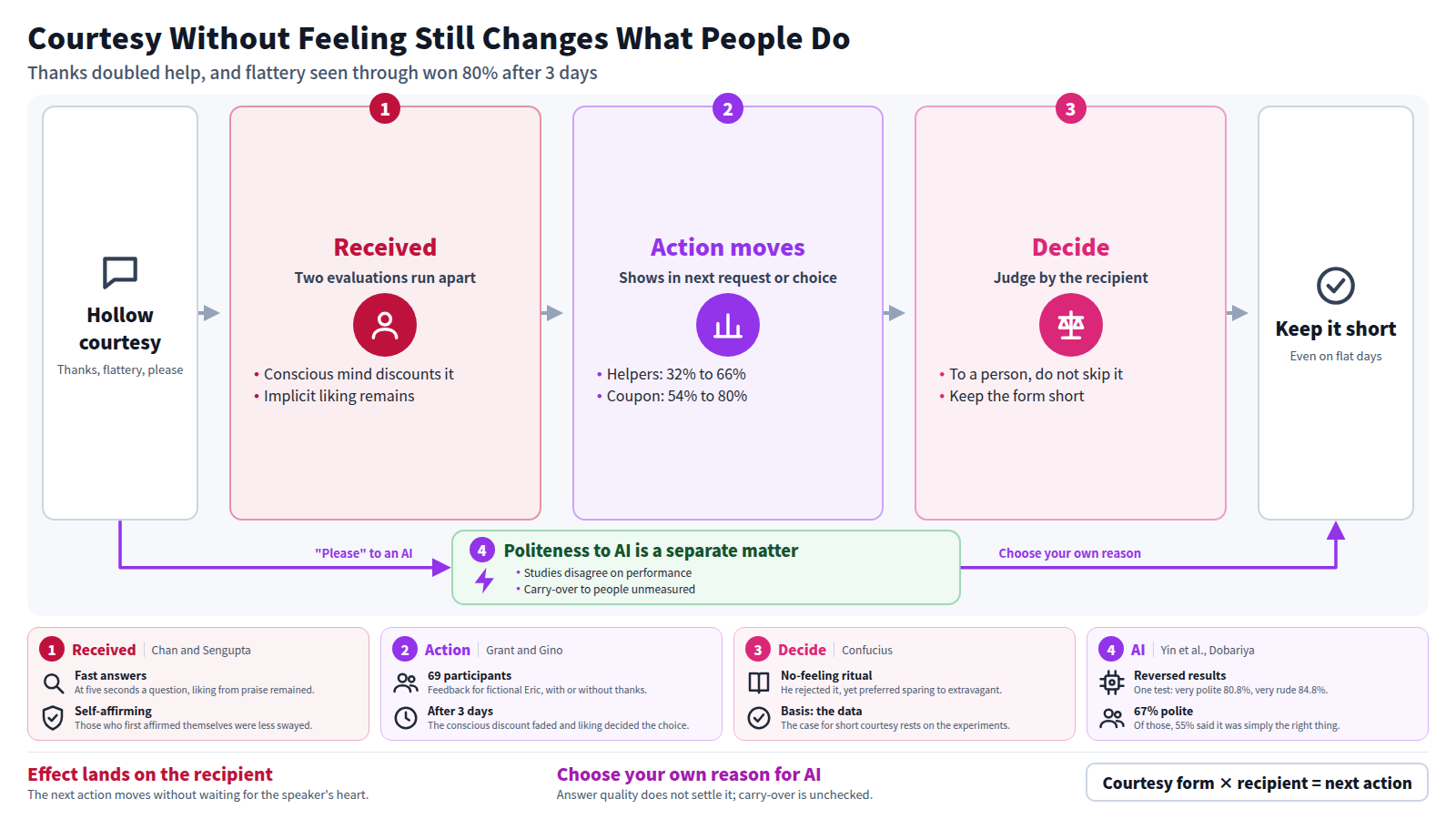
In April 2025, OpenAI's Sam Altman was asked on X how much electricity it costs when people type "please" and "thank you" to ChatGPT. His answer: "tens of millions of dollars well spent — you never know." Some who say please do so knowing the AI has no feelings. Does courtesy mean anything without the feeling behind it? It does. The effects of courtesy that researchers have measured show up in what the recipient does next, not in the speaker's inner state.
01Courtesy without feeling still has effects, and they appear in the recipient's behavior
Psychology experiments have counted the effects of courtesy in what recipients do. In one study, people who received a thank-you email from someone they had helped agreed to help again 66% of the time. Among those who received an email with no thanks, the figure was 32%.
In another study, a store's flattering flyer swayed people's choices even when they recognized the flattery as self-serving. That store's coupon was chosen by 54% of those who chose at once and by 80% of those who chose three days later. Neither study measured how the speaker felt. Both measured what the recipient did. The thanks was written by the researchers, and the flattery was seen through.
It follows that courtesy known to have no feeling behind it, such as the polite stock phrases an AI produces, can still carry meaning on the receiving end. Three practical choices follow for us. Do not skip the thank-you on days the feeling is thin. Since studies do not agree that politeness improves an AI's answers, decide why you are polite to AI on grounds other than answer quality. And keep the form short.
02Courtesy is a fixed form of words toward others, and Confucius rejected it without humaneness
By courtesy, I mean fixed forms of words and behavior directed at another person: thanks, greetings, compliments. Because the form is fixed, any of them can be said without the feeling.
Words of thanks
Recipients tend to take them as sincere. Their effect was measured in willingness to help.
A store's flattery
Recipients see through the motive. Liking for the store still remained.
"Please" to an AI
Some users know the AI has no feelings. In the US, 67% of respondents said they were polite to it.
The habit of separating form from feeling is old. In the Analects, in the book titled Bayi, Confucius asked: "If a man is not humane, what has he to do with ritual?" The original reads 人而不仁,如禮何. The question is what the forms of ritual can mean to someone without care for others.
Confucius drew a line between the form of ritual and the humaneness behind it, and he gave no value to ritual without humaneness. That is the opposite of this essay's answer. His words state a view: courtesy ought to express what is inside. The sections below test that view against the numbers.
03The effects were counted in work and shopping settings: a request to edit a document and a store's sales flyer
Confucius rejected ritual without humaneness. So where, in practice, has the effect of courtesy been counted? This essay relies on two experiments.
The first is a 2010 experiment by the psychologists Adam Grant and Francesca Gino. Participants were asked to give feedback on a cover letter for a job application written by a student named Eric, who was fictional. After they sent their comments, Eric replied and asked for help with a second letter.
The second is a 2010 study by Elaine Chan and Jaideep Sengupta at the Hong Kong University of Science and Technology. Participants read a department-store leaflet that praised their fashion sense, then rated the leaflet and the store. Afterward they chose between a coupon from the flattering store and one from a competitor that had not flattered them.
The settings, then, were a request to review a document and a sales pitch. Both are situations people meet often at work and in shopping. None of the sources in this essay measured courtesy in specialized professional settings, such as the review of promotional materials. What can be said is what happened in these two experiments.
04Seeing through flattery does not erase the warm response: conscious discounting and implicit liking run separately
The store's flattery worked even when its motive was visible. Chan and Sengupta explained this by showing that people evaluate flattery in two separate ways.
One is the conscious evaluation. Given time to think, participants noticed that the flattery had a motive, and they discounted the store accordingly. The other is implicit liking. The researchers measured it by having people answer under time pressure, five seconds per question. Measured that way, the good feeling that came from being praised remained, undiscounted.
The difference between those two evaluations showed up in the coupon choice. Among people who chose right after reading the leaflet, 54% picked the flattering store's coupon. Among those who came back three days later to choose, 80% did. As the conscious discount faded with time, the researchers explained, the implicit liking decided the choice.
The researchers reported one more result. People who first did a short exercise affirming their own worth were less moved by the flattery. After affirming themselves, people were harder to sway with praise.
05One line of thanks lifted help with a second edit from 32% to 66%
Flattery's warmth can last three days. How much does courtesy change whether people lend a hand? Grant and Gino's experiment shows the size of the effect.
The 69 participants were split into two groups by the reply they received from Eric. One group got a reply in which Eric thanked them for the feedback. The other got a neutral reply with no thanks. Among those thanked, 66% helped with the second letter; among those not thanked, 32% did.
| What to look at | Grant and Gino (2010) | Chan and Sengupta (2010) |
|---|---|---|
| Form of courtesy | A thank-you email for editing | Flattery in a store leaflet |
| How recipients read it | Taken as gratitude | Motive seen and discounted |
| Behavior measured | Helped with a second letter: 32% → 66% | Chose the store's coupon: 54% at once, 80% after 3 days |
Set side by side, the two experiments show recipients reading courtesy in opposite ways. The thanks was taken at face value; the flattery was suspected. Yet in both, the next action moved toward the courtesy.
Eric was fictional, and the researchers wrote his thank-you. Whether any feeling lay behind those words was simply not part of the experiment. The only question was whether the recipient helped again.
06The recipient decides the effect, and politeness to AI does not reliably improve its answers
A line of thanks doubled the share of people who helped, from 32% to 66%. From that number, several judgments about courtesy toward people and toward AI come into view.
Judge by the recipient
Thanks given on a day without much feeling still changes what the recipient does next.
Choose a reason for AI
Studies disagree on whether politeness improves an AI's answers.
Keep the form short
Keep up a short courtesy rather than an elaborate one. Confucius, too, preferred plain to lavish.
The first judgment is to measure courtesy by what the recipient does. A thank-you email doubled the helpers, and even flattery seen through moved 80% of choices three days later. So do not drop the thank-you on a busy day when the feeling is not there. In both experiments, even when the speaker's feeling looked thin, the effect arose on the recipient's side.
The second concerns politeness toward AI. In 2024, Yin and colleagues at Waseda University and elsewhere tested how prompt politeness affects large language models, the systems underneath tools like ChatGPT, in English, Chinese and Japanese. They found that impolite prompts often led to poor performance, while overly polite language did not guarantee better outcomes.
A small 2025 experiment by Om Dobariya and Akhil Kumar on GPT-4o pointed the other way. Very polite prompts scored 80.8% accuracy; very rude prompts scored 84.8%. The two studies used different conditions, so neither settles the matter. What can be said is that studies do not agree that politeness makes an AI's answers better. The reason to be polite to an AI has to be decided on other grounds.
The third concerns the form courtesy takes. The same Confucius who rejected ritual without humaneness also said, in the same book: "In ritual, it is better to be sparing than extravagant." On a day when feeling runs short, there is no need to dress courtesy up. Confucius was advising against display, not endorsing ritual without humaneness. The support for keeping up a short courtesy comes from the numbers: what raised help was a single line of thanks.
07Whether politeness toward AI carries over to people has not been measured
If politeness to AI does not reliably improve its answers, is the real reason for it the link to how we treat people?
A late-2024 survey reported by GIGAZINE found that 67% of American respondents said they treat chat AI with courtesy. Of those, 55% said it was simply the right thing to do. Another 12% said they feared an AI uprising. Altman put the electricity cost of all that courtesy at tens of millions of dollars, though reports noted his joking tone suggested he had not calculated it precisely.
More than half of the polite respondents gave rightness as their reason, an answer that reads as the same reason behind manners toward people. But among the sources checked for this essay, none tested whether being polite or rude to an AI carries over to how people treat other people. For now, no one can say it does, or that it does not.
What we can check is our own habits. Has the courtesy we drop with an AI started disappearing from emails to colleagues? On a day without much feeling, did we still manage one short line of thanks? Until research answers the question, rereading our own words is the evidence we have.
- A single line of thanks raised help from 32% to 66%, and seen-through flattery still won 80% of choices three days later. Courtesy works through what the recipient does.
- Politeness toward AI cut both ways: rudeness hurt results in Yin et al., yet scored higher in Dobariya and Kumar. Answer quality does not settle why we are polite to AI.
- Confucius rejected ritual without humaneness yet preferred plain ritual to lavish ritual. That a short courtesy is worth keeping on days the feeling is thin rests on the experiments, not on Confucius.
Within what the two experiments show, courtesy means something even without the feeling. Its effect shows up in what the recipient does next and does not wait for the speaker's heart. A thank-you email doubled the number of helpers, and flattery seen for what it was still moved choices three days on.
The feeling matters when deciding to keep the form plain and keep it up. On the days the feeling is missing, write the one short line of thanks anyway. It is a choice made with knowledge of what happens on the other side. Whether to thank an AI is a separate choice, made for a reason of your own rather than for answer quality.
- GIGAZINE. OpenAI CEO Sam Altman says politeness to ChatGPT costs tens of millions of dollars in electricity. 2025-04-21.(Altman's remark; late-2024 survey: 67% of US respondents polite to chat AI)
- Ziqi Yin, Hao Wang, Kaito Horio, Daisuke Kawahara, Satoshi Sekine. Should We Respect LLMs? A Cross-Lingual Study on the Influence of Prompt Politeness on LLM Performance. arXiv:2402.14531, 2024.(English, Chinese, Japanese; impolite prompts often hurt performance)
- Om Dobariya, Akhil Kumar. Mind Your Tone: Investigating How Prompt Politeness Affects LLM Accuracy. arXiv:2510.04950, 2025.(GPT-4o: very polite 80.8%, very rude 84.8%)
- Psych Central (Jeremy Dean). Why 'Thank You' Is More Than Just Good Manners. 2010.(Grant and Gino: 69 participants, cover-letter feedback, 32% to 66%)
- HKUST Business School (BizInsight). Insincere Flattery Works. 2010-03.(Chan and Sengupta: conscious discounting and implicit liking, 54% at once, 80% after 3 days)
- The Analects, Book III (Bayi). Original text on Wikisource. Accessed 2026-10-07.(人而不仁,如禮何; 禮,與其奢也,寧儉)