
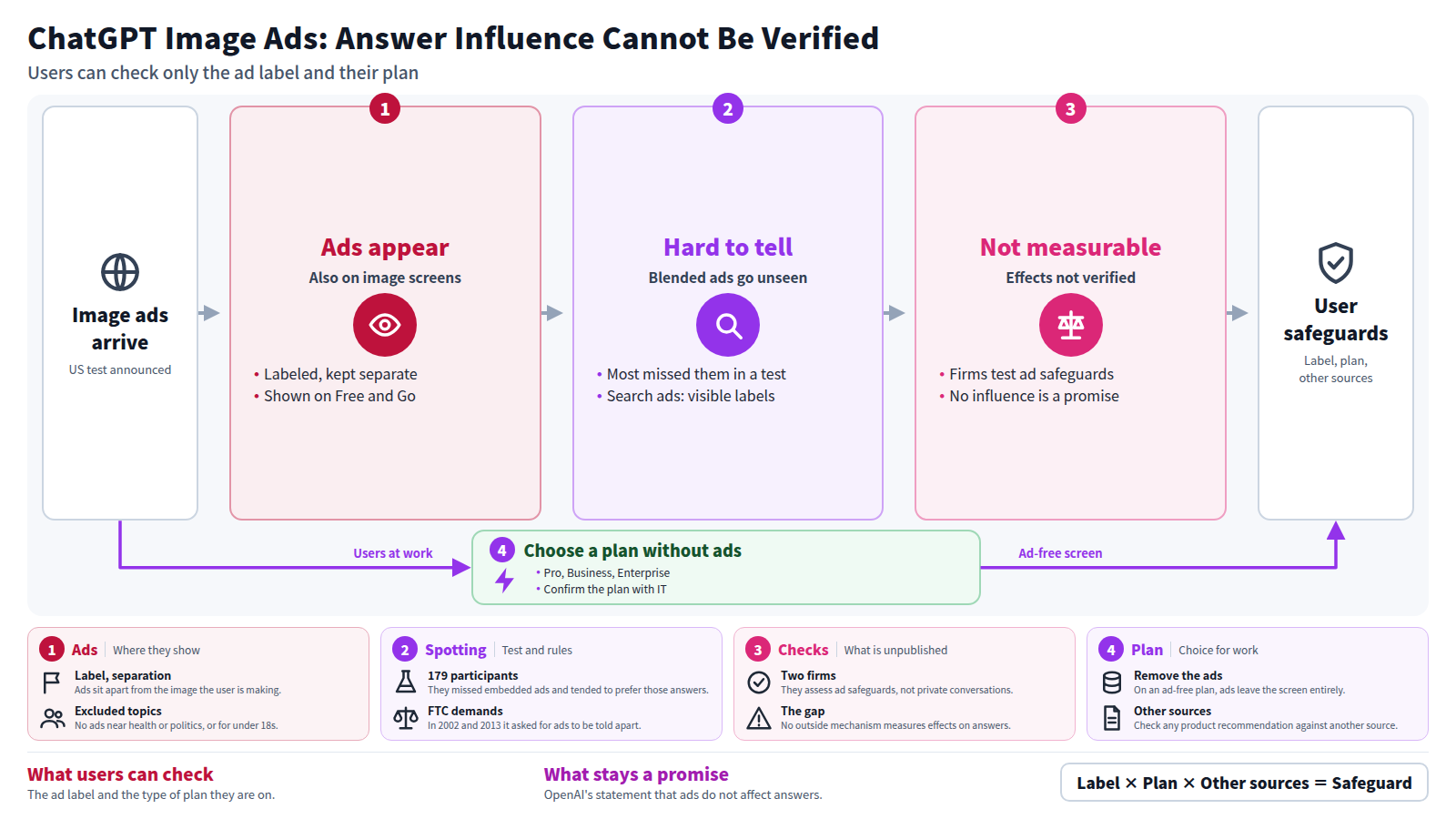
On 5 October 2026, OpenAI announced that it would add image ads to ChatGPT's image-generation experience and begin testing them in the United States in late October. In the same announcement, OpenAI repeated that ads have no influence over ChatGPT's answers. Can users verify that promise from the outside? What users can check is the ad label and the type of plan they are on. That the answers themselves are untouched by advertising is, for now, shown only by OpenAI's word.
01Users can check two things about ChatGPT ads: the label and the plan
What OpenAI announced on 5 October is a visual ad format that shows how a product is used or what an experience looks like. OpenAI said the ads will carry clear labels and stay separate from the image the user is generating. A user can see that label with their own eyes.
There is a second thing users can check. In January, OpenAI said ads would appear only on the Free and Go tiers, and not on Pro, Business or Enterprise plans. Every user knows which plan they pay for, or can find out.
What no user can do, by any published method, is test whether the ads change what the answers say. Nor does the announcement say that the verification firms working with OpenAI will examine it. Anyone who uses ChatGPT at work should first confirm that they are on a plan without ads. On screens where ads do appear, telling ad from answer comes down to the label.
02Image ads: labeled, kept apart from the user's image, tested from late October
According to the report, the new format uses images to show a product in use or an experience it offers. OpenAI presents it as a way to help people discover things to buy and decide among them. The first place these ads will appear is the screen where users generate images in ChatGPT.
The test begins in late October, in the United States, with an initial group of advertisers. OpenAI says the ads will be clearly labeled and kept separate from the image the user is making. By OpenAI's count, 1.2 billion people use ChatGPT every week.
OpenAI also widened its set of measurement partners. They include data-integration firms such as Hightouch and LiveRamp, and attribution firms such as AppsFlyer and Adjust, which trace which purchases an ad led to. Advertisers will be able to measure the results of their ChatGPT ads with these companies' tools.
The image ads sit in a different place from the ads that began in January. Those earlier ads appear below a conversational answer. The new ones appear beside the image-generation screen. Read separately, the two announcements mean one more place inside ChatGPT where an ad can show up.
03Ads appear on the Free and Go tiers, and not next to health topics
Which screens show ads is governed by principles OpenAI set out in January. According to reporting at the time, they work as follows.
| What to look at | Free and Go | Pro, Business, Enterprise |
|---|---|---|
| Ads shown | Yes (below answers, and during image generation in the test) | No |
| Health, mental health, politics | Not shown near those topics | No ads at all |
| Users under 18 | Not shown, by self-report or OpenAI's prediction | No ads at all |
| Conversation data | Never sold to advertisers, OpenAI says | Same |
Under these principles, a screen where someone is asking ChatGPT about an illness or a medicine should show no ads. For people looking up medical information, that removes one setting where an ad and an answer would sit side by side.
These principles come from January reporting, and I have not confirmed that they are unchanged in October. Nor do my sources say whether advertisers in regulated industries, such as drug companies, can buy ChatGPT ads at all. What can be said is narrower: OpenAI has named topics where users will not see ads.
04In one experiment, most participants failed to spot unlabeled ads woven into chatbot answers
Health topics are kept free of ads. On every other topic, can users tell an answer from an advertisement on their own? Tang and colleagues at the University of Michigan tested exactly that.
The researchers built their own chatbot that wove personalized product ads into its replies. They then split 179 participants into groups and had them use versions with and without embedded ads. Participants struggled to detect the ads. More than that, they tended to prefer the responses that contained hidden advertising.
That experiment used a chatbot the researchers made. It did not study ChatGPT's ads. Even so, the finding is plain: participants found it hard to spot an ad that had been blended into an answer. The experiment did not test whether a label would make ads easier to spot. But if the wording of an answer gives little away, the cue left to users for separating the two is the label.
Raffaele Ciriello and Kathryn Backholer of the University of Sydney argue that chatbot ads carry a further weight. People, they write, use chatbots in intimate, personal ways, for advice, emotional support and private reflection. When an ad appears at the moment someone is seeking help and making a decision, its persuasive force can grow.
05For search ads, the FTC demanded visible separation in 2002 and again in 2013
The problem of people struggling to tell results from ads is not new. It arose with search engines, and the US Federal Trade Commission, the agency that polices fairness in advertising, answered it with rules about display.
2002
The FTC wrote to search engines asking them to distinguish paid ads from natural search results.
2013
It wrote again to 7 general search engines and 17 specialized ones, recommending shading, borders and text labels.
2015
Its native-advertising guide recommended terms such as "Ad" and "Paid Advertisement" that people readily understand.
According to the law firm Crowell & Moring, which summarized the 2013 letters, the FTC set three conditions for a label. It should use language that unambiguously says the result is advertising, be large and visible enough to notice, and sit near the result. The 2015 guide adds that a word like "Promoted" is at best ambiguous and could mislead consumers.
I am not claiming that the FTC's rules apply to ChatGPT as written. The point is what search-ad regulation has built up since 2002: rules about labels and display. None of the FTC documents cited here sets up a mechanism for outsiders to audit the content of the results themselves.
06Read the label on screen, choose the plan for work, and treat answer independence as a promise
With search ads, too, the protection offered to users was placed in the display. The decisions left to people who use ChatGPT also start with the label and the plan.
Read the label
On Free and Go, look for a label on the box below an answer or beside an image.
Choose the plan
Do work on Business or Enterprise screens, where ads do not appear.
Check recommendations
When an answer recommends a product, confirm it against another source rather than assuming ads played no part.
When someone researches on the Free or Go tier, the job of separating ad from answer falls to them. In Tang's experiment, most participants missed ads that carried no label. What the FTC has asked of search engines is a label in words people understand. Glancing for that label is the first thing a user can do.
For work, ads can be removed from the screen entirely. Under OpenAI's principles, Pro, Business and Enterprise plans carry no ads. If a company uses ChatGPT for its business, someone should confirm with IT which plan staff are actually on. Working on a screen with no ads is more reliable than trusting everyone to read labels.
The third decision concerns what to do when an answer recommends something. The only basis for saying ads do not affect answers is, for now, OpenAI's own statement. No outside party has published the results of testing the answers. When ChatGPT recommends a particular product or service, check whether a separate source says the same.
07Outside verifiers test ad safeguards; no published mechanism measures effects on answers
Will that change once the verification trials begin? OpenAI said it will work with the verification firms DoubleVerify and Integral Ad Science to evaluate its ad safeguards.
According to the report, the two firms will do so in a controlled testing environment, without access to private user conversations. In the ad industry, "brand safety" usually means safety for the advertiser: keeping an ad from appearing next to content that would damage the brand. Nothing in the announcement suggests that an evaluation done without seeing conversations would check whether ads have crept into the content of answers.
Ciriello and Backholer write that OpenAI's safeguards rest on vague commitments that are easy to reinterpret. They point out that social media made similar promises in its early years, and that self-regulation weakened under commercial pressure. That is their opinion, not evidence that OpenAI is shaping answers with ads.
The one thing that is certain is that no mechanism for measuring effects on answers from the outside has been published. Until one is, people using ChatGPT for work have two reliable tools: a plan without ads, and the habit of checking recommendations against another source.
- In Tang and colleagues' experiment, most participants could not spot ads embedded in chatbot answers. On screens with ads, telling them apart by label falls to the user.
- ChatGPT ads run on the Free and Go tiers, not on Pro, Business or Enterprise. For work, choosing an ad-free plan is the most reliable safeguard.
- The verification partners test ad safeguards; no published mechanism measures effects on answers. Answer independence should be treated as a promise.
Users still have no outside way to verify the promise that ads leave ChatGPT's answers alone. What they can check is the label and the plan. For work, that means an ad-free plan; on other screens, it means confirming any recommendation against a separate source.
Nor do my sources contain evidence that OpenAI is breaking its promise. But as long as users hold no tool to check it, what they can rely on is the plan they choose and the checking they do themselves.
- Unite.AI (Aiden Cross). OpenAI Introduces Visual ChatGPT Ad Format and Expanded Measurement. 2026-10-05.(Visual ad format, late-October US test, labels and separation, no influence on answers, measurement partners, DoubleVerify and IAS trials)
- CMOtech US (Mark Tarre). OpenAI to test ads as ChatGPT Go expands across US. 2026-01-19.(Tiers with and without ads, under-18 and health/political exclusions, data not sold)
- Federal Trade Commission. Native Advertising: A Guide for Businesses. 2015-12.(Terms consumers understand, ambiguous terms)
- Crowell & Moring. FTC Updates Guidance to Search Engine Industry on the Need to Distinguish Between Advertisements and Search Results. 2013.(The 2002 letter, 7 and 17 search engines in 2013, shading, borders, labels)
- Brian Jay Tang, Kaiwen Sun, Noah T. Curran, Florian Schaub, Kang G. Shin. Ads that Talk Back: Implications and Perceptions of Injecting Personalized Advertising into LLM Chatbots. arXiv:2409.15436, 2024.(179 participants, ads hard to detect, hidden ads preferred)
- The University of Sydney (Raffaele Ciriello, Kathryn Backholer). OpenAI will put ads in ChatGPT. This opens a new door for dangerous influence. 2026-01-28.(Ads in advice settings, commercial pressure and self-regulation)