In April 2025, OpenAI's Sam Altman was asked on X how much electricity it costs when people say "please" and "thank you" to ChatGPT, and he replied: "tens of millions of dollars well spent — you never know." Is gratitude something we feel, or something we practise? It begins as a feeling. But what research has been able to measure is the practice of writing it down or delivering it. The effect is modest, and those who express it underestimate how much it pleases the person who receives it.
01Research has measured the act of writing and delivering thanks
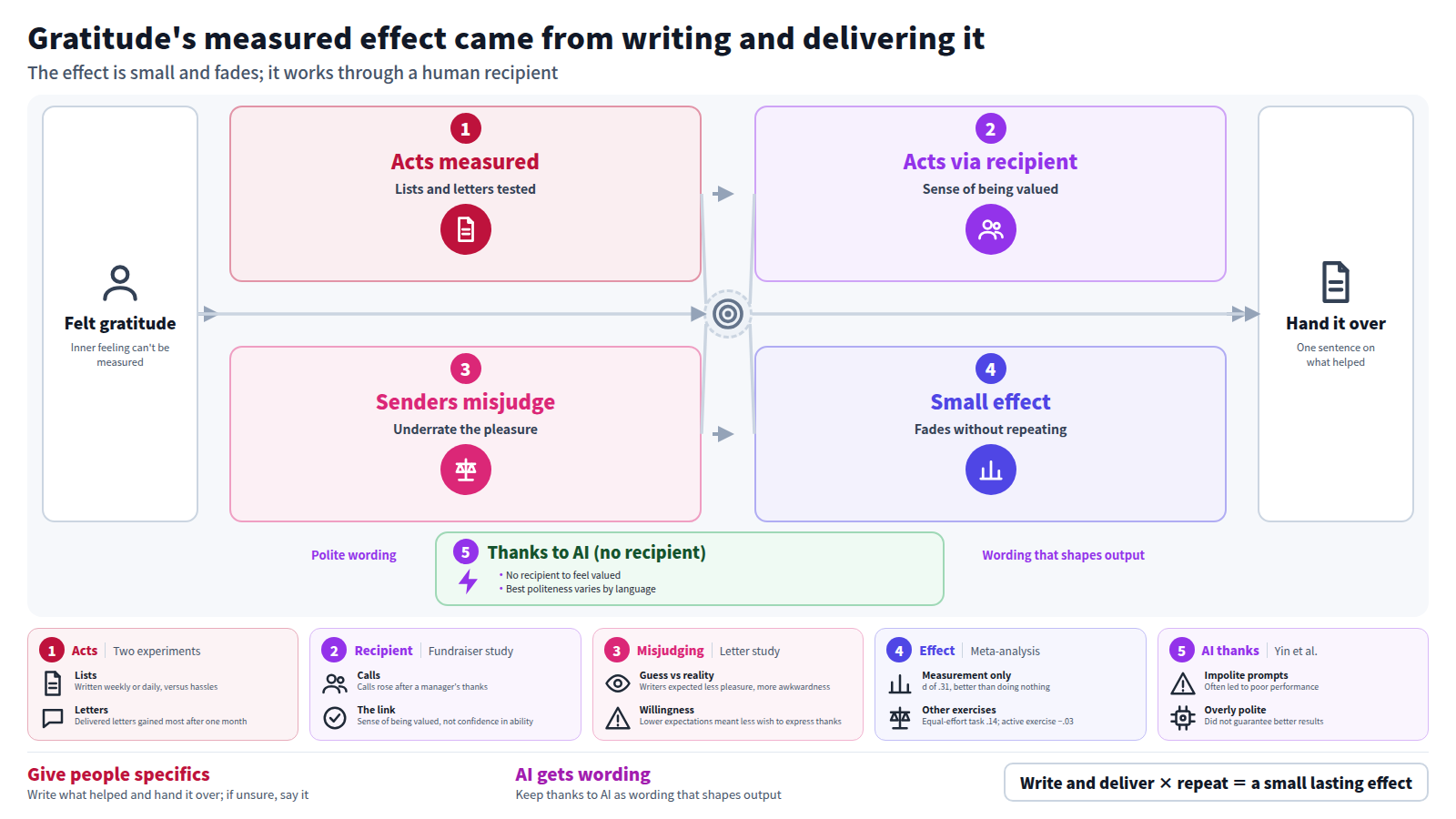
In 2003 the psychologists Robert Emmons and Michael McCullough ran experiments in which people wrote down what they were grateful for. Fifteen years later, Amit Kumar and Nicholas Epley published experiments in which people wrote letters of thanks. Many studies of gratitude came in between. In each of the ones discussed here, what was measured was an act: writing gratitude down, or expressing it to someone.
Researchers cannot measure the gratitude a person carries inside. They can measure whether someone wrote a list, and whether a letter was delivered. So I am not dismissing gratitude as a feeling. My point is narrower. What the research has shown is the effect of gratitude that was written or delivered.
That effect is small. A 2016 meta-analysis found that even against doing nothing the difference was small, and that gratitude exercises did no better than other psychologically active exercises. And Kumar and Epley found that people who write letters of thanks expect the recipient to be less pleased than the recipient turns out to be.
My answer follows from these facts and from how thanks works on the recipient, shown later. Gratitude is better treated as a practice. And it is better kept separate from the politeness we offer an AI, which has no one on the receiving end.
02The experiments manipulated weekly lists and letters, not feelings
The "acts" that research measured were specific. Two experiments show what the participants were actually asked to do.
Gratitude lists (2003)
Emmons and McCullough had people write down things they were grateful for, weekly or daily, and compared them with people who wrote down hassles.
Gratitude letters (2005)
Seligman and colleagues had people write a letter of thanks and deliver it in person, and set this beside four other exercises and a control task.
Emmons and McCullough assigned participants to groups at random. One group wrote down blessings. Another wrote down burdens. Across three studies, the gratitude groups showed higher well-being on several of the outcome measures, though not on all of them. The clearest effect was on positive mood.
In 2005, Martin Seligman and colleagues compared six groups in an online study with random assignment. Five groups did exercises that were supposed to raise happiness. The sixth did a plausible control exercise. The group that wrote a gratitude letter and delivered it showed the largest gain in happiness one month later.
Neither experiment asked people to hold a feeling. Both asked them to write something, and in the second case to hand it over. In these two experiments, "gratitude" is defined by that act.
03A manager's brief thanks increased university fundraisers' calls
Expressing thanks might change behaviour outside private life too. One experiment tested this at work.
In 2010, Adam Grant and Francesca Gino studied fundraisers at a university, whose job was to ask for donations by telephone. When a manager expressed gratitude to the fundraisers, the number of calls they made went up.
That experiment took place among university fundraisers. It was not run in a workplace like mine, where the reviewer who sends material back and the person who revises it face each other across the same document. Still, many workplaces consist of people correcting each other's work, and those places have their own moments when thanks could be said. That is as far as I can take it.
04Senders underrate the recipient's pleasure and overrate the awkwardness
A manager's word can change what people do. Yet a great deal of gratitude never leaves the person who feels it. Kumar and Epley looked at that gap.
In their 2018 experiments, participants wrote letters of gratitude. Before sending them, the writers predicted how the recipients would feel. The recipients then reported how they actually felt.
Writers underestimated how surprised recipients would be by what they were thanked for. They underestimated how positive the recipients would feel. And they overestimated how awkward the recipients would feel. These expectations mattered: writers who expected a less positive reaction were less inclined to express their thanks.
This, I think, is one reason so much gratitude stays unspoken. Kumar and Epley showed a link between the prediction and the wish to express thanks, not that it is the only cause. The sender assumes the recipient will not be very pleased and may feel awkward. Even when that guess is wrong, the sender never finds out unless the thanks is actually given.
Grant and Gino's experiment shows what happens on the receiving end. What raised the number of calls was the fundraisers' sense of being valued, their social worth. Their confidence in their own ability did not explain the increase.
05Gratitude exercises had small effects, and the letter's effect had faded after six months
Suppose someone writes thanks down, or gets past the misjudgement and expresses it. The size of the effect, and how long it lasts, can be put in numbers.
In 2016, Don Davis and colleagues published a meta-analysis of gratitude interventions. A meta-analysis pools the results of many studies to estimate the size of an effect in a single figure. Here the figure is d; the closer it is to zero, the smaller the difference.
| Compared with | Difference in well-being (d) | Reading |
|---|---|---|
| Measurement only | .31 | Better than doing nothing |
| A different task of equal effort | .14 | The gap narrows when effort is matched |
| Another psychologically active exercise | −.03 | No better than other exercises |
Compared with people who did nothing beyond filling in measures, gratitude exercises raised well-being. Compared with another task that took the same effort, the difference shrank. Compared with other exercises designed to act on the mind, there was no difference at all.
The effect also did not last long. In Seligman's experiment, happiness among those who delivered a gratitude letter peaked one month later. Six months later it had dropped back to where it was before.
A gratitude practice is not a one-off remedy. It is a small effect that does not last after a single attempt.
06Thanking an AI tunes its output; thanks works through the recipient when aimed at a person
If the effect is small and fades without repetition, the effort has to be spent somewhere. Writing a list needs no recipient. When it comes to delivering thanks, the choice is between people and AI. One can thank both, but I recommend spending that effort on people, on three grounds.
A small effect is kept by repeating it
The effects in Davis's meta-analysis were small. The effect of Seligman's letters was gone by six months. Turned into a one-off event, a gratitude practice leaves nothing behind. Writing and delivering thanks again and again, even briefly, is the better course.
Thanks works when someone receives it
In Grant and Gino's experiment, thanks worked through the recipient's sense of being valued. An AI has no recipient who can feel valued. Politeness toward an AI does a different job. In 2024, Ziqi Yin and colleagues tested whether the politeness of a prompt changes how language models perform, in English, Chinese and Japanese. Impolite prompts often led to poor performance. But overly polite language did not guarantee better results, and the best level of politeness differed by language. Courtesy toward an AI, in other words, is a choice of wording that shapes the answer. I am not against being polite to AI. I am saying it serves a different purpose.
When in doubt, say it
In Kumar and Epley's experiments, writers underestimated how pleased recipients would be and overestimated the awkwardness. So when you are unsure whether to say thank you, it is reasonable to say it. The sender's guess tends to err on the side of silence.
Keep it small and steady
The letter's effect peaked after one month and had faded by six months.
Aim it at a person
Thanks changed behaviour when the recipient felt valued.
When unsure, deliver it
Writers underrated the recipient's pleasure and overrated the awkwardness.
Turning a moment of help at work into a practice of gratitude follows this order.
For my part, I would write down one moment of help from that day. If the help came from a colleague, I would write one sentence on what exactly helped and hand it over. If it came from an AI, I would treat my thanks as wording that shapes the next instruction. A thank-you to an AI does not settle what I owe a person.
07I have found no study measuring thanks between people in workplaces that let AI draft
Delivered thanks works through the recipient when the recipient is a person. The open question is what happens to thanks between people as AI spreads through the workplace.
Altman's reply assumes that many users say "thank you" to AI. His "tens of millions of dollars" was a light-hearted reply, not a careful calculation, and I do not rely on the figure.
In workplaces where AI writes the first draft, people may help one another less often. Or people may spend more time fixing AI drafts together, and find more occasions to thank each other. I have not found a study that measures which of these happens.
What can be said is limited to the facts above. The effects of gratitude have been measured when it was written down by oneself or delivered to a person. Thanks said to an AI lies outside what those studies measured.
- The experiments by Emmons and McCullough and by Seligman and colleagues measured lists and letters. What these studies say about gratitude's effects applies to gratitude as a practice.
- Davis and colleagues found effects of d = .14 to .31 against doing nothing or an equal-effort task, and the letter's effect had faded by six months. A one-off practice leaves no lasting effect.
- Thanks changed behaviour through the recipient feeling valued, and senders underrate that pleasure. Keep thanks to people separate from politeness to an AI, and lean toward delivering specifics.
Gratitude starts as a feeling, but research has confirmed effects for the practice of writing it down and delivering it. The effect is modest, must be sustained, and works through the recipient when the recipient is a person.
Politeness to an AI can stay as wording that shapes output. Thanks to people is a separate practice: write down what helped, and hand it over.
- Robert A. Emmons, Michael E. McCullough. Counting blessings versus burdens: an experimental investigation of gratitude and subjective well-being in daily life. Journal of Personality and Social Psychology, 2003.
- Martin E. P. Seligman, Tracy A. Steen, Nansook Park, Christopher Peterson. Positive psychology progress: empirical validation of interventions. American Psychologist, 2005.
- Greater Good Science Center, UC Berkeley. Gratitude Letter. Greater Good in Action, accessed 2026-10-04.
- Don E. Davis et al. Thankful for the little things: A meta-analysis of gratitude interventions. Journal of Counseling Psychology, 2016.
- Amit Kumar, Nicholas Epley. Undervaluing Gratitude: Expressers Misunderstand the Consequences of Showing Appreciation. Psychological Science, 2018.
- Adam M. Grant, Francesca Gino. A little thanks goes a long way: Explaining why gratitude expressions motivate prosocial behavior. Journal of Personality and Social Psychology, 2010.
- TechCrunch. Your politeness could be costly for OpenAI. 2025-04-20.
- Ziqi Yin, Hao Wang, Kaito Horio, Daisuke Kawahara, Satoshi Sekine. Should We Respect LLMs? A Cross-Lingual Study on the Influence of Prompt Politeness on LLM Performance. arXiv, 2024.