
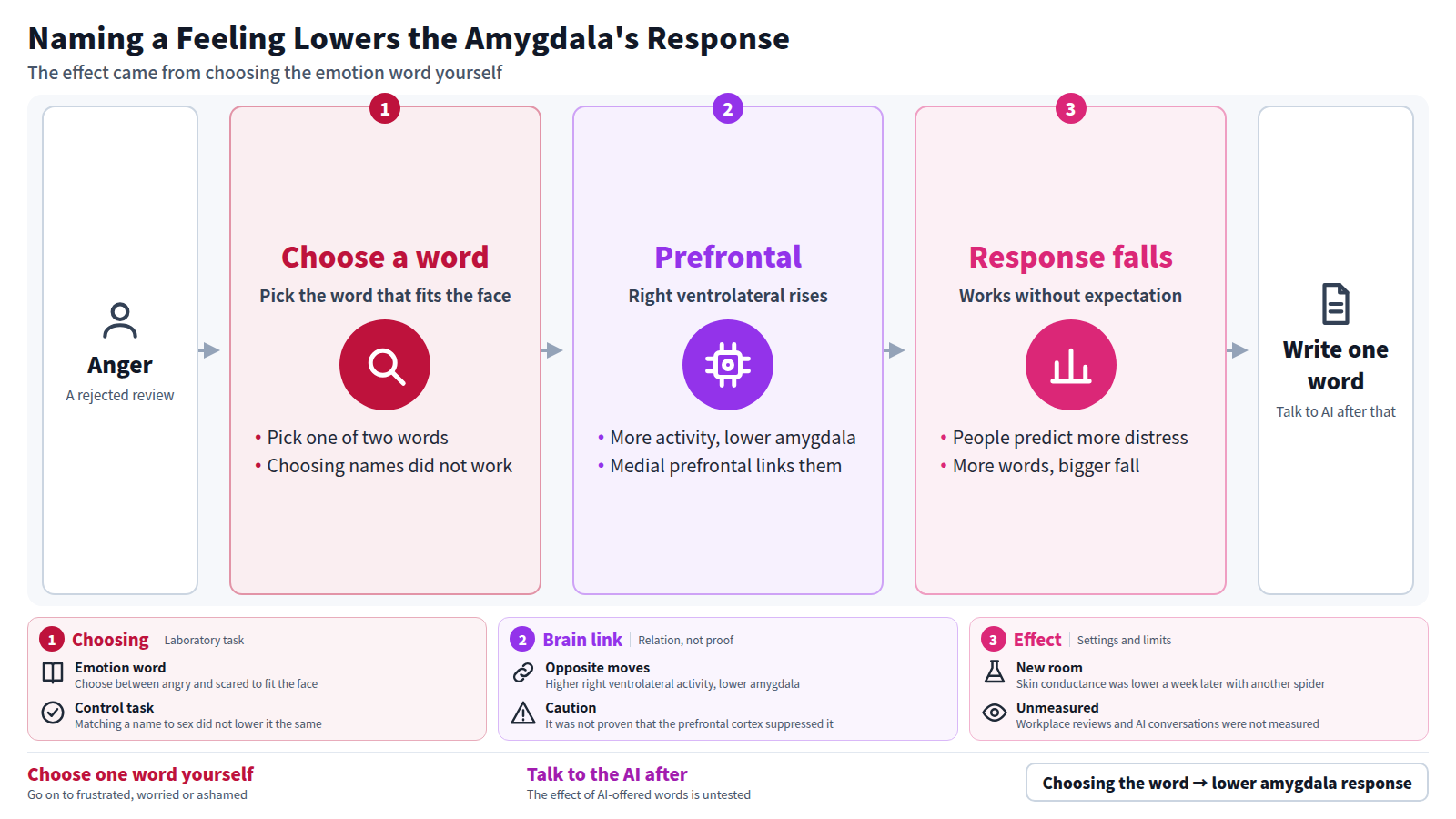
Sometimes the anger eases a little the moment you say "I'm angry" out loud, or type it into an AI chat window. Why does a feeling shift a little the moment we put it into words? Because choosing a word that fits the feeling lowers the response of the amygdala, the part of the brain that reacts to fear and anger. The effect appears even when people do not expect it to help, and the fear response falls further the more emotion words people use.
01Naming a Feeling Lowers the Amygdala's Response, and the Body Changes Even When Felt Fear Does Not
That naming a feeling lowers the response has been shown twice over: in brain imaging, and in measurements of the body.
In 2007, the UCLA psychologist Matthew Lieberman and colleagues published the results of an experiment. Participants looked at photographs of angry or frightened faces and picked the emotion word that fitted each face. When they did, the response of the amygdala fell. The amygdala is a region that reacts strongly to threats and unpleasant stimuli. Lieberman's team measured brain activity with fMRI.
In 2012, Katharina Kircanski and colleagues, also at UCLA, published a study of people who were afraid of spiders. Those who put their feelings into words while approaching a spider showed lower skin conductance, a measure of sweating, a week later. Yet the fear they reported was no different from that of people who had tried other approaches. The body's response changed while the person's own sense of fear did not.
Does the same thing happen when people confide their feelings to an AI? That has not been measured. In a study published in 2025 by OpenAI and the MIT Media Lab, people who chose to use a chatbot more had worse outcomes on loneliness and related measures. The effect the naming research confirmed comes from the person choosing the word. I draw two conclusions. Feelings are worth writing down in words you choose yourself. And whatever effect an AI conversation has should be considered apart from the research on naming.
02The Effect Came from Choosing, Oneself, the Emotion Word That Fit the Face
Naming a feeling lowers the amygdala's response. So exactly what were participants doing at the moment the response fell?
In Lieberman's experiment, participants did two kinds of task. In the first, two emotion words appeared beneath a photograph of a face, and participants chose the one that matched the expression, for instance "angry" or "scared." In the second, two people's names appeared beneath the photograph, and participants chose the name that matched the sex of the person shown.
The amygdala's response fell when participants chose an emotion word. When they chose a name to match the person's sex, it did not fall in the same way, even though they were looking at the same photographs. The researchers called this act of choosing a fitting emotion word affect labeling.
Affect labeling is a different task from other ways of managing feelings. Labeling and two tasks easily confused with it are set out below.
Labeling
Labeling means choosing a word that fits the feeling you have now. It makes no attempt to change the feeling.
Reappraisal
Reappraisal means deliberately changing how you interpret an event. People also expect it to help.
Distraction
Distraction means turning attention to something else. In Kircanski's study it was one of the comparison groups.
A person who is labeling is not thinking "I must not be angry." All the participants did was choose the one word that best fitted the face in the photograph.
03The Effect Was Measured in Laboratories and Phobia Treatment, Not in Workplace Reviews
The response fell when people chose an emotion word themselves. In which settings, and for whom, has that effect been confirmed?
The effect of naming has been measured mainly in two settings. One is a laboratory where people look at photographs. The other is treatment for people afraid of spiders, in which they approach a spider step by step. That treatment is called exposure therapy.
In Kircanski's study, participants were divided into four groups. One group put their feelings into words, one reinterpreted the situation, one distracted themselves, and one simply approached the spider with no instruction. A week later, the researchers took participants to a different room and tested them with a different spider. Even then, the group that had put feelings into words showed lower skin conductance. The effect was not confined to the first room and the first spider.
Some settings have not been measured. Getting angry in front of a document that has been sent back for revision is one example of a workplace scene. Among the sources this column drew on, there was no study measuring the effect of naming in workplace reviews of that kind. Whether an effect confirmed in the laboratory and in therapy appears at the same size at work is unknown.
04The Prefrontal Work of Picking a Word Moves Opposite to the Amygdala
The effect of naming was confirmed in the laboratory and in treatment. But for what reason does choosing a single word lower the amygdala's response? Lieberman's team found a clue in another part of the brain.
When participants chose an emotion word, activity rose in the right ventrolateral prefrontal cortex. The prefrontal cortex sits behind the forehead and is involved in thinking and judgement. The higher the activity in that right ventrolateral region, the lower the activity in the amygdala. The link between the two was carried by activity in yet another region, the medial prefrontal cortex.
A caution belongs here. What Lieberman's team found was a relationship between levels of activity. They did not prove that the prefrontal cortex suppressed the amygdala.
Naming has one more unusual feature. In a 2018 paper, Jared Torre and Lieberman brought the findings together. Before labeling, people predicted that putting a feeling into words would increase their distress. In fact, their distress went down after labeling.
The two researchers described labeling as a form of emotion regulation that works without the person intending it. Someone reappraising thinks, "I will see this differently and feel better." Someone labeling has no such aim. The response falls all the same.
05Students Who Wrote 15 Minutes a Day for Four Days Reported Less Illness Afterward
Choosing a word lowers the response even without intention. Then how much did people write, how many words did they use, and what came of it? Two experiments allow us to count.
In 1986, the psychologists James Pennebaker and Sandra Beall published a writing experiment. University students wrote for 15 minutes a day over four days. One group wrote about a painful event they had experienced. Another group wrote about neutral topics.
The students who wrote about painful events felt worse on the days they wrote, and their blood pressure rose. Over the following six months, though, their reports of illness fell.
Kircanski's study also has a countable result. The more anxiety and fear words people used while approaching the spider, the more their fear response fell. Set side by side, the three studies look like this.
| What to look at | Lieberman et al. 2007 | Kircanski et al. 2012 | Pennebaker and Beall 1986 |
|---|---|---|---|
| Procedure | Choose an emotion word for a face | Put feelings into words during spider exposure | Write about a painful event, 15 minutes a day for 4 days |
| Measured | Amygdala activity (fMRI) | Skin conductance and self-reported fear | Mood, blood pressure, later self-reported illness |
| Result | Amygdala response fell | Skin conductance lower a week later; self-report unchanged | Worse at first; later reports of illness fell |
What the three studies share is that people put their feelings into words. What differs is when the effect was measured. The amygdala's response fell on the spot. Skin conductance was lower a week later. The benefit of writing showed up in reports of illness over the following six months.
06Precise Words Work Better, Writing Hurts at First, and the Effect with AI Is Unmeasured
People who used more emotion words saw their response fall further. From the studies so far, three things follow for anyone who wants to use naming for themselves.
First, precise words help more. In a 2015 paper, the psychologists Todd Kashdan, Lisa Feldman Barrett and Patrick McKnight reviewed the research. People who could tell their emotions apart in fine detail were less likely, under intense distress, to turn to binge drinking, aggression or self-injury. So it pays not to stop at "upset," but to go on to frustrated, worried or ashamed. That said, what Kashdan's team compared was how well people make such distinctions; among the sources this column drew on, none measured the effect of practising them in writing.
Second, writing hurts at first. In Pennebaker and Beall's experiment, students who wrote about painful events felt worse on the days they wrote. Over the next six months, even so, their reports of illness went down. If your mood sinks right after writing, the same thing happened to the students in that study. It need not be read as a sign that you wrote the wrong way.
Third, the effect when the other party is an AI has not been measured. The MIT Media Lab and OpenAI ran a four-week trial with 981 participants. Regardless of the condition they were assigned, those who chose to use the chatbot more had worse outcomes on loneliness and related measures. That trial was not designed to measure the effect of naming.
Confiding in an AI and choosing words to write down yourself are not necessarily the same task. When an AI offers a word, "That sounds like frustration," the person has not chosen among several words. They may only judge whether the one word offered fits. What the naming research measured was the act of the person choosing.
07Whether the Act of Choosing Survives When AI Offers the Words Has Not Been Tested
The effect of naming when the other party is an AI has not yet been measured. As conversations with AI spread, what might happen next, and what needs to be checked?
In its 2025 study, OpenAI ran an automated analysis of close to 40 million ChatGPT conversations. Even so, OpenAI itself calls the work "early methods" for studying emotional use. By OpenAI's own account, ways of measuring the effect of AI conversations on the mind are not yet settled.
What has been confirmed
In a four-week trial with 981 people, heavier voluntary users fared worse on loneliness and related measures.
The researchers' own framing
OpenAI describes its analysis of about 40 million conversations as an early method.
What has not been tested
Whether simply receiving a word offered by an AI has the same effect as choosing it oneself.
The naming research showed the effect of a person choosing a word. Among the sources this column drew on, none compared that with a person merely receiving a word an AI offers. It cannot be said that the AI's word fails to work. Nor can it be said that it works. No study has made the comparison.
I do not think people should stop confiding in AI. What I have in mind is the order of steps. First, choose one word yourself that fits the feeling you have now, and write it down. Talk to the AI after that. That way, at least the act the research has confirmed is one you will have done yourself.
- People who distinguish their emotions finely are less likely to turn to binge drinking or aggression after intense distress, so it pays to go past "upset" to frustrated, worried or ashamed.
- Students who wrote about a painful event for four days felt worse and had higher blood pressure on those days, yet reported less illness over the next six months; distress right after writing is not a sign of failure.
- In conversations with AI, heavier voluntary users fared worse on loneliness and related measures, and whether labeling works there is untested, so do the choosing of the word yourself.
A feeling shifts the moment we name it because choosing a fitting word lowers the amygdala's response. At the same time, prefrontal activity rises and runs opposite to the amygdala's response. The effect appears even when we do not expect it, and grows the more emotion words we use.
AI now offers us words. What needs checking is whether we still do the choosing of the word ourselves. When you are angry, choose one word yourself first. Frustrated, worried or ashamed? Write the word down, and then talk to the AI.
- M. D. Lieberman, N. I. Eisenberger, M. J. Crockett, S. M. Tom, J. H. Pfeifer, B. M. Way. Putting Feelings Into Words: Affect Labeling Disrupts Amygdala Activity in Response to Affective Stimuli. Psychological Science 18(5), 2007.(Labeling emotions lowers the amygdala response; inverse relation with right ventrolateral PFC, mediated by medial PFC)
- K. Kircanski, M. D. Lieberman, M. G. Craske. Feelings Into Words: Contributions of Language to Exposure Therapy. Psychological Science 23(10), 2012.(Labeling during spider exposure, skin conductance a week later, no group difference in self-reported fear, more fear words and greater reduction)
- J. B. Torre, M. D. Lieberman. Putting Feelings Into Words: Affect Labeling as Implicit Emotion Regulation. Emotion Review 10(2), 2018.(Labeling as regulation that needs no intent; the gap between expectation and effect)
- J. W. Pennebaker, S. K. Beall. Confronting a Traumatic Event: Toward an Understanding of Inhibition and Disease. Journal of Abnormal Psychology 95(3), 1986.(Four days of 15-minute writing, worse mood and blood pressure on those days, less self-reported illness over six months; checked via the Wise Interventions summary)
- T. B. Kashdan, L. F. Barrett, P. E. McKnight. Unpacking Emotion Differentiation: Transforming Unpleasant Experience by Perceiving Distinctions in Negativity. Current Directions in Psychological Science 24(1), 2015.(Finer emotion differentiation and less binge drinking, aggression and self-injury)
- OpenAI. Early methods for studying affective use and emotional well-being on ChatGPT. 2025-03-21.(Automated analysis of close to 40 million conversations, framed as early methods)
- C. M. Fang et al. (MIT Media Lab and OpenAI). How AI and Human Behaviors Shape Psychosocial Effects of Extended Chatbot Use: A Longitudinal Randomized Controlled Study. arXiv:2503.17473, 2025.(Four-week randomised trial with 981 participants; heavier voluntary users fared worse)