
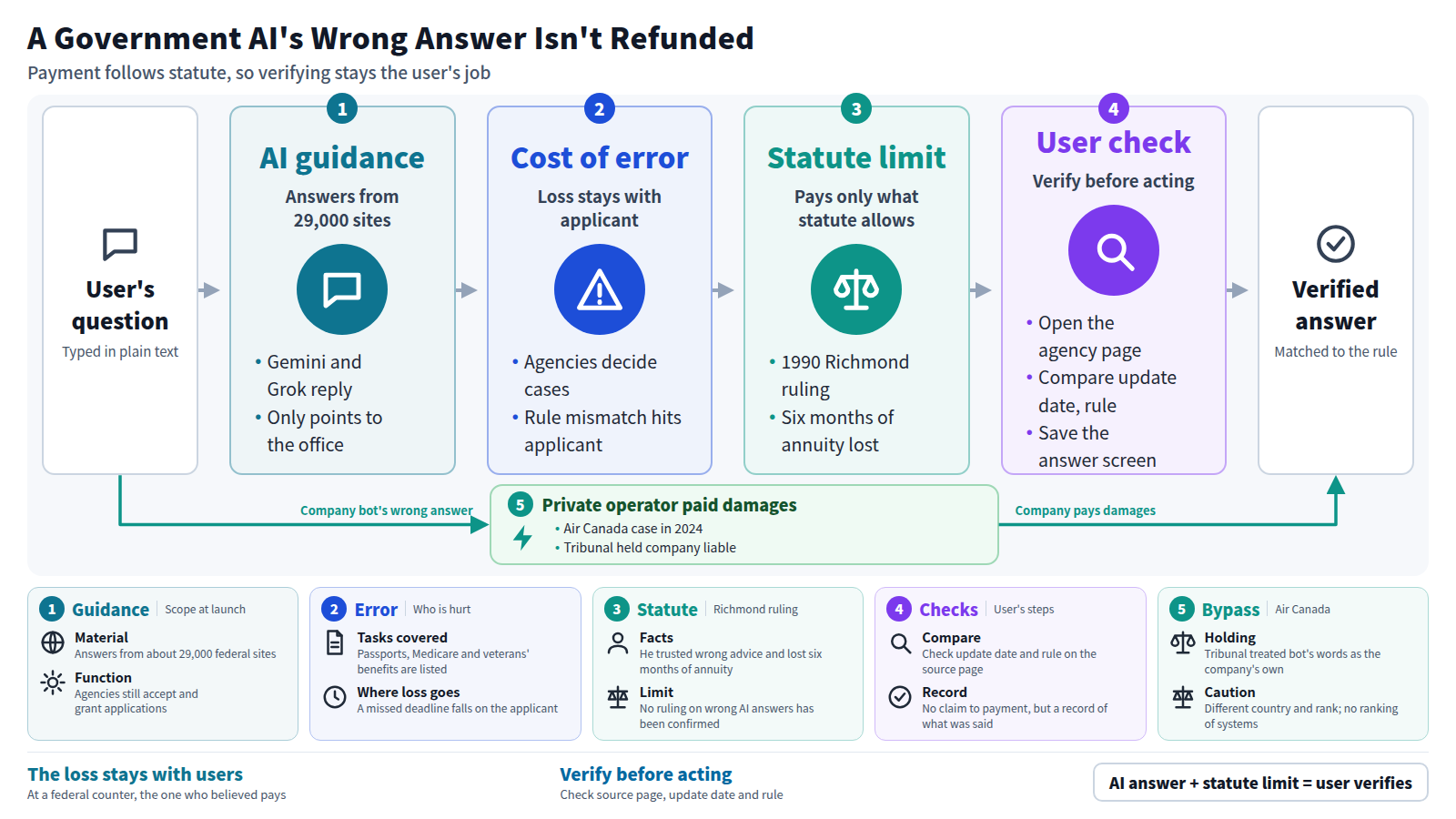
On September 29, 2026, the Trump administration launched America.gov, a federal guidance site where an AI chatbot built on Google's Gemini and xAI's Grok answers questions using information from roughly 29,000 government websites. When that AI gives wrong guidance, is the person who acted on it protected? Under American precedent on mistakes by human officials, no. In 1990 the Supreme Court refused payment to a man who lost annuity benefits by relying on an official's wrong advice, and nothing published so far says AI guidance will be treated differently.
01An AI Answer Can Be Wrong; the Statute Still Decides the Benefit
America.gov tells people which office handles a passport or a Medicare enrollment, in reply to a typed question. FedScoop reports that Gemini and Grok produce the replies, drawing on material from about 29,000 federal sites.
If a reply is wrong and the user loses money by following it, I have confirmed no American precedent that makes the government cover the loss. In OPM v. Richmond, decided in 1990, the Supreme Court denied payment to a former Navy employee who had trusted a personnel specialist's mistaken advice. The Court's reason was short: money leaves the Treasury only as a statute authorizes.
Something remains within the user's control. The first step: after the chatbot replies, open the agency page the reply came from and read the rule there.
A caveat belongs here at the start. Richmond was about a human employee. I have found no decision about a person who relied on a wrong AI answer.
02For Now America.gov Tells Users Which Office Handles a Task, and Stops There
If the statute fixes the amount of a benefit, then America.gov fixes nothing, at least at launch. FedScoop describes a chatbot that answers questions and gives directions to the place a government service is located. Accepting an application and granting a benefit remain the work of each agency, as before.
The project is led by Joe Gebbia, the US Chief Design Officer. KUTV carried his pitch: anyone who has used Grok, Gemini or ChatGPT will understand America.gov instantly. The user types a question in plain sentences and gets sentences back.
Carrying out the transaction on the site is a plan for 2027. The State Department has set a goal of routing most passport applications through America.gov by the end of that year, and KUTV reports an executive order directing agencies to integrate their services. Both the goal and the order describe work still to be done. On launch day, a visitor could ask and be answered, and that was all.
03The Cost of an Error Lands on People Looking Up Passports and Medicare
America.gov points to an office and does not rule on any application. So when the office or the deadline it names is wrong, the one in trouble is the person who asked. KUTV lists the tasks the site is meant to cover: applying for a passport, changing a name after marriage, enrolling in Medicare, claiming veterans' benefits.
| Aspect | At launch (September 2026) | Planned (2027) |
|---|---|---|
| Work done by the AI | Answers questions and points to the right office | Lets users continue a transaction on the site and track its progress |
| Material | About 29,000 government websites | Connections to each agency's services |
| Who decides | Each agency | Not published |
At launch, each agency decides whether an application succeeds. The agency measures the application against its rules and the documents the applicant submitted. If the chatbot's reply departed from those rules, the missed deadline or the missing form falls on the applicant who followed it.
At least one report raised the possibility of error on the first day. TechCrunch wrote that large language models are not infallible and remain prone to hallucinations.
Everything in this column concerns federal procedures in the United States. State and city offices, and governments elsewhere, run on other rules.
04The Cause Is an Appropriations Rule: Treasury Pays Only as Statute Authorizes
The government's counter made the mistake, and the applicant keeps the loss. Where the claim is for a payment of money, the Supreme Court found the explanation in the American rule on public money.
Richmond had worked for the Navy and was drawing a disability annuity. He asked a Navy personnel specialist how much he could earn without losing it. The specialist answered from an outdated rule and handed him an outdated edition of a booklet. Richmond relied on both, took the work, and lost six months of his annuity.
The Supreme Court gave him no relief. Payments of money from the Federal Treasury, it said, are limited to those authorized by statute. An employee's mistake cannot make a court order a sum that Congress never approved. That is the line of the reasoning.
The idea that checking is the citizen's task is older than Richmond. In Federal Crop Insurance Corp. v. Merrill, in 1947, the Court said that anyone who enters into an arrangement with the government takes the risk of having accurately ascertained that the person acting for the government stays within the bounds of his authority.
The courts have not yet ruled on a wrong answer produced by an AI. Richmond was misled by a human specialist and a printed booklet. That a court would reach the same result for a chatbot is my inference, and I mark it as one.
05New York City's Bot Gave Unlawful Advice; a Commerce Department Bot Tells Users to Verify
An employee's bad advice does not raise the amount the government owes. So what does error look like once the counter is staffed by software? A city offers an earlier example. In March 2024 The Markup reported that MyCity, New York City's official chatbot, was giving business owners answers that contradicted the law.
MyCity's wrong answers
It said employers could take a cut of workers' tips, and that no rule required businesses to accept cash. Both were wrong.
The city's notice
New York City's site warned that the bot may occasionally produce incorrect, harmful or biased content.
The trade agency's notice
The International Trade Administration tells users not to treat its chatbot's responses as legal or professional advice.
The third notice comes from a federal body, an arm of the Commerce Department. City and federal agency alike published their bots knowing the bots could be wrong.
A disclaimer does not change what the bot answers. It tells the user that verifying is the user's job. Once the notice is posted, the operator can say it asked people to check, and the user will find it harder to say nobody warned them.
Whether America.gov carries such a notice, and in which words, I could not confirm for this column.
06The Same Kind of Wrong Answer Cost Air Canada Damages and Cost the Federal Government Nothing
Operators post notices and the bots err anyway. Who then bears the loss? At a counter run by a private company and at one run by the federal government, the outcomes were opposite.
| Aspect | Air Canada (2024) | Richmond (1990) |
|---|---|---|
| Source of the error | A chatbot on the company's website | A Navy personnel specialist and an outdated booklet |
| Deciding body | British Columbia's Civil Resolution Tribunal | US Supreme Court |
| Result | The company pays damages | No payment allowed |
| Reason | It makes no difference whether information comes from a static page or a chatbot | Treasury pays only as statute authorizes |
The two decisions differ in country and in rank. One came from a provincial tribunal in Canada, the other from the highest court in the United States. I set them side by side to show that the loss fell on opposite parties. I am not ranking the two legal systems.
In the Air Canada case, the operator bore the loss from a wrong answer. The tribunal treated the chatbot's words as information Air Canada had put on its own website, and held the company responsible for them. For a customer of a commercial bot, a saved copy of the answer is a record that can later be shown to the company.
At a federal counter, if Richmond governs, the person who believed the answer bears the loss. The Court in Richmond asked whether a statute authorized the payment. Who had made the mistake did not change the outcome. Whether a human employee or an AI gives the answer, the amount the statute authorizes is the same. I therefore doubt that an America.gov reply could serve as grounds for claiming a benefit.
If the government will not make up the loss, the user needs to verify the AI's answer before acting on it. The International Trade Administration already asks users not to take its bot's replies as legal advice. An agency running such a tool is itself asking users not to rely on the reply as it stands.
07Plans to Move Transactions onto the Site in 2027 Could Put AI Errors into Application Forms
Today America.gov only names the right office, so a user can test its answer by opening the agency's page. Under the 2027 plan FedScoop describes, users will continue a transaction on the site and follow its progress. If the State Department meets its goal, most passport applications will pass through America.gov.
Once transactions move to the site, the point at which the AI can go wrong may move too. Today an error appears in the answer to "which office do I go to?" If the AI takes part in the transaction, an error could appear in the contents of the application form. No report says this. It is my inference.
Correcting an error
If an AI error spoils an application, to whom does the user turn for a correction? I found no published procedure.
Keeping the answer
Whether the government retains the answers users received is not known.
Reach of the precedent
No court decision on whether the government must pay someone who relied on a wrong AI answer has been confirmed.
I cannot say the government has made no provision for corrections or for keeping answers. I can say only that I found no published document. The State Department's passport goal is set for the end of 2027, and I will check whether those two matters are made public before then.
- In 2024 a Canadian tribunal ordered Air Canada to pay for its chatbot's wrong answer. In that case, the operator bore the loss from the error.
- In 1990 the US Supreme Court refused payment to a man who lost six months of annuity after relying on an official's wrong advice. At a federal counter, the loss falls on the person who relied.
- America.gov builds AI answers from roughly 29,000 government sites. The user needs to open the source page, compare its update date with the rule, and save the answer screen.
When the AI on an official government site gives wrong guidance, American precedent on mistakes by human officials does not protect the person who acted on it. The statute decides what is paid, and no rule yet treats AI guidance differently.
It is tempting to reason that an answer from an official site must be right. Richmond trusted a Navy specialist and a Navy booklet. His six months of annuity did not come back.
When a government AI answers me, I do three things. I open the agency page behind the answer. I compare its update date with the rule. I save the screen. The third gives me no claim to payment, but it leaves me a record of what I was told. America.gov plans to handle applications themselves in 2027, and I want the three to be habit before it does.
- FedScoop. Trump launches AI-fueled America.gov in bid to tie government services together. 2026-09-29. (Launch date, use of Gemini and Grok, roughly 29,000 government websites, launch function limited to directions, the 2027 plan)
- KUTV (The National News Desk). America.gov launches as Trump's new AI shortcut for passports, Medicare and more. 2026-09-29. (Tasks covered, Joe Gebbia's remarks, the State Department's end-of-2027 goal, the executive order on integration)
- Supreme Court of the United States. Office of Personnel Management v. Richmond, 496 U.S. 414. 1990-06-11. Cornell Law School Legal Information Institute. (Treasury payments limited to those authorized by statute; Richmond's loss of six months of annuity)
- Supreme Court of the United States. Federal Crop Insurance Corp. v. Merrill, 332 U.S. 380. 1947-11-10. Cornell Law School Legal Information Institute. (The party dealing with the government bears the risk of ascertaining the agent's authority)
- TechCrunch. Can a chatbot fix the government maze? The White House is about to find out. 2026-09-29. (Launch-day observation that large language models are not infallible)
- The Markup. NYC's AI Chatbot Tells Businesses to Break the Law. 2024-03-29. (MyCity's unlawful advice and the wording of the city's notice)
- International Trade Administration, US Department of Commerce. Chatbot Disclaimer. Accessed 2026-09-30. (Users asked not to use the chatbot's responses as legal or professional advice)
- McCarthy Tétrault (TechLex). Moffatt v. Air Canada: A Misrepresentation by an AI Chatbot. 2024-02-19. (The 2024 tribunal decision holding the company responsible for its chatbot's misinformation, 2024 BCCRT 149)