
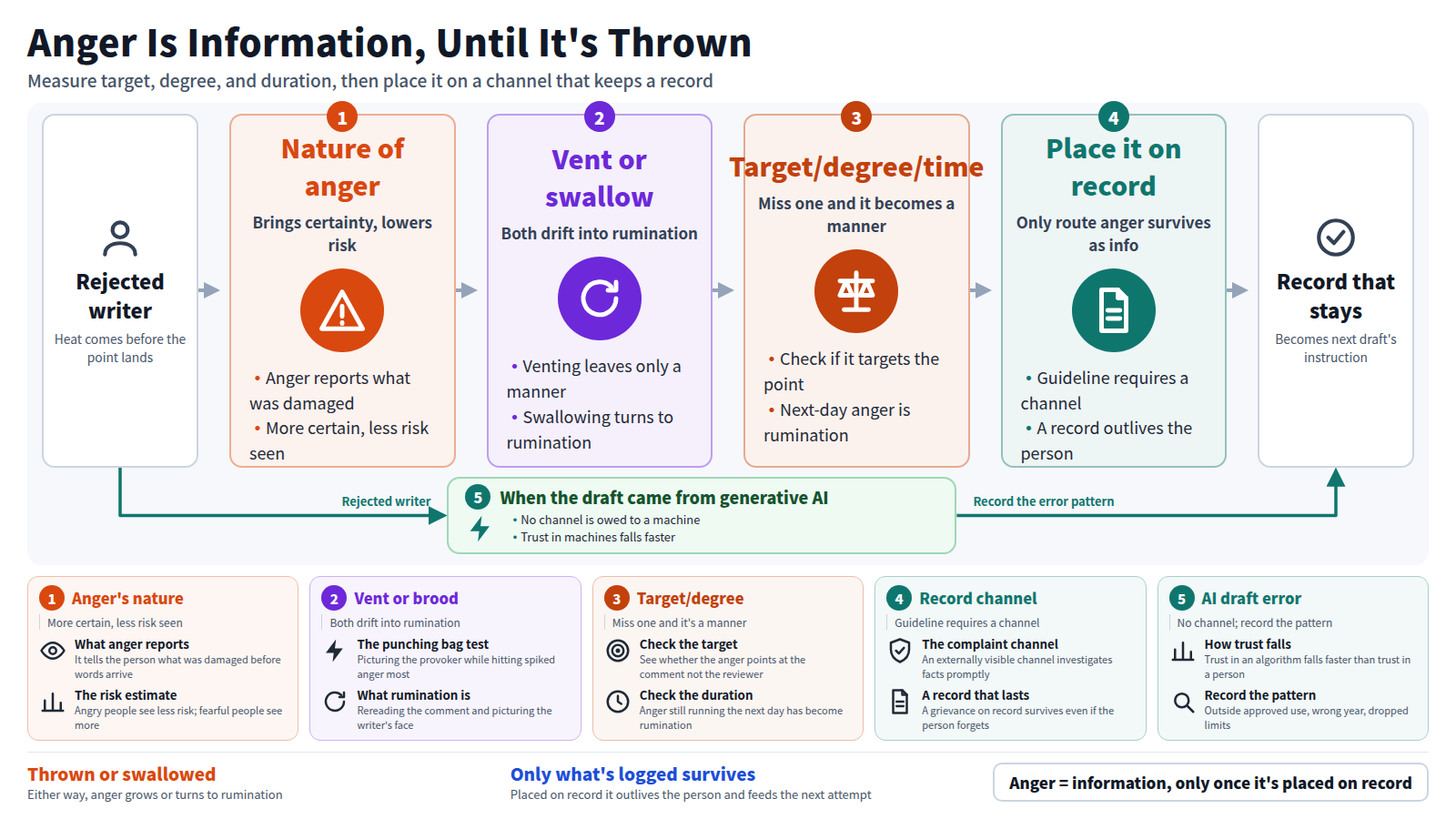
A draft written with generative AI comes back rejected, and reading the reviewer's comments heats the body before any of the substance registers. Is that heat information to be passed on, or an impulse to be held down? It is information. It stops being information the moment it is thrown at someone.
01Anger Is Information, and the Manner of Release Can Destroy It
Anger tells the person what has been damaged. Time wasted. Treatment that was careless. Months of accumulated judgment dismissed unread. None of this has reached words before the anger arrives.
Throw that content at the other person, though, and all that lands is a manner. What was damaged disappears behind the volume. The recipient carries away the memory of being cornered rather than the fact being raised.
The route that keeps it in a form checkable later is to place it where a record is kept. Japan's guideline on promotional information activity requires an externally visible channel for complaints, and requires that facts be investigated promptly once a complaint arrives. That requirement exists to make the matter checkable, not to calm anyone down. A grievance on the channel survives a change of personnel. A grievance thrown across a desk dies there.
02Anger Brings Certainty and a Sense of Control, and Lowers the Estimate of Risk
If anger is information, what does that information distort? Lerner and Tiedens set out how each emotion tilts the view of the world in a settled direction. Angry people feel more certain, feel they can move events themselves, and judge risk as lower. Fearful people, in the same situation, judge risk as higher.
The point is not that anger scrambles judgment. Judgment does not scramble; it leans. Anger moves the estimate toward it will be fine and I can push this through.
A decision made while angry therefore feels calm from inside, because certainty comes with it. The strength of that certainty is no guide to whether the decision is sound.
03Anger at a Returned Draft Hides the Substance of the Review
The tendency of anger to bring certainty can operate when a draft comes back. What the angry reader turns to first, though, is not the size of the risk but the wording of the comments. Opening the list, the reader looks first at how it is written. The tone is sharp. Separate items raised one by one where one summary would do. The same treatment passed last time and was stopped this time.
Throughout those minutes, the comments themselves go unread. A rejection happens at the stage before materials reach a physician, and a point missed there has limited opportunity to be caught later. The minutes of strongest anger fall on top of the minutes that call for the most careful reading.
| Point of comparison | Thrown | Swallowed | Recorded on the channel |
|---|---|---|---|
| Anger immediately after | Grows | Stays | Does not turn to rumination |
| What reaches the other person | A manner only | Nothing | Facts and a request |
| Checkable later | Nothing remains | Nothing remains | A record remains |
The same sequence runs for the person who receives a complaint and for the person who is reprimanded. This is not confined to the people who draft.
04Those Who Hit the Punching Bag Grew Angrier Because They Kept Going Over It
If the anger runs too hot for the comments to be read, would letting it out settle it? Bushman tested exactly that. He provoked participants and split them into three groups. One hit a punching bag while picturing the person who had provoked them. One hit the bag while thinking about something else. One did nothing.
The angriest group was the one picturing the provoker while hitting. That group also showed the most aggressive behavior afterward. The distracted group came next, and the group that did nothing was the calmest. Letting it out was not settling it.
The hitting itself did not raise the anger. What raised it was going over the person again and again while hitting. Rumination sustains the anger. The few minutes spent at a desk reading a rejection comment a third time and picturing the face of whoever wrote it are that same rumination.
05Anger Can Be Measured by Target, Degree, and Duration
Released, it grows; swallowed, it turns into rumination. What is left is measurement. In Book IV of the Nicomachean Ethics, Aristotle writes about gentleness. He calls gentle the person who feels anger on the right grounds, against the right persons, in the right manner, at the right moment, and for the right length of time. He does not praise the person who never feels anger.
The original splits the conditions into four or more. For practical use they fold into three: target, degree, duration.
Target
Check whether the anger points at the substance of the comment rather than at the reviewer. If it points at a person, turn it back first.
Degree
Check whether the size of the anger matches the number of items returned. Two items and a ruined day do not match.
Duration
Check whether it is still running the next day. If it is, this is no longer a response to a comment; it is rumination.
Miss any one of the three and anger turns from information into a manner. Anger aimed at the wrong target fails to land even when its content is correct.
06The Outcome Splits Three Ways: Recorded, Ruminated, or Redirected
Once target, degree, and duration have been measured, where does the anger go? It goes to one of three places, and which one is chosen settles the broad shape of the outcome.
First, onto a channel that keeps a record. The channel defined in the guideline extends to investigating the facts promptly and taking the measures required. A grievance placed there can be followed by others even after the person who raised it has forgotten it. This is the only route on which anger survives as information.
Second, inward, into rumination. Bushman's experiment showed that this does not reduce anger. Nothing reaches the other person either, so room remains for the same rejection to arrive again next time. On this road the party losing is the angry one.
Third, onto someone unrelated. Complaining to a colleague on the train home. Snapping at family. Nussbaum holds that anger conceptually involves a wish for some sort of payback, and that the wish is mired in thinking that does not hold together. Strip the wish for payback and attention moves to the repair ahead: what to fix so the same rejection does not arrive again.
07Anger at an AI Draft Settles Into Distrust of the AI Itself
If placement settles the outcome, what happens when the other party is a machine rather than a person? On finding an error in a draft produced by generative AI, the available destinations are narrow from the start. Telling the machine fixes nothing, and no complaint channel is owed one.
Dietvorst and colleagues showed experimentally that after seeing the same error, confidence in an algorithmic forecaster falls faster than confidence in a human one. When a person misses, we assume the next attempt will go better. When a machine misses, we stop using it.
How trust falls
For the same error, trust in a machine falls faster than trust in a person.
What replaces judgment
The anger converts into a decision about whether to use the tool. The content of the error goes unexamined.
Comments that leave nothing
The pattern of the error is never recorded, so the same error readily returns in the next draft.
Dietvorst and colleagues studied numerical forecasting, not written drafts. Carrying the finding across to a promotional draft is my own inference, and I hold no study that measured it.
What to do stays the same as with a person. Record the pattern of the error. Outside the approved efficacy. Citation year mismatched. Statement of limitations dropped. Written down, these change the instruction given for the next draft. Discard the tool while angry and the record goes with it.
- In Bushman's experiment, the group that hit a punching bag while thinking of the person who had angered them was the angriest and the most aggressive. Releasing is not settling.
- Lerner and Tiedens set out that angry people feel more certain and judge risk as lower. A decision made while angry rests on a looser estimate than usual.
- Japan's guideline on drug information activity requires an externally visible channel for complaints. Anger survives as information only when it reaches a route that keeps a record.
Anger is information. That part needs no doubting. It reports something damaged before the person can put the damage into words.
It is treated as information only when it is placed on a route that keeps a record. Thrown, it grows. Swallowed, it turns into rumination. On either road, what it reported is lost.
So when a rejection comment heats the body, there is no need to weigh venting against suppression. What gets decided is placement. Measure target, degree, and duration separately, then put whatever deserves to survive into a form that survives.
- Brad J. Bushman. Does Venting Anger Feed or Extinguish the Flame? Catharsis, Rumination, Distraction, Anger, and Aggressive Responding. Personality and Social Psychology Bulletin, 2002. (Rumination raised rather than lowered anger and aggression; doing nothing was calmest)
- Jennifer S. Lerner, Larissa Z. Tiedens. Portrait of the Angry Decision Maker: How Appraisal Tendencies Shape Anger's Influence on Cognition. Journal of Behavioral Decision Making, 2006. (Angry people made optimistic risk assessments; fearful people pessimistic ones)
- Berkeley J. Dietvorst, Joseph P. Simmons, Cade Massey. Algorithm Aversion: People Erroneously Avoid Algorithms After Seeing Them Err. Journal of Experimental Psychology: General, 2015. (Confidence in algorithmic forecasters falls faster after the same error)
- Aristotle. Nicomachean Ethics, Book IV (Bekker 1125b–1126b). Perseus Digital Library. (Anger on the right grounds, against the right persons, in the right manner, at the right moment, for the right length of time)
- University of Chicago News. Prof. Martha Nussbaum book examines the trouble with anger and forgiveness. (Anger conceptually involves a wish for payback; that wish is mired in incoherent thinking)
- Ministry of Health, Labour and Welfare, Japan. Guideline on Promotional Information Activities for Prescription Drugs. 2018-09-25. (Externally visible complaint channel; prompt investigation of facts and required measures)