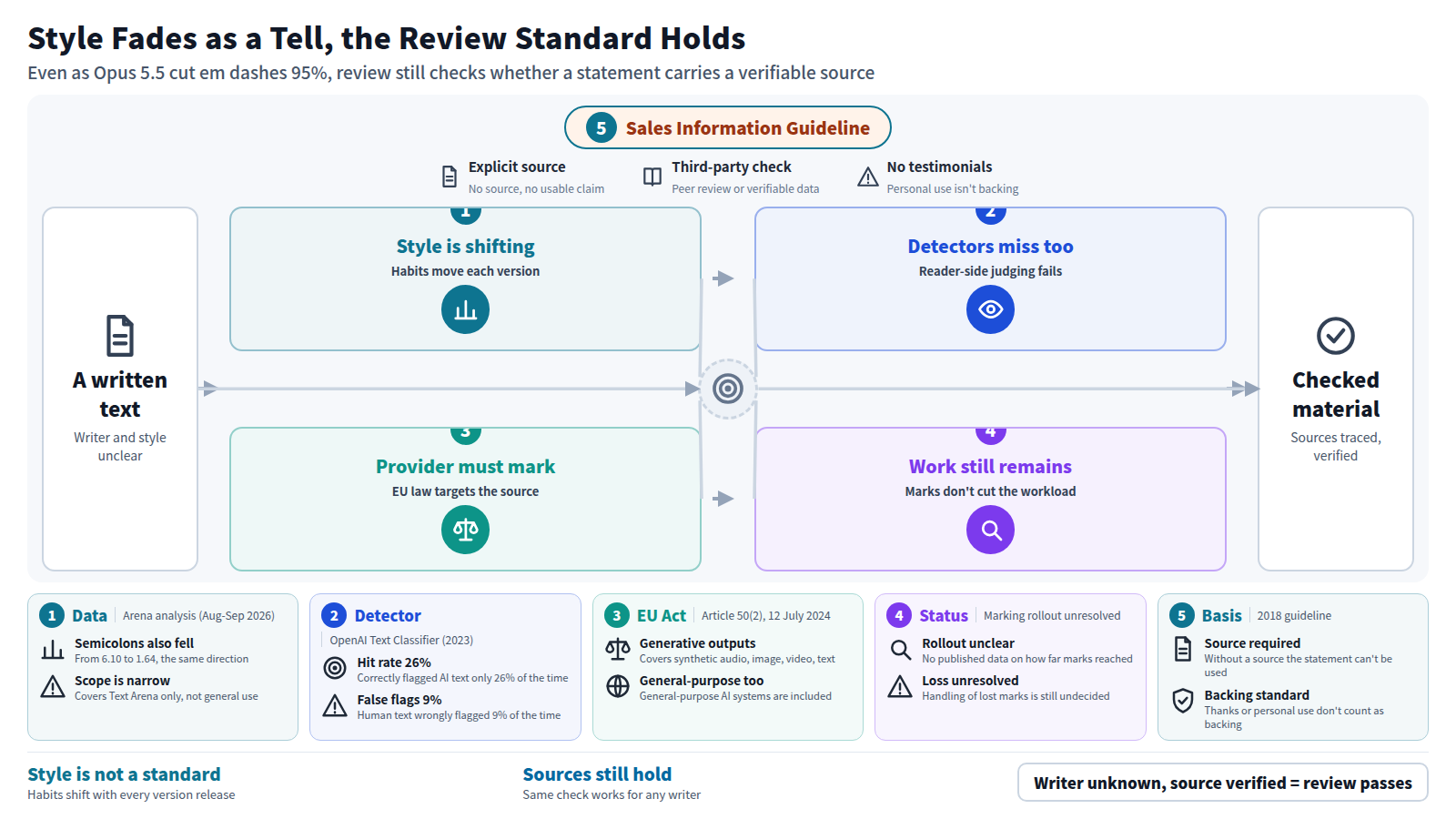
On 26 September 2026 the em dash, the punctuation mark most often named as the giveaway of AI writing, was reported to have fallen in Claude Opus 5.5 from 15.2 to 0.8 per 1,000 words. Once a writer's habits no longer identify an AI system, what is left to check a document against? Style cannot answer it. What remains is the standard long applied to human-written material: every statement carries a source, and a third party can verify that source.
01As the em dashes vanished, style-based detection lost its footing
According to an analysis by Arena, Opus 5 used 15.2 em dashes per 1,000 words and Opus 5.5 brought that down to 0.8, a drop of 95%. Semicolons fell from 6.10 to 1.64 over the same comparison.
What those figures show is that a model's writing habits move when the version changes. A reader who learned to treat a dense scatter of one punctuation mark as the mark of an AI system loses that signal on the day the next version ships. A single version change was enough to retire that signal.
So what survives? Whether each statement carries a source, and whether you can follow that source yourself. This check costs the same number of steps whether the writer was a person or a model, because it never requires identifying the writer at all.
Promotional material review already checks at that position, which is why this week's figures change nothing in the review procedure. What moved was only the footing of anyone who wanted style to do the work.
02Four measures all show that habits move from version to version
Arena gathered and analysed Text Arena responses from August and September 2026. More than one figure moved. Em dashes went from 15.2 to 0.8, semicolons from 6.10 to 1.64, average sentence length from 12.14 words to 10.03, and average answer length from 453 words to 481. Ten of the twelve measures were judged to have moved in the direction of improvement.
The last figure is the easy one to miss. The sentences got shorter while the total answer got longer: more short sentences, laid end to end. Shorter sentences on their own do not mean there is less to read.
Three of the four measures fell and only the answer length rose. Whatever adjustment cut the punctuation did not push the answer length the same way.
| Measure | Opus 5 | Opus 5.5 |
|---|---|---|
| Em dashes (per 1,000 words) | 15.2 | 0.8 |
| Semicolons (per 1,000 words) | 6.10 | 1.64 |
| Average sentence length | 12.14 words | 10.03 words |
| Average answer length | 453 words | 481 words |
One limit is worth stating: the analysis covered responses submitted to Text Arena. Nothing in that material says ordinary use produces the same distribution.
03Promotional material review never looked at style
However the four figures move, nothing happens in a place that was not watching habits. Promotional material review is such a place.
Japan's guideline on sales information provision activities requires that information cited in promotional materials carry an explicit source, and restricts scientific substantiation to material that a third party can objectively evaluate and verify, original data included, or that has passed peer review or comparable scrutiny. The commentary on the advertising standards states that letters of thanks from users, and lines such as "I take it myself," cannot serve as objective substantiation.
What the two documents share is that neither looks at how a sentence runs. Regardless of who wrote it and in what register, they ask whether the statement can be traced to the material behind it. So when the draft arrives from a model, nothing is added to the reviewer's workload.
An explicit source
Information cited in the material must name its source. Without one, the statement itself cannot be used.
Verifiable substantiation
Scientific substantiation is limited to material a third party can verify, original data included, or that has passed peer review.
Objective backing
Words of thanks and accounts of personal use are not treated as objective backing. How well the prose reads does not enter the judgement.
04The developer itself showed in 2023 that detectors do not work
Review has not watched how sentences run, and that is more than a policy choice: on the published figures, the tools that read style to identify the writer did not work.
OpenAI retired its own AI Text Classifier on 20 July 2023, citing a low rate of accuracy. It correctly identified 26% of AI-written text as likely AI-written, and incorrectly flagged human-written text 9% of the time. In retiring the tool, the company said it was turning to research on recording the provenance of text instead.
A rate of 26% means missing three out of four. A rate of 9% means suspecting close to one in every eleven pieces of human writing. Both numbers came out of a design that placed the judgement with the reader.
Those figures predate this week's story by three years. The statistics of style were already insufficient before the habits started moving.
05The EU moved the basis for detection from the reader to the provider's marking
What 26% and 9% demonstrated is that this way of placing the judgement with the reader did not work. European law instead places a marking obligation on the side that produces the text.
Article 50(2) of the EU AI Act requires providers of AI systems that generate synthetic audio, image, video or text content, general-purpose systems included, to ensure the outputs are marked in a machine-readable format and detectable as artificially generated. Counting punctuation has no place in that arrangement.
What moved, though, is where the obligation sits, not the act of verification. A marking can be present and still say nothing about what the text rests on.
| Point of comparison | The reader judges | The provider marks |
|---|---|---|
| Basis | Statistics of style | A machine-readable mark |
| Direction of error | Both misses and false flags | The unmarked case still needs a call |
| Where responsibility sits | With the reader | With the generating provider |
How far this obligation reaches, from what date and over which parties, is more than I have traced. What is firm here is the direction.
06The checkable things are the source, the marking, and the drafting record
Moving the obligation does not remove the work of reading a document you received. Three claims, taken separately.
First, writing habits cannot serve as a standard. What changes is that the ground under any such judgement gives way with each version. This follows from Arena's finding that ten of twelve measures moved across a single version change; use habits as a standard and you rebuild it every release.
Second, a source can be checked the same way no matter who wrote the text. What changes is that the procedure stops depending on the identity of the writer. The guideline asks for an explicit source and for third-party verifiability, and neither requirement mentions what kind of writer produced the draft.
Third, marking is an obligation on the producing side. What changes is where responsibility sits, not how much work the recipient does. A recipient can check whether the mark is there, and can follow the sources whether it is there or not.
07Even with marking in place, not one verification step disappears
Of the three, marking is the only one outside your own hands, which narrows what it can be asked to carry.
No published material I could find shows how far machine-readable marks have been implemented across products. Nor has anyone settled how to treat text whose mark was lost through copying or rewriting. Until those two are fixed, checking for a mark answers only part of the question.
What remains is reading each statement against its source, one at a time. The 2018 guideline asked for exactly that, and the Opus 5.5 figures leave it untouched. Not one step falls away.
Implementation of marking
No published material shows how far machine-readable marks have reached across products.
Text with the mark gone
How to treat text whose marking was lost through copying or rewriting remains unsettled.
- In Opus 5.5 em dashes fell from 15.2 to 0.8 per 1,000 words and semicolons from 6.10 to 1.64. Any judgement resting on such habits has to be rebuilt with every new version.
- OpenAI retired its own classifier in 2023, reporting 26% correct identification of AI text and a 9% false-positive rate on human text. Placing the judgement with the reader was already failing before the habits changed.
- Article 50(2) of the EU AI Act puts machine-readable marking on the provider, while Japan's guideline requires explicit sources verifiable by third parties. What remains for the recipient is to check for the mark and to follow the sources.
Nothing was lost when the stylistic tells disappeared. Counting em dashes to identify a writer never had anything to show that it was getting it right.
The standard for checking a document is whether each statement carries a verifiable source. That standard was written into the 2018 guideline, and it works the same way whether the writer was a person or a model.
If there is time to spend guessing whether an AI system wrote something, following one source is faster. Guessing has no way to confirm the answer; following has an end.
- BleepingComputer. Claude Opus 5.5 uses 95% fewer em dashes, but its answers are getting longer. 26 September 2026. (15.2 per 1,000 words in Opus 5 against 0.8 in Opus 5.5; semicolons from 6.10 to 1.64; average answers from 453 to 481 words.)
- Inquirer (technology.inquirer.net). OpenAI shuts down AI detector due to low accuracy. 26 July 2023. (The AI Classifier withdrawn as of 20 July 2023; 26% of AI-written text correctly identified, 9% of human-written text incorrectly flagged.)
- TechCrunch. OpenAI scuttles AI-written text detector over "low rate of accuracy". 25 July 2023. (The stated reason for retirement, and the shift toward research on provenance techniques for text.)
- Regulation (EU) 2024/1689 (EU AI Act), Article 50(2). Article 50: Transparency Obligations for Providers and Deployers of Certain AI Systems. 12 July 2024. (Providers generating synthetic audio, image, video or text content must ensure outputs are marked in a machine-readable format.)
- Ministry of Health, Labour and Welfare (Japan), PSEHB Notification No. 0925-1. Guideline on Sales Information Provision Activities for Prescription Drugs. 25 September 2018. (Explicit sources; scientific substantiation objectively evaluable and verifiable by third parties, original data included, or peer reviewed.)
- Ministry of Health, Labour and Welfare (Japan), Notification No. 0929-5 of the Director of the Compliance and Narcotics Division. Commentary on the Standards for Fair Advertising of Drugs and Related Products. 29 September 2017. (Letters of thanks and accounts of personal use cannot serve as objective substantiation.)