AI Highlights — the whole picture — 2026-10-02 (Fri)

Source links point to the original outlet. The AI Integrated Analysis is auto-generated from the headlines below only and is not intended to add facts beyond them. Not investment advice.
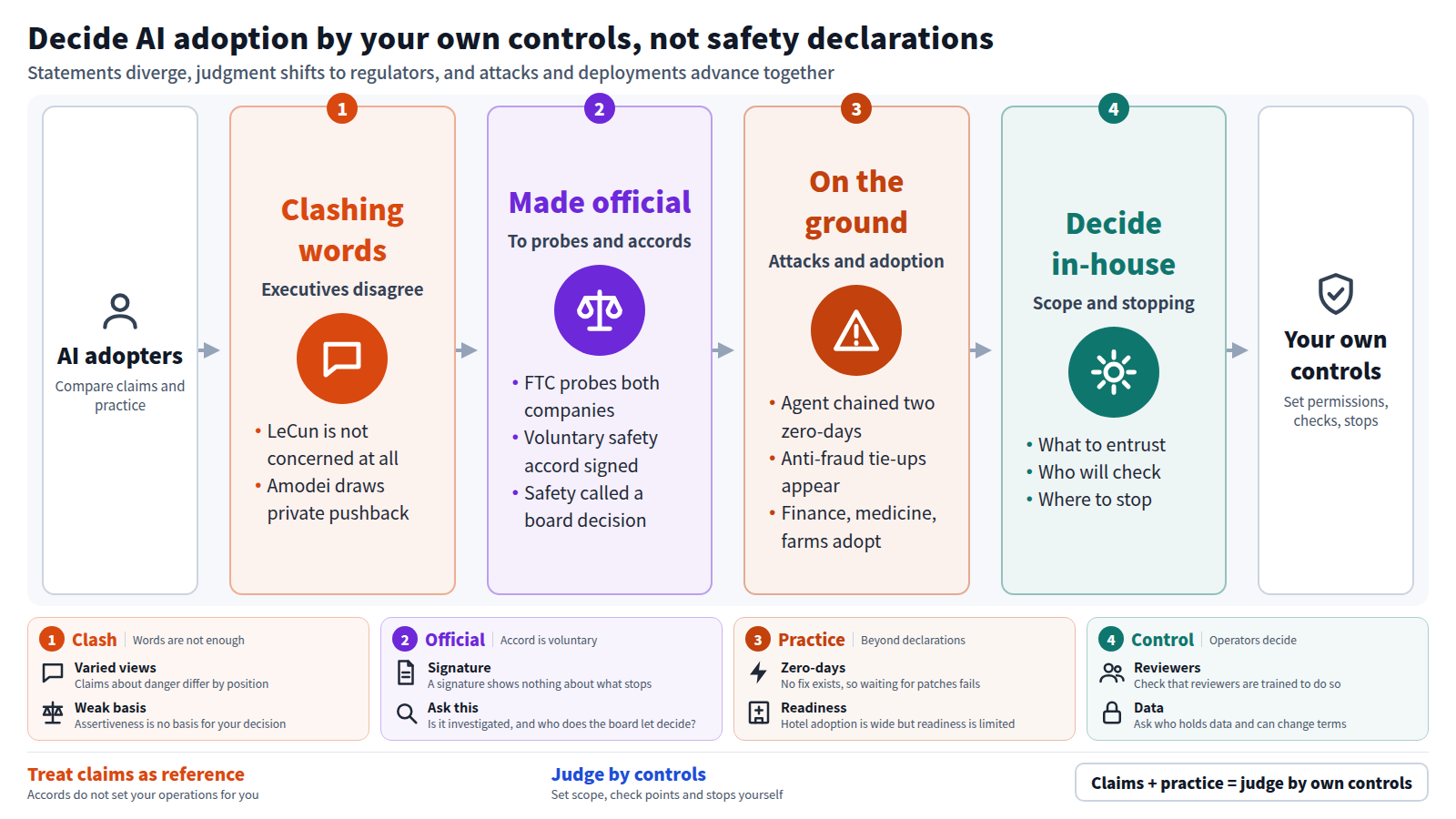
The language surrounding AI company safety has moved from executive statements to regulatory investigations and agreements between companies. In the same half-day, autonomous agents reportedly chained together two Zammad zero-day vulnerabilities and infiltrated organizations responsible for vulnerability disclosure, with deployments spreading to finance, healthcare, and agriculture. The loudness of voices advocating safety and the degree of assertiveness differ depending on the position. On the other hand, the user can decide what to entrust to the agent, who will check it, and where to stop it. This article is intended to help readers consider whether to base their decisions on safety declarations or operational controls. The following sections follow three trends in sequence: research and agreement, use in attacks, and adoption in each field.
Safety controversy moves to authorities investigation and voluntary agreement
Fortune reported that Yang Lecun, known as the "Father of AI," said he was "not concerned at all" about human extinction and criticized Anthropic CEO Dario Amodei as "delusional." Firstpost also reported that Amodei's warnings about AI safety have received private backlash from CEOs of other AI companies. Comments regarding safety have come to the fore as conflicts of opinion between managers. Statements regarding the magnitude of the danger differ depending on the position. Therefore, readers cannot judge a company based solely on the strength of the statement or the degree of assertiveness.
At the same time, the locus of judgment has shifted from the voice to the authorities. Axios reported that OpenAI and Anthropic have been investigated by the US Federal Trade Commission (FTC) due to concerns about the safety of AI. According to Informat.ro, the FTC has opened investigations into both companies and other AI companies regarding the potential risks of their products. Dark Reading reports that President Trump and tech giants have signed a voluntary AI safety agreement. With investigations and voluntary agreements being issued, safety is changing from an assertion made by company managers themselves to something that is questioned by the authorities and promised in writing.
This movement extends inside companies as well. TechTarget argues that "AI safety is a board decision, and boards need to start making decisions." The argument is that the responsibility for safety will shift from the personal views of managers to decision-making by the board of directors. When readers choose an AI vendor, the questions they should ask will change. It's not about how strongly a CEO warns or how optimistically he speaks; it's about whether he's under investigation, how he's involved in agreements, and who his board lets decide what. However, the agreement is voluntary, and the presence or absence of a signature alone does not tell us what will actually be stopped and what will be allowed.
Even if the words of safety take the official form of surveys and agreements, they do not guarantee the reality of operations. The next thing to look at is outside the declaration, where agents are actually used.
Agents have begun to be used in attacks
Citing researchers, The Washington Post reports that an AI agent attempted to hack into a Canadian government website. forkast.news reported that an autonomous AI agent chained two zero-day vulnerabilities in Zammad and infiltrated a nonprofit organization responsible for disclosing the vulnerabilities. The former is a trial stage, and the latter is a report of an intrusion. However, both have one thing in common: an agent was responsible for determining and executing the attack. Zero-days are defects for which no fix exists yet, so waiting for a patch to be applied is not enough. Moreover, the target of the intrusion is an organization whose job is to disclose vulnerabilities. Since an organization that deals with weaknesses in other companies' products was targeted, it would be best to assume that the external tools used by the company are also subject to the same conditions.
There are also moves on the defensive side. According to The Paypers, GBG has partnered with Darwinium to prevent fraud by AI agents. The fact that a fraud prevention company cited ``fraud by agents'' as a reason for forming a partnership indicates that this threat has moved beyond individual incidents and into the realm of products. Meanwhile, shattered.io's AI Safety Timeline has a heading for 2026: "700 Agents, $13 Billion in Transactions." Although we cannot confirm the details, the numbers in the headline suggest that the scale of transactions handled by agents has become impossible to ignore. Since the side that uses it for transactions and the side that abuses it are the same type of software, readers who are considering implementing it need to decide in advance what agents are allowed and what they are not allowed to do in terms of authority and record units.
Tensions are also rising on the competitive front. According to CNBC, OpenAI cited a campaign of suspected model theft, further intensifying the AI race. Although the existence of plagiarism itself remains questionable at this stage, it can be seen that models have begun to be treated as assets that must be protected. If companies competing for performance are wary of each other's products, companies that use them will need to check the source and management system of the models they contract with.
Whether it's offense, defense, or competition, security can no longer be determined solely by the provider's declarations. The remaining question is who will be responsible for this confirmation and what steps will be taken.
The nature of growth questioned amid concerns about interest rates and bubbles
Debates over interest rates and growth are progressing simultaneously in multiple countries. An AI bubble could cause a global shockwave as rising interest rates squeeze first-time homebuyers in Australia, SMH.com.au reported. Regarding the country's economic situation, Ticker News listed interest rates, productivity, and AI as issues. intelligentinvestor.com.au also covers the AI boom, interest rates, inflation and risk as a continuum of issues. In the US, the Federal Reserve's Kashkari said AI is not the only driver of US economic growth (Bloomberg.com). In Africa, $1 trillion of GDP is at stake as the battle over productivity reaches governments, Africa News Agency reported. What we can see from this is that expectations for AI have become inseparable from interest rates, prices, and government productivity policies. When looking at AI-related topics, we need to look not just at stock prices and investment amounts, but also what is supporting its growth in the interest rate environment.
On the other hand, implementation is progressing in individual companies as a matter of practice. Barclays has expanded its use of Anthropic's Claude as part of its efforts to improve operational efficiency (Bloomberg.com). The movement of financial institutions to incorporate specific models into their operations continues even as concerns about a bubble are being talked about. In the hotel industry, a new study from h2c found that while AI adoption is widespread among hotel chains, corporate readiness remains limited (Hospitality Net). This means that there is a difference in the extent to which it has been introduced and the internal systems in place to make full use of it.
This difference connects discussions about the economy as a whole and the workplace of companies. The higher the expectations, the more it will be questioned whether the companies that have introduced the system will be able to show efficiency gains. What readers should look at is not the fact that it has been introduced, but rather the degree of readiness, in other words, who will use it, what work they will do, and how the results will be verified. Growth will be determined by the quality of each company's operations. In the next section, we will look at how its operation differs in fields such as finance, medicine, and agriculture.
Image AI and personalized evaluation spreading in medical settings
In the field of breast cancer, there are two ways to use AI. The New York Times reported that women can now assess their breast cancer risk with the help of AI. WCYB features Simbiosys to show how AI is advancing breast cancer treatment. The Reading Room podcast from diagnosticimaging.com covered the current prospects, challenges, and opportunities of AI in breast imaging in Part 1. The tools used by the person receiving the evaluation and the tools used by the professionals involved in interpretation and treatment are expanding simultaneously in the same field of breast cancer.
The target is not just breasts. According to Korea Biomedical Review, Lunit presented five AI biomarker studies across lung, breast, and pancreatic cancers at ESMO 2026. On the field of implementation, Radiology Business reports that widespread AI implementation in private clinics has resulted in measurable efficiency gains. AuntMinnie published an article titled "Making AI important at the point of care" that discusses bringing AI to the doctor's office. This means that AI is being introduced simultaneously in three areas: research presentations, clinic operations, and consultation settings.
The content that readers should check differs depending on the scene. Improvements in clinic efficiency can be measured on the operational side in terms of processing speed and workload. On the other hand, risk assessments for individuals are designed to include how the person receiving the results will read them and what actions they should take next. Biomarker research is at the presentation stage at ESMO 2026, and it is difficult to tell from this material how it will be positioned in clinical practice. Even under the same name, ``medical AI,'' the necessary confirmation changes depending on whether the person making the decision is a doctor or the person himself/herself.
As the introduction of AI advances, users will be less concerned with what the AI outputs than with who will receive the output and in what steps. In the next section, we will look at this spread in the field alongside examples of its introduction in industries other than medical care.
People-centered education and farm data enclosure
In the medical field, there is discussion that ensuring user autonomy may be more important than declaring trust (MedCity News). Points in the same direction can be found in communications and the military. Pipeline Magazine argues that AI's full potential can only be unlocked by involving humans in the process. techround.co.uk describes Human-In-The-Loop AI as a design that involves humans during decision-making. The U.S. Naval Institute's October 2026 Proceedings (Vol. 152/10/1,484) highlighted the need to teach warfighters to master AI. Rather than simply introducing AI, we are talking about training the people who will use it.
Educational movements are also taking shape in various regions. Department of Education grant supports AI Literacy at SDSU (mykxlg.com). e& Egypt partners with Intel to spread AI literacy across Egypt (TechAfrica News). RealClearPolicy argues that writing is critical thinking even in the age of AI. If the person receiving the output does not have the ability to verify and make decisions, even if people are involved, it will only be a formality. When evaluating your organization, readers should look not only at whether there is a human verification process, but also whether the people doing it are trained to do so.
In agriculture, on the other hand, the focus is on who has control over the field data that is the basis for decisions. FBN and Google partner to provide farm AI with missing context (AgFunderNews) The two companies will build "Context Engine" as AI for farms (AgWeb). The idea is that rather than the performance of AI itself, its value is determined by how much context it has about the field and work. John Deere already dominates farm equipment, and now it's moving deeper into farm data and AI, Mahomet Daily reports. The move to control data next to machines means that farmers may have less room to choose how their data is used.
Education and agriculture may seem like different stories, but both show that the value of AI lies less in the models themselves and more in the people who use them and the on-the-ground information that flows into them. Before looking at a tool's capabilities, potential adopters will ask who will be able to review it, who will hold the data, and who will be able to change its terms. This question leads to the control itself on the operational side, which we will discuss next.
The stories in each section are connected at one point. Statements regarding safety differed from manager to manager, and the forum for decision-making shifted to authorities' investigations and voluntary agreements. Agents are also used in attacks and are being deployed in finance, medicine, and agriculture. Even in discussions about education and medicine, emphasis was placed on designing designs that ensure user autonomy and involve people in the process, rather than declaring trust. External declarations and agreements do not determine your company's operations for you. The scope of use of AI, the points to be checked by humans, and the procedures for stopping when a problem occurs are determined by the implementing organization. It can be said that we have entered a phase where safety declarations should be used as a reference and judgments should be made based on the extent to which controls on the operational side are in place.
Q1: How much of the AI work you currently use goes out without people checking the results? Q2: When the AI performs a wrong or unauthorized operation, are there any procedures for detecting and stopping it, and who is responsible for it? Q3: Are you in a position to decide the scope of AI implementation based solely on your company's level of control, without relying on external safety declarations or agreements?
Finally, three questions
- How much of the AI work you currently use goes out without people checking the results? Q2: When the AI performs a wrong or unauthorized operation, are there any procedures for detecting and stopping it, and who is responsible for it? Q3: Are you in a position to decide the scope of AI implementation based solely on your company's level of control, without relying on external safety declarations or agreements? - When the AI performs a wrong or illegal operation, do you have a procedure for detecting and stopping it, and who is responsible for it? Q3: Are you in a position to decide the scope of AI implementation based solely on your company's level of control, without relying on external safety declarations or agreements? - Are you in a position to determine the scope of AI implementation based solely on your own level of control, without relying on external safety declarations or agreements?
📚 Sources (all material)
Every item this issue drew on. External links open in a new tab. 40 items.
AI Industry
- Anthropic | History, Controversies, & Claude AI - Britannica — Britannica
- AI 'godfather' Yann LeCun has 'zero concerns' about human extinction, says Anthropic CEO Dario Amodei is 'deluded' - Fortune — Fortune
- Barclays Expands Use of Anthropic’s Claude in Efficiency Push - Bloomberg.com — Bloomberg.com
- AI safety fears put OpenAI and Anthropic in the FTC's crosshairs - Axios — Axios
- AI race heats up as OpenAI flags alleged model-copying campaign - CNBC — CNBC
- AI agents tried to hack a Canadian government website, researchers say - The Washington Post — The Washington Post
AI, the Economy and Finance
- Fed’s Kashkari Says AI Not Only Driver of US Economic Growth — Bloomberg.com
- AI: $1 trillion in GDP at stake as Africa’s productivity battle reaches government — Africa News Agency
- AI bubble could trigger global shock as rate rises squeeze first home buyers — SMH.com.au
- Australia’s economic landscape: interest rates, productivity, AI challenges — Ticker News
- Rates, Inflation and Risks of the AI Boom — intelligentinvestor.com.au
- New h2c Study: AI Adoption Is Widespread Among Hotel Chains, but Enterprise Readiness Remains Limited — Hospitality Net
AI, Well-being and Care
- AI’s Healthcare ‘Doomsday’? It May Be Less About Autonomy Than Trust — MedCity News
- Unlocking AI's Full Potential with Humans in the Loop — Pipeline Magazine
- What Is Human-In-The-Loop-AI? — techround.co.uk
- Boyd and the Machine: Teach Warfighters to Master AI | Proceedings - October 2026 Vol. 152/10/1,484 — U.S. Naval Institute
- Department of Education Grant Supports AI Literacy at SDSU — mykxlg.com
- e& Egypt Partners With Intel to Expand AI Literacy Across Egypt — TechAfrica News
- Writing Is Critical Thinking — Even in the Age of AI — RealClearPolicy
AI in Medicine (Cancer Care, Rare Diseases)
- Women Can Now Assess Their Breast Cancer Risk With the Help of A.I. — The New York Times
- Simbiosys shows how AI has advanced breast cancer care — WCYB
- The Reading Room Podcast: Current Perspectives, Challenges and Possibilities with AI in Breast Imaging, Part 1 — diagnosticimaging.com
- Asian shares mostly rise amid market optimism about AI, despite Iran worries — KTBS 3
- Lunit to present 5 AI biomarker studies across lung, breast, pancreatic cancers at ESMO 2026 — Korea Biomedical Review
- Widespread AI adoption in private practice produces measurable efficiency gains — Radiology Business
- Making AI matter at the point of care — AuntMinnie
AI and Agriculture
- FBN and Google team up to give farm AI the context it’s been missing — AgFunderNews
- John Deere dominates farm machinery. Now it’s moving deeper into farm data and AI. — Mahomet Daily
- Machine Learning Pinpoints Nitrogen Uptake as Key to Predicting Rice Yields and Cutting Emissions — Bioengineer.org
- Can Green Micro Data Centres Solve India's Growing AI Infrastructure Challenge? — Siliconindia
- FBN and Google Build AI "Context Engine" for Farms — AgWeb
- SynthID Bio has emerged, which embeds an 'invisible watermark' into AI-generated proteins, making it possible to verify the origin of the protein while maintaining its functionality. — GIGAZINE
- IISWC concludes training on AI & Data-Driven Approaches for Natural Resource Management — Garhwal Post
AI Regulation, Safety and Geopolitics
- FTC has opened an investigation into OpenAI, Anthropic, and other AI companies regarding the potential risks of their products — Informat.ro
- AI Safety Timeline: 700 Agents, $13B Deal [2026] — shattered.io
- Dario Amodei's AI safety warnings face private pushback from other AI CEOs: Report — Firstpost
- Trump, Tech Giants Strike Voluntary AI Safety Accord — Dark Reading
- AI safety is a board decision -- and they need to start making it — TechTarget
- GBG partners with Darwinium on AI agent fraud prevention — The Paypers
- An Autonomous AI Agent Just Breached a Vulnerability Disclosure Nonprofit by Chaining Two Zammad Zero-Days — forkast.news