AI & Healthcare News — 2026-10-08 (Thu) Morning News

Source links point to the original outlet. The AI Integrated Analysis is auto-generated from the headlines below only and is not intended to add facts beyond them. Not investment advice.
Overview
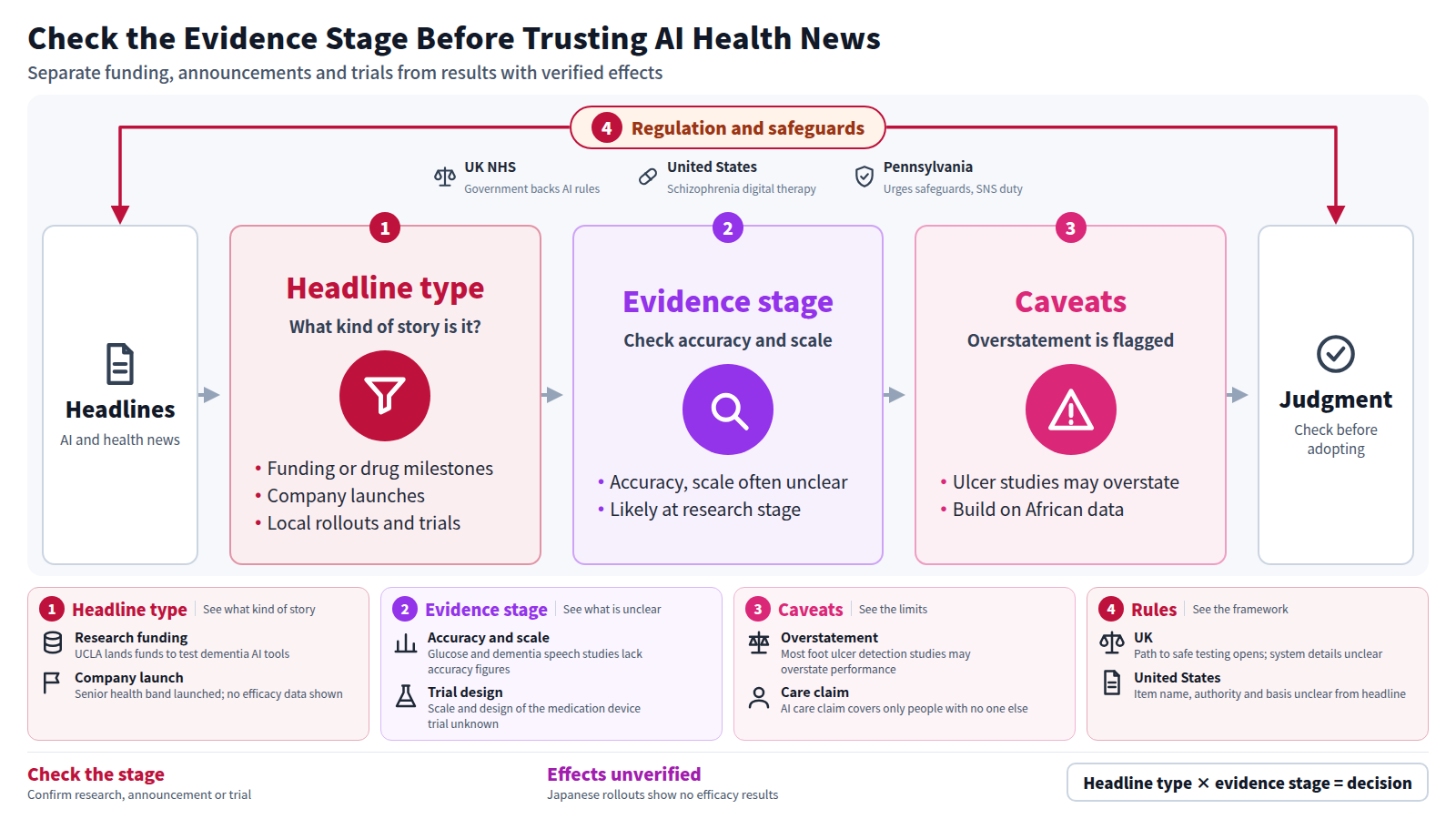
- In terms of mental health, there were several headlines dealing with "AI anxiety," highlighting the aspect that AI can cause anxiety. - In the area of physical health, research and demonstrations of detection and prediction systems were lined up, including wearables, blood sugar prediction, and voice analysis for dementia. - In terms of mechanisms, the UK NHS's AI regulation policy and Japanese local governments' introduction of chatbots for the elderly and nursing care were moved.
Mental health
- "AI Anxiety" is a hot topic: KNOE "Managing AI Anxiety", MedPage Today (weekly summary including AI Anxiety), Yahoo News UK "US therapist points out rising AI anxiety among young adults". The measurement content, scale, and level of evidence are unclear from the headline (it appears to be a report from the therapist, but the survey design has not been confirmed). - The MedPage Today headline reads "Digital Schizophrenia Therapeutic Cleared," suggesting that a digital treatment for schizophrenia has been cleared. The item name, authority, and basis are unclear from the headline. - BullFrog AI (BioBuzz): Milestone reached in depression drug discovery program. This is a story at the drug discovery stage, and does not indicate its effectiveness in maintaining or improving health. - Tempus AI's cancer treatment-related alliances are not covered as they are subject to a separate category.
Exercise/physical activity
- Mount Sinai: Wearable AI predicts prolonged sitting in women with chronic pelvic pain. The target is chronic pelvic pain in women. The accuracy, scale, and level of evidence are unclear from the headline. - Harvard: Advancement of wearable technology using AI (commentary/research introduction). Details unknown. - CloserLook.AI: Launched "CloserLook Health Band" for monitoring the elderly (company announcement, no efficacy data in the headline). - Korean Venture (벤처스퀘어): AI healthcare that reads joint angles with a single camera. The details of the verification are unknown. - CNBC: This is an article evaluating stocks related to wearable AI, not information on health effects.
sleep
No applicable information
Nutrition/Meals
No applicable information
Prevention/Medical checkup
- Realnews Magazine: Mr. Adewole points out that cancer care AI in Africa should be built using African data (issue of data representativeness). - Bioengineer.org: Visualizing damage to the lymphatic system in breast cancer survivors using AI. The target audience is breast cancer survivors. The scale and evidence level are unknown. - Both are in the field of cancer, and the details will be treated in separate sections.
Self-management of chronic diseases
- Type 1 diabetes: AI ensemble predicts blood sugar levels with minimal data organization (Bioengineer.org). The accuracy and scale are unclear from the headline. It is likely to be in the research stage. - Heart disease: AI tool detects widely overlooked heart disease (Technology Org). Disease name and detection rate are unknown. - Diabetic foot ulcers: Many AI detection studies may overestimate performance (Bioengineer.org). Heading indicating reservations about the quality of the evidence. - Digital Information World: Explanation of what is possible and what is not possible in health advice using AI.
Elderly people/nursing care
- UCLA: Wins $25 million to validate dementia AI tool (Longevity.Technology). This is at the research funding stage, not the results. - Chosun Ilbo: AI detects signs of dementia from speaking patterns. Accuracy and scale are unknown. - Bioengineer.org: For people who have no one to rely on, AI-based care may surpass human care. The claim has a limited scope, and the level of proof is unclear. - Mirage News: Trial of AI medication device for elderly people with memory impairment. The scale and design are unknown. - Pennsylvania: Requires AI safety measures and social media operators to take responsibility to prevent fraud (Penn State). Issues related to fraud victims among the elderly.
Digital treatment/regulation
- UK: Government supports NHS AI regulation, paving the way for safe testing (National Health Executive). The specific details of the system are unclear from the headline. - United States: Clearance for digital treatments for schizophrenia suggested (above). Item name is unknown.
Workplace health
- HR Executive: Article on the US federal government's "Super Intelligence Force" demonstrating continued federal interest in AI in the workplace (institutional). - Líder Legal: Burnout and AI. The argument is that efficiency increases the amount of work (operational aspect). - The Rundown AI "A breakout moment for AI medicine" and Fortune's article on the Asian entertainment industry, the link to workplace health is not obvious from the headline.
Japanese movements
- Sharp: Demonstrated "AI trainer for nursing care" using AI and TV at nursing care facilities. - Adachi Ward: For the first time in Tokyo's 23 wards, we started providing an interactive AI chatbot specializing in elderly care and nursing care (24 hours a day, 365 days a year). Provided by PR TIMES announcement. - Fujisawa City's SDT: Signed a contract with Kyoto City to introduce a generated AI chatbot for nursing care facilities. - Health and Welfare Public Relations Association: "H.C.R.2026 53rd International Welfare Equipment Exhibition" will be held for 3 days from October 7, 2026. - The announcement of the confirmed patent number for "AI Healthcare Automation" (Sportsmania) was a company announcement, and no health effects have been shown. - Domestic demonstration and introduction are both within the scope of the headline, and results of effectiveness verification are not shown.
Remarks from VIPs
The list of important people being tracked is empty, so there is no relevant information. (Reference: Mr. Adewole's statement is not treated as an important person because his title is unknown.)
AI video/commentary
No relevant information (headlines derived from YouTube cannot be confirmed)
- Pill Peddling Doc Convicted; Digital Schizophrenia Therapeutic Cleared; AI Anxiety — MedPage Today10/07 17:00 UTC
- Tempus AI expands cancer therapy deal with Moderna, Merck — TradingView10/07 13:01 UTC
- Building Smarter Wearable Technologies with AI — Harvard University10/07 14:49 UTC
- This wearable AI stock is set to rally thanks to a broader business focus, Jefferies says — CNBC10/07 14:15 UTC
- CloserLook.AI Announces Launch of the CloserLook Health Band for Senior Health Monitoring — The Des Moines Register10/07 14:39 UTC
- “Reading even joint angles with a single camera”… Agency CEO Kim Hyun’s AI Healthcare — 벤처스퀘어10/07 08:41 UTC
- Cancer care AI must be built on African data, Adewole warns — Realnews Magazine10/07 16:00 UTC
- Scientists Map Hidden Lymphatic Damage in Breast Cancer Survivors Using AI — Bioengineer.org10/07 10:10 UTC
- AI Ensemble Predicts Blood Glucose in Type 1 Diabetes with Minimal Data Cleanup — Bioengineer.org10/07 16:55 UTC
- Using AI for Health Advice? Know What It Can and Can’t Do — Digital Information World10/07 11:03 UTC
- AI Can Spot Diabetic Foot Ulcers, But Most Studies May Be Overstating How Well It Works — Bioengineer.org10/07 00:55 UTC
- UCLA lands $25m to test dementia AI tools — Longevity.Technology10/07 16:11 UTC
- AI Caregiving May Beat Human Care for Those Who Have No One Else — Bioengineer.org10/07 12:10 UTC
- PA Urges AI Safeguards, Social Media Accountability to Stop Scams — The Pennsylvania State University10/07 12:52 UTC
- Trial Tests AI Medication Device for Older Adults With Memory Loss — Mirage News10/07 14:36 UTC
- Burnout and artificial intelligence: when efficiency multiplies work — Líder Legal10/07 12:03 UTC
- A breakout moment for AI medicine — The Rundown AI10/06 07:00 UTC
- Will AI kill the Asian entertainment industry, or reinvent it? — Fortune10/06 07:00 UTC
- Experience the latest welfare technologies, from AI robots to disaster prevention! “H.C.R.2026 53rd International Welfare Equipment Exhibition & Forum” begins! 3 days from Wednesday, October 7, 2026 - Introducing nursing care and life support equipment - | Health and Welfare Public Relations Association, General Incorporated Foundation — アットプレス10/07 08:45 UTC
- Fujisawa-based SDT signs contract with Kyoto City for generative AI chatbot for care providers — 湘南人10/07 08:57 UTC
- First in Tokyo's 23 wards: conversational AI chatbot for seniors and care provided to Adachi Ward, running 24/7 — PR TIMES10/07 04:39 UTC