AI & Healthcare News — 2026-10-07 (Wed) Evening News
Source links point to the original outlet. The AI Integrated Analysis is auto-generated from the headlines below only and is not intended to add facts beyond them. Not investment advice.
Overview
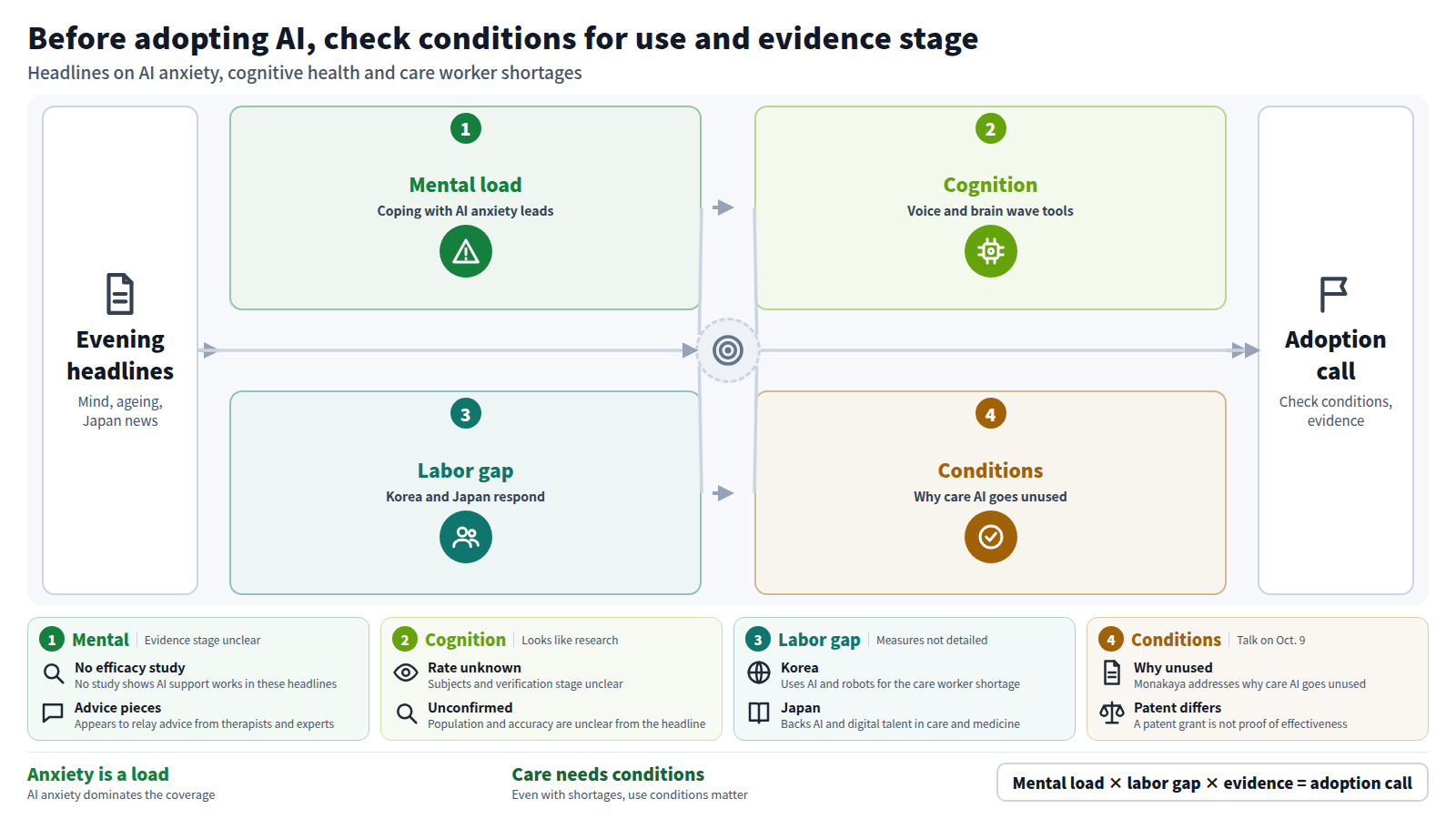
- In the area of mental health, there are a lot of reports dealing with ``anxiety about AI'', and the focus is on the burden that AI places on the mind rather than support using AI. - In terms of physical health, the focus is on developments in the area of elderly people and cognitive function, such as detecting dementia using voice and differentiating between Alzheimer's disease and frontotemporal dementia (FTD) using brain waves and machine learning. - In terms of mechanisms, the Japanese government supported the development of human resources who utilize AI and digital technology, and the use of AI and robots to address the shortage of nursing care workers in South Korea.
Mental health
- Multiple US news outlets (WKYT, CBS News, KTVN, cbs19.tv) have covered how to deal with and balance AI anxiety. The content appears to introduce advice from therapists and experts. - Spring Health publishes guide to “AI for Mental Health.” - From the headline, the measurement indicators, target scale, and stage of evidence are all unclear. Studies demonstrating the effectiveness of AI assistance are not included in this group of headings.
Exercise/physical activity
- CNET published a commentary that sees Meta's "AI Tamagotchi" as a precedent for smart watches in 2027. There is no information in the headline indicating an effect on physical activity. - Plaud (released in Indonesia, AI transcription in over 112 languages) cannot be read from the headline about its relationship to health and exercise, so I won't go into details.
sleep
No applicable information
Nutrition/Meals
- An AI app that personalizes nutrition and health management through daily meals was featured in Vietnam's Young Startup Award (Vietnam.vn). This is an introduction to the award, and the effects and scale of the verification are unclear from the headline.
Prevention/Medical checkup
- Brain Waves and Machine Learning (Bioengineer.org) is a study that uses brain waves and machine learning to distinguish between Alzheimer's disease and FTD. The target population and accuracy are unclear from the headline, and the level of evidence has not been confirmed (details are provided in 8.).
Self-management of chronic diseases
- No applicable health information. Mr. Cuban's criticism of Meta's AI fraudulent advertising (MoneyWise.com) is about fraudulent advertising, not information about self-management of chronic diseases.
Elderly people/nursing care
- Dementia detection: Naver Cloud's AI detects dementia through voice analysis (조선일보). The detection rate, number of targets, and verification stage are unclear from the headline. - Differentiation: Differentiation between Alzheimer's disease and FTD using EEG and machine learning (Bioengineer.org). It appears to be in the research stage, but details have not been confirmed. - Lack of caregivers: South Korea uses AI and robots to prepare for shortage of nursing care workers (Korea JoongAng Daily). - Discussion: University of Waterloo public lecture “Including human aging in the age of AI”. - The link between Amorepacific's beauty research (IFSCC 2026) and the health and care of the elderly cannot be gleaned from the headline.
Digital treatment/regulation
No relevant information (no headings regarding regulatory approvals, guidelines, and insurance handling)
Workplace health
- Report that a teacher in Muskoka, Canada started a business using AI after experiencing difficulties in the classroom (Muskoka Region). It is unclear from the headline whether the story is about interventions or systems for the mind and body of working people.
Japanese movements
- Government: The government supports the development of human resources who utilize AI and digital technology in medical and nursing care (Asahi Shimbun). The specific details of the measures are unclear from the headline. - Company (Patent): FitEasy (212A) timely discloses confirmation of patent number related to "AI Healthcare Automation" (Nihon Keizai Shimbun, October 7, 2026). This is the establishment of a patent, not the verification of its effectiveness. - Corporate (nursing care): Monaya gave a lecture at "H.C.R.2026" on October 9th. We will discuss the reasons why nursing care AI is not used and the three conditions for it to be used (PR TIMES). - Nursing care sites: Introducing the vision of care in 2040 by combining AI/robots and home care in response to labor shortages (DX Magazine). - Individual movements of ministries, local governments, and insurers cannot be confirmed from the headlines.
Remarks from VIPs
- The name of Prime Minister Sanae Takaichi (President of the Liberal Democratic Party) is included in the Asahi Shimbun headline. However, it is not possible to confirm the content of the prime minister's own statement just by looking at the headline.
AI video/commentary
No applicable information
- Better Living: Managing anxiety caused by AI — WKYT10/06 21:38 UTC
- Therapists offer advice for coping with growing anxiety over AI — CBS News10/06 22:02 UTC
- How to deal with AI anxiety — KTVN10/06 23:59 UTC
- Guide: Spring Health's AI for Mental Health — Spring Health10/06 13:32 UTC
- AI anxiety grows as experts urge balance over fear — cbs19.tv10/07 02:08 UTC
- Meta's 'AI Tamagotchi' Looks to Me Like a Smartwatch Preview for 2027 — CNET10/05 12:00 UTC
- Plaud Officially Arrives in Indonesia, Brings AI Transcription in More than 112 Languages — VOI.ID10/07 01:27 UTC
- Cuban rips Meta over AI scam ads — MoneyWise.com10/06 21:01 UTC
- Naver Cloud AI Detects Dementia via Speech Analysis — 조선일보10/07 06:47 UTC
- Korea turns to AI, robots to tackle looming care worker shortage — Korea JoongAng Daily10/06 22:55 UTC
- Brain Waves and Machine Learning Join Forces to Tell Alzheimer's and FTD Apart — Bioengineer.org10/06 18:10 UTC
- Public Talk: Building for Ourselves: Including Human Aging in the Age of AI — University of Waterloo10/06 20:25 UTC
- Amorepacific Presents AI-Powered Future Beauty Research at IFSCC Congress 2026 — The Manila Times10/07 03:22 UTC
- 'I needed an exit plan': Muskoka teacher turns classroom struggles into AI-powered business — Muskoka Region10/05 10:15 UTC
- How to Train AI and Digital Talent in Healthcare and Nursing Care, With Government Support — 朝日新聞10/06 21:00 UTC
- FitEasy [212A] Announces Patent Number Confirmed for 'AI Healthcare Automation' (Oct. 7, 2026) — 日本経済新聞10/07 07:10 UTC
- Monakaya to Speak at H.C.R.2026 on Oct. 9 on Why Care AI Goes Unused and 3 Conditions for Use — PR TIMES10/07 01:00 UTC
- “Latest technology x home care” that challenges the limits of labor shortage! Care sites will change in 2040 with AI and robots — DXマガジン10/07 06:33 UTC
- Young Startup Award: AI App Personalizes Nutrition and Health Management Through Daily Meals — Vietnam.vn10/07 05:41 UTC