AI and Cancer Research ── Breast ── 2026-10-08
Breast cancer: treatment, trials and AI
- Abstract
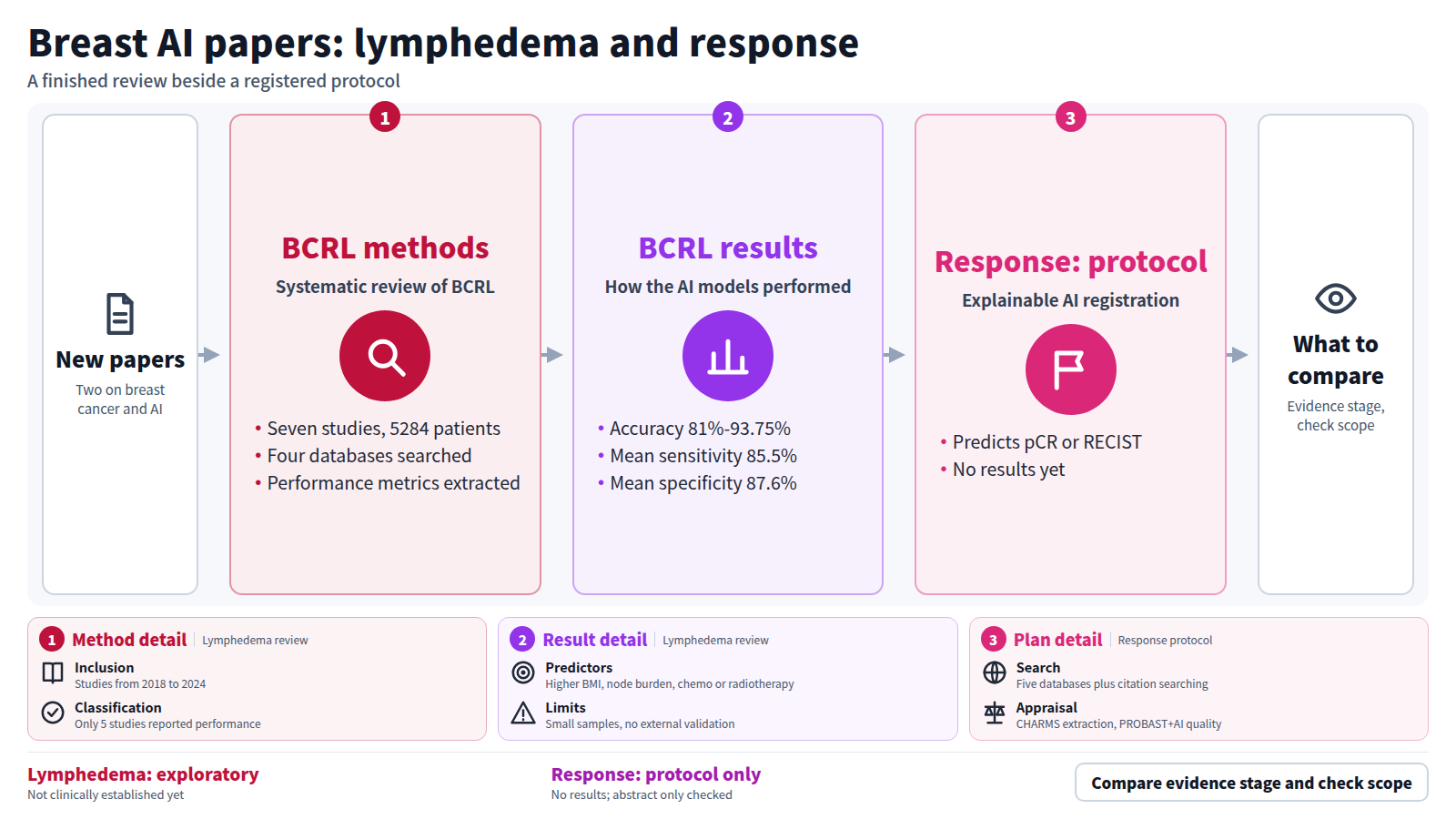
BACKGROUND: Breast cancer-related lymphedema (BCRL) impairs quality of life and function, and early detection is crucial for preventive intervention. AI models, particularly machine learning and deep learning, hold promise for improving BCRL prediction and personalized risk stratification. This systematic review evaluates AI applications for predicting BCRL and, where available, summarizes how their reported performance compared with traditional diagnostic or non-AI methods. METHODS: This systematic review followed the Preferred Reporting Items for Systematic Reviews and Meta-Analyses guidelines. A literature search in MEDLINE, EMBASE, Cochrane Library, and Google Scholar was conducted in July 2024 using keywords related to breast cancer, lymphedema, and AI. Relevant studies were screened and selected based on predefined inclusion and exclusion criteria, with performance metrics such as accuracy, sensitivity, and specificity extracted for analysis. RESULTS: Seven studies from 2018 to 2024 were included, with 5284 patients. Among the 5 studies reporting BCRL classification performance, AI models achieved accuracies of 81%-93.75% (mean 87.2%), mean sensitivity 85.5%, and mean specificity 87.6%. Commonly reported predictors included higher body mass index, greater lymph node burden, and receipt of chemotherapy or radiotherapy. Younger age and neoadjuvant chemotherapy were associated with higher predicted risk in some studies. CONCLUSIONS: AI shows promise for early detection and risk stratification in BCRL, but current models remain exploratory rather than clinically established. Small sample sizes, data heterogeneity, absent external validation, and inconsistent calibration highlight the need for larger, multi-institutional datasets, standardized evaluation, and prospective validation before clinical integration.
Journal IF-equivalent: 1.2 (OpenAlex 2-year mean citedness, value as of 2026-10-07, retrieved 2026-10-08; not the official Clarivate IF)Reference: [No authors listed]. Artificial Intelligence for Prediction of Breast Cancer-Related Lymphedema: A Systematic Review. Plast Reconstr Surg Glob Open. [Epub ahead of print]. doi:10.1097/GOX.0000000000008132; PMCID: PMC13641666.Checked: Full text checked - Abstract
This systematic review will examine explainable and interpretable artificial intelligence models for predicting response to neoadjuvant or preoperative systemic treatment in breast cancer. Eligible studies must predict pathological complete response (pCR) or an explicitly RECIST-defined response and apply an explicit explainability or interpretability component to the prediction model. We will examine how these models are developed and validated, how their explanations are evaluated, and what evidence supports their use in clinical practice. We will search PubMed/MEDLINE, Embase.com, Scopus, Web of Science Core Collection and IEEE Xplore from inception to the final search date, without database-level language or publication-year restrictions. Backward and forward citation searching will supplement the database searches. Eligible publications will be peer-reviewed journal articles, including stable early-access and article-in-press publications. Two reviewers will independently screen records and assess full texts. Data extraction will follow the CHARMS framework, and study quality, risk of bias and applicability will be assessed using PROBAST+AI. The synthesis will describe patient populations, treatments, data modalities, model families, explanation methods, validation, calibration, leakage safeguards and evidence of clinical translation. pCR and RECIST-defined outcomes will be synthesized separately. A narrative and descriptive synthesis is planned; no meta-analysis is prespecified. This registration follows the approved protocol, version 1.0, dated 30 September 2026. The final database searches are planned within seven days after registration. Searches conducted from 12 to 21 July 2026 under an earlier scoping review protocol are superseded and will not contribute records or counts to this review or its final PRISMA flow.
Journal IF: unknown (could not be matched)Reference: [No authors listed]. Explainable and Interpretable Artificial Intelligence for Predicting Neoadjuvant Treatment Response in Breast Cancer. Open Science Framework. [Epub ahead of print]. doi:10.17605/osf.io/dzkfe.Checked: Abstract only