
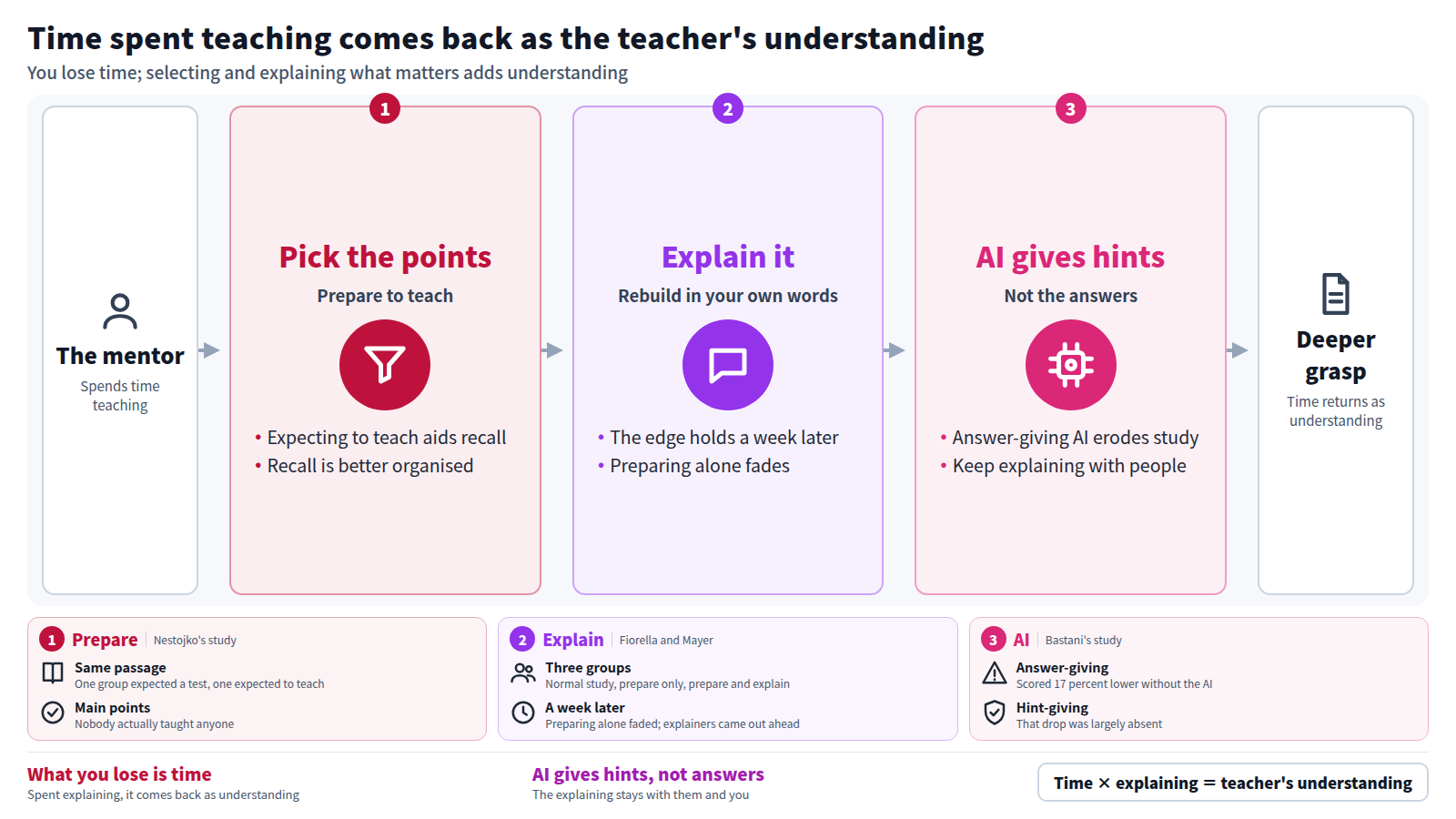
In workplaces where generative AI answers a newcomer's questions on the spot, senior staff may find themselves explaining less. What teaching leaves with the teacher can be read from a simple experiment reported in 2014 by the psychologist John Nestojko and colleagues. People who read a passage after being told they would later teach it to someone recalled more of it, and in better order, than people told they would be tested. None of them actually taught anyone. Why does helping someone else grow not leave less of you? Because choosing what matters and explaining it to someone else deepens the teacher's own understanding. What you lose is time; what you gain is understanding. But letting generative AI hand over the answers skips that work.
01Teaching costs time, and explaining adds understanding
When you bring on a junior colleague, your own working hours do shrink. Your understanding, however, grows. Count those two separately and the feeling that teaching diminishes you becomes easier to see through.
There are three pieces of evidence. People who studied expecting to teach recalled more, and in better order. People who actually explained the material kept their advantage a week later. People who served as workplace mentors reported higher job satisfaction and stronger commitment to their organisation. The third is a correlation, and it measures satisfaction, not understanding.
A different result has appeared where generative AI supplies the answers. High school students who practised with an answer-giving AI scored lower once the AI was taken away. When AI takes over the work of building the answer, the learner scores lower once the AI is gone.
For anyone responsible for developing others, I would suggest two things. Treat time spent teaching as work that adds to your own understanding. And where AI takes on part of the job, have it return hints, not answers.
02Merely expecting to teach made recall fuller and better organised
The claim that understanding grows starts with Nestojko's 2014 experiment, published in the journal Memory & Cognition.
The researchers had participants read the same passage. One group was told it would be tested afterwards. The other was told it would teach the material to someone else. In the end both groups sat the same test. Nobody in the teaching group actually taught.
The teaching group did better. Its members recalled more of the passage and organised what they recalled more clearly. They were especially good at answering questions about the main points. The authors attribute this to people who expect to teach adopting more effective ways of learning.
When I say "helping someone grow" in this column, I mean choosing the main points for another person, putting them in order, and explaining them. Doing the other person's work for them is not included. Nestojko's study showed that even the first step, looking for the main points while expecting to teach, makes what the teacher recalls fuller and better organised.
03Workplace mentors also reported higher satisfaction and commitment
Students who expected to teach recalled more. Do adults who develop colleagues at work see a similar gain?
In 2013, Rajashi Ghosh and Thomas Reio pooled studies of workplace mentoring in a meta-analysis, a method that combines the results of many studies into a single estimate. They compared people who had served as mentors with people who had not.
Job satisfaction
Mentors were more satisfied with their jobs than non-mentors.
Commitment
Mentors also reported stronger commitment to their organisation.
Career success
Giving career advice was most strongly linked to the mentor's own career success.
Intention to leave
No type of mentoring was significantly linked to intention to leave.
The result has two limits. The pooled studies span many industries, not pharmaceutical workplaces in particular. And the figures for satisfaction and commitment are self-reports.
Beyond that, the analysis shows correlation only. It cannot tell whether mentoring raised satisfaction or whether satisfied people were more likely to take on mentoring. Still, nothing in it suggests that the people doing the developing come out behind.
04A week later, the gain held for those who actually explained, not those who only prepared
The mentors' satisfaction was self-reported. What actually makes the teacher's understanding grow is better tested by experiment. Logan Fiorella and Richard Mayer came close to an answer.
Across four experiments, Fiorella and Mayer split learners into three groups: those who studied normally, those who only prepared to teach, and those who prepared and then actually explained the material. On a test right after learning, the group that only prepared also outperformed the normal learners.
The difference appeared a week later. On the delayed test, the advantage of preparing alone had vanished. Only those who had actually explained the material outperformed those who had only prepared.
In Fiorella's account, preparing is the work of selecting and arranging the main points. Explaining is the work of rebuilding the content in your own words. Understanding that lasts comes from the rebuilding.
The observation is not new. The Roman philosopher Seneca wrote in a letter to a friend that people learn while they teach. His words come almost two thousand years before Fiorella and Mayer's measurement. Fiorella and Mayer confirmed the observation with test scores a week later.
05When AI spread experts' methods to newcomers, the experts' productivity barely moved
Those who actually explained kept their understanding. So what happened to experienced staff in a workplace where AI carries their know-how to newcomers? This is where the link to AI becomes concrete.
The economist Erik Brynjolfsson and colleagues studied about 5,000 customer-support agents who were given a generative AI tool that suggested replies. In the first version of the paper, released in 2023, the number of issues resolved per hour rose by 14 percent on average.
The gain was largest for less experienced agents. For experienced agents, it barely moved. The authors write that they have suggestive evidence the AI spread the possibly tacit knowledge of more able workers to newer ones.
A later version adjusted the figures: 5,172 agents and an average gain of 15 percent. It also reports that the most experienced and highest-skilled agents saw small gains in speed and small declines in quality. It would be wrong to say the experts benefited. But when their knowledge passed to newcomers, their productivity did not fall by much.
The experts' knowledge reached newcomers through the AI. What the study measured was the experts' productivity, not their knowledge itself.
06Time turns into understanding, handing out answers erodes learning, and sharing knowledge leaves productivity intact
The experts kept their productivity even as their knowledge reached newcomers. Put that together with the three earlier studies and three things can be said about how to use time spent developing others.
Time spent teaching becomes the teacher's understanding
In Fiorella and Mayer's experiments, only those who actually explained kept their edge a week later. These were experiments, so the result cannot be carried straight into workplace mentoring, but time spent teaching is not necessarily a deduction from your own output. Spent on explaining, it comes back as understanding.
AI that supplies the answers erodes learning
Hamsa Bastani and colleagues gave about 1,000 high school students in Turkey generative AI for maths practice, in two forms: GPT Base, which gave answers directly, and GPT Tutor, which gave only hints. During practice, compared with students without AI, the GPT Base group scored 48 percent higher and the GPT Tutor group 127 percent higher.
| What to look at | Customer support (Brynjolfsson et al.) | High school maths (Bastani et al.) |
|---|---|---|
| Who was studied | About 5,000 customer-support agents | About 1,000 high school students in Turkey |
| AI's role | Suggesting replies in line with experienced agents' methods | Answer-giving GPT Base and hint-giving GPT Tutor |
| Learners | The newer the agent, the larger the gain | 48% and 127% higher in practice; GPT Base group 17% lower without AI |
| Teachers and experts | Productivity barely changed | Not studied |
On the test without AI, the result reversed. The GPT Base group scored 17 percent lower than students who had never used it. In the GPT Tutor group, that drop was largely absent. When the AI supplies the answer, the learner skips the work of building it. If you use AI to help develop a junior colleague, set it up to return hints.
The same holds when a junior colleague revises a draft written with generative AI. If they simply accept the AI's corrections, they never work out why the text was changed. Ask them to explain the reasons for each change and their understanding grows. The senior colleague who listens and corrects also does explaining work, in putting the reasons for each correction into words. By Fiorella and Mayer's results, some understanding stays with them too.
When knowledge passes on, the giver's productivity barely falls
In customer support, the experts' knowledge spread to newcomers through AI, and the experts' productivity barely changed. No result shows the experts losing much because their knowledge reached newcomers.
07Whether teachers keep the gain once AI does the explaining has not yet been measured
Of the three points, the evidence that teaching adds to the teacher's understanding was measured with a person explaining to another person. What happens to the teacher's gain once AI starts doing the explaining? Much of that is still unknown.
Causation
Mentors' higher satisfaction is a correlation; it is not yet shown that mentoring raised it.
Workplaces where AI explains
Whether human teachers understand less when AI writes the explanations has not been measured.
Experts' quality
The later version reported a small decline in quality among the most skilled agents.
The evidence so far comes from separate settings: people explaining to people, and AI helping learners. I have not found a study that measures what happens when AI writes the explanations and people get fewer chances to teach, and whether the teacher's understanding shrinks along with them.
What follows is my speculation. In a workplace where AI answers a newcomer's questions instantly, senior staff may explain less often. If they stop explaining, the lasting understanding that Fiorella and Mayer found may become harder for them to build. Whether that is true will not be known until someone measures it.
One more thing remains unconfirmed. The mentors' gain shows up only as a self-reported correlation. No one has yet shown that spending more time developing others raises satisfaction. I want to be careful not to overstate the case for teaching.
- People who studied expecting to teach recalled more, in better order, and only those who actually explained kept the edge a week later. Time spent teaching becomes the teacher's understanding.
- Students who practised with an answer-giving AI scored 17 percent lower once it was removed. If AI takes on part of the teaching, have it return hints.
- Where AI spread experienced agents' methods to newcomers, the experts' productivity barely changed. No result shows the experts losing much when their knowledge passed on.
Helping others grow does not leave less of you, because choosing what matters and explaining it adds to your own understanding. What you spend is time, and time spent explaining comes back as understanding.
So I do not pass the AI's answer straight to a junior colleague who asks me something. I let the AI give hints, and the work of explaining is done by them and by me.
- Nestojko, J. F., Bui, D. C., Kornell, N., & Bjork, E. L. Expecting to teach enhances learning and organization of knowledge in free recall of text passages. Memory & Cognition, 2014.(Expecting to teach, fuller and better organised recall, main-point questions)
- Fiorella, L. The Cognitive Benefits of Learning by Teaching and Teaching Expectancy. University of California, Santa Barbara, 2014.(Preparing versus explaining after one week; Fiorella & Mayer's four experiments)
- Ghosh, R., & Reio, T. G. Career benefits associated with mentoring for mentors: A meta-analysis. Journal of Vocational Behavior, 83(1), 2013.(Mentors' satisfaction, commitment, career success)
- Brynjolfsson, E., Li, D., & Raymond, L. Generative AI at Work. arXiv:2304.11771v1, 2023.(14 percent average gain; little effect on experienced agents)
- Knowledge at Wharton. Without Guardrails, Generative AI Can Harm Education. 2024-08-27.(About 1,000 students in Turkey; 48%, 127%, 17%)
- Bastani, H., et al. Generative AI without guardrails can harm learning: Evidence from high school mathematics. PNAS, 2025.(Penn CHIBE summary page)
- Seneca. Epistulae Morales ad Lucilium, Book I, Letter VII. The Latin Library, accessed 2026-10-06.(homines dum docent discunt)
- Brynjolfsson, E., Li, D., & Raymond, L. Generative AI at Work (latest version). arXiv:2304.11771, accessed 2026-10-06.(5,172 agents, 15 percent, small quality decline among the most skilled)