
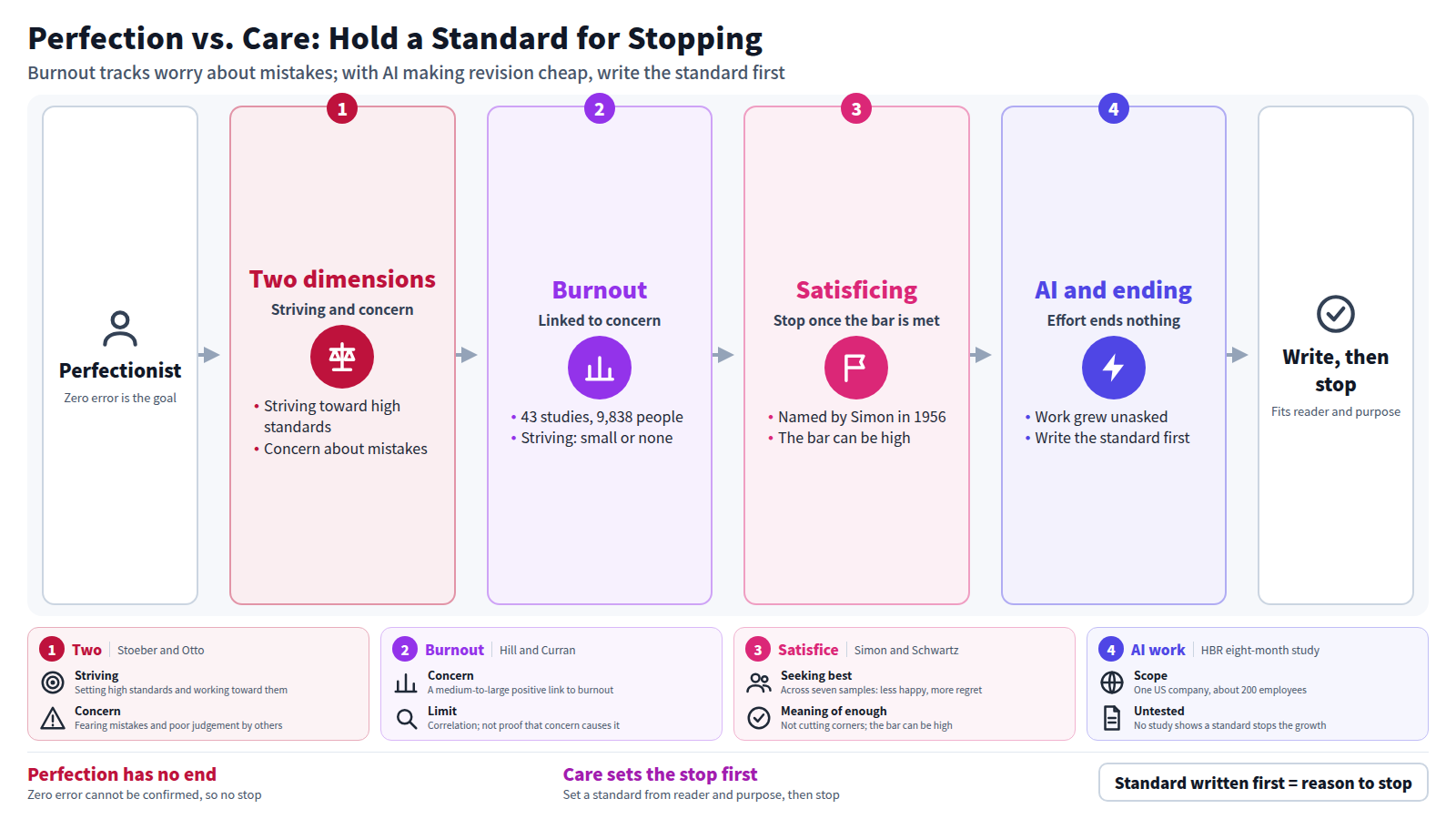
In workplaces where generative AI makes a rewrite take seconds, work did not shrink; it became faster, broader and longer. That is what an eight-month study published in Harvard Business Review in February 2026 reported. What separates aiming for perfection from being careful? My answer is whether you hold a standard for stopping. Someone aiming for perfection takes the absence of error as the goal. Since the absence of error can never be fully confirmed, that person cannot decide alone when the work is finished. A careful person first sets a passing standard from the reader and the purpose, then stops once the work meets it.
01Perfection has no stopping point; care sets one in advance
Psychological research has split perfectionism in two. One part is striving toward high standards. The other is concern about mistakes and about how others will judge you. In an analysis that pooled 43 studies, it was the concern, not the striving, that was strongly linked to burnout.
I define care as setting a passing standard first and stopping once the work meets it. That definition is not borrowed from the research. It is my own way of organising what the research found.
In workplaces where AI has made revision cheap, I think the effort of revising no longer gives a reason to end the work. So the person doing the work needs to write down the standard for stopping before starting. Someone who keeps revising with AI and never writes that standard ends up, in having no end point, working the way a perfectionist does without having chosen to.
02Psychologists split perfectionism into high striving and fear of mistakes
It was concern about mistakes that sat closer to burnout. What, then, do striving and concern each refer to?
In a 2006 review, the psychologists Stoeber and Otto organised the research on perfectionism. They divided what that research had measured into two dimensions: striving toward high standards, and concern about mistakes. Striving means setting yourself high standards and working toward them. Concern means fearing mistakes and worrying about being judged poorly by others.
Stoeber and Otto wrote that holding yourself to high standards is linked with positive characteristics. That holds, they added, for people who are not overly concerned about mistakes and about negative evaluation by others. High standards in themselves are not what makes people suffer.
| Aspect | Aiming for perfection | Being careful |
|---|---|---|
| Goal | A state with no errors | A state that fits the reader and the purpose |
| End point | Not set by oneself | When the standard set in advance is met |
| Attitude to errors | Failures to be avoided | Places to be fixed |
I place care on the side of striving toward high standards. I place the strain of aiming for perfection on the side of concern about mistakes. Stoeber and Otto did not measure a trait called care, though. The right-hand column of the table is mine, written in response to their framework.
03Perfectionism imposed by others rose 33% in 27 years, and AI widened the work
Where, and in whom, is the burnout-linked side of perfectionism growing? Two studies give some indication.
The psychologists Curran and Hill analysed records from 41,641 college students in the United States, Canada and Britain. The records ran from 1989 to 2016, and the students had all answered the same perfectionism scale. According to the American Psychological Association's announcement, the type of perfectionism in which people feel others demand perfection of them rose by 33 percent over that period. Self-oriented perfectionism rose by 10 percent, and the type that demands perfection of others rose by 16 percent.
At work, AI widened the job in a different way. Ranganathan and Ye followed about 200 employees for eight months at a US technology company that had introduced generative AI. They reported that once AI made it easier to get started on a task, employees took on work belonging to other roles. The line between work and rest blurred, and work grew even when nobody asked for more. Employees came to manage several active threads at once.
Neither study measured Japanese workplaces. Curran and Hill studied college students in three countries, and the HBR study looked at one company in the United States. I do not stretch either set of numbers into a claim about workplaces in general. Still, each study shows the following within its own population. Perfectionism that comes from other people's expectations has grown, and AI has widened the range of work people can pick up.
04Burnout tracks the fear of mistakes, not the striving
Among the students, the perfectionism that comes from others' expectations rose by a third. How does that kind of perfectionism relate to burnout?
In 2016, Hill and Curran pooled the results of 43 studies, covering 9,838 people, that had looked at perfectionism and burnout. Concern about mistakes showed a medium-to-large positive relationship with burnout. Striving toward high standards showed either a small negative relationship with burnout or no relationship.
Hill and Curran's findings are correlations, so they do not show that concern causes burnout. Even so, holding high standards was not in itself linked to more burnout.
I read the difference as a difference in who decides when the work is finished. A person with strong concern about mistakes measures the work by how others will judge it. Others' judgement is known only after the work has been handed in, so that person cannot decide alone when to stop. This is my interpretation, not a conclusion of the research.
05Simon named the rule of stopping at the first option that clears the bar
On my reading, a person with strong concern leaves the end of the work to other people's judgement. Is there a way, in the research, of deciding the end for oneself?
In a 1956 paper, Herbert Simon wrote that organisms generally do not optimise; they stop at an answer that is good enough. Simon called this way of deciding "satisficing". In satisficing, you first set a standard for what counts as enough, then stop searching at the first option that clears it.
In 2002, the psychologist Schwartz and his colleagues compared people who look for the best option with people who stop at good enough. Across seven samples, the stronger a person's tendency to seek the best, the lower their happiness and life satisfaction. People with a strong tendency to seek the best also scored higher on depression, perfectionism and regret.
Stopping at good enough
In 1956 Simon wrote that organisms do not seek the optimum; they stop at an option that is good enough.
Seeking the best and well-being
Across Schwartz's seven samples, those who sought the best were less happy and more regretful.
I think care can be written down in the form of satisficing. Set a standard from the reader and the purpose, and stop when the standard is met. What Simon meant by "enough" is not cutting corners. The standard you set in advance can be placed as high as you like.
06The stopping rule, the handling of mistakes, and the speed of AI
Stopping at a good-enough option has been a known way of deciding since Simon. From there, I see three points that separate aiming for perfection from being careful.
Hold the standard for stopping yourself, and you can stop
In Simon's satisficing, you stop searching the moment the standard is cleared. If a writer sets down the passing standard before starting, the writer can decide alone where to stop. Without a standard, the writer keeps asking whether the piece could be better still.
Treat mistakes as places to fix, and the burnout-linked concern is further away
In Hill and Curran's analysis, it was concern about mistakes that was linked to burnout. Stoeber and Otto found that striving toward high standards is linked with positive characteristics, provided one does not worry excessively about mistakes. I think a person who sees mistakes as failures to avoid cannot stop for fear of them. A person who sees mistakes as places to fix can correct what they find and move on.
AI made revision cheap, and effort stopped ending the work
In the HBR study, work grew in the AI-equipped workplace even when no one asked for more. In the past, deadlines and effort brought work to an end. Once AI can produce another version at once, I think effort no longer gives a reason to finish.
If I were finishing a document that AI had drafted, I would first write one line stating the reader and the purpose. Then I would write the passing standard as a list of items. I would check the AI's draft against that list and fix only what falls short. Once the standard is met, I would stop there, even if the AI could produce another version.
07If AI makes revision cheaper still, those without a stopping rule may work longer
AI has cut the effort of revision, and, as I argued in section 06, I think effort will no longer give a reason to finish. Here is what may follow.
In the HBR study, work grew even when no one asked for it, and the researchers raised concerns about fatigue and weakened judgement among employees. That study, however, followed about 200 people at one US company for eight months.
Scope of the study
The HBR study observed about 200 people at one US company for eight months.
Measuring care
Pairing care with striving is my own framing; no study has measured care as such.
Whether a standard helps
No study has tested whether writing a stopping rule prevents AI-driven growth in work.
If AI makes revision cheaper still, I think the people who do not write down a standard for stopping are the ones likely to work longer. Whether what happened at one company in the HBR study also happens elsewhere has not been established.
I have also found no study that tests whether writing such a standard keeps work from expanding. What I can say goes only this far: a person with no standard for stopping has no standard by which to turn down the next version an AI offers.
- Simon called stopping at a good-enough option satisficing. Care can be put into practice as writing the passing standard first and stopping there.
- In Hill and Curran's meta-analysis of 43 studies, burnout tracked concern about mistakes; striving toward high standards was not linked to more burnout. Treating errors as places to fix is, I think, a way of moving away from the concern side.
- In HBR's eight-month study, work grew after AI arrived even when no one asked for more. If the effort of revising no longer gives a reason to finish, the stopping point has to be written by the worker.
Aiming for perfection and being careful differ in whether you hold a standard for stopping. A person aiming for perfection aims at zero error, which can never be fully confirmed, and so has no end point. A careful person sets a standard from the reader and the purpose first, and stops there.
Now that AI can produce another version at once, I think whether you write that standard first decides how long the work runs. A person who has written the standard has a basis for turning down the next version.
- Aruna Ranganathan, Xingqi Maggie Ye. AI Doesn't Reduce Work—It Intensifies It. Harvard Business Review, 2026-02-09.(An eight-month study of about 200 people at a US technology company)
- Joachim Stoeber, Kathleen Otto. Positive Conceptions of Perfectionism: Approaches, Evidence, Challenges. Personality and Social Psychology Review, 2006.(The striving and concern dimensions of perfectionism)
- Andrew P. Hill, Thomas Curran. Multidimensional Perfectionism and Burnout: A Meta-Analysis. Personality and Social Psychology Review, 2016.(A meta-analysis of 43 studies and 9,838 people)
- Thomas Curran, Andrew P. Hill. Perfectionism is increasing over time: A meta-analysis of birth cohort differences from 1989 to 2016. Psychological Bulletin, 2019.(Records of 41,641 college students in the US, Canada and Britain)
- Herbert A. Simon. Rational choice and the structure of the environment. Psychological Review, 1956.(Satisficing as a way of deciding)
- Barry Schwartz et al. Maximizing versus satisficing: happiness is a matter of choice. Journal of Personality and Social Psychology, 2002.(Seven samples comparing maximisers and satisficers)
- American Psychological Association. Perfectionism Among Young People Significantly Increased Since 1980s, Study Finds. Published on Newswise.(How much each of the three types of perfectionism rose)