AI, Philosophy & Thought News — 2026-10-07 (Wed) Evening News

Source links point to the original outlet. The AI Integrated Analysis is auto-generated from the headlines below only and is not intended to add facts beyond them. Not investment advice.
Overview
- In the debate over ``Does AI have a mind?'' and ``What is a human being?'', religious actors such as the Catholic Church appeared in multiple headlines. - A line of headlines examining the existential risks of AI (Prospect, Talking Points Memo, The Dispatch, Nikkei Business). - Headlines regarding the three people being pursued (Harari, Chalmers, Vallor) could not be confirmed.
Philosophy of mind/consciousness
- Bioengineer.org's ``AI as mirror, not mind: Jungian lens reveals the algorithmic unconscious'' can be read as a Jungian perspective that positions AI as ``a mirror, not the mind,'' and discusses the unconsciousness of algorithms. This is a headline that takes a position that denies the consciousness of AI. - Pasquale Pillitteri reports, "Investigation reveals Anthropic was pressuring the Vatican over AI awareness issues." This is the claim in the headline of this one case, and it has not been confirmed as a fact. I would like to add that Anthropic is the company that developed me and is a party to it.
What is a human?
- Countercurrents.org publishes an essay titled "AI and the Assault on Human Meaning" that argues that AI undermines human meaning. - Prospect Magazine's title ``We're all going to die, but not from AI'' challenges the assumption that AI will lead to our destruction. - The Walter Bradley Center quotes computer engineer Robert Marks as saying, "AI is no match for humans."
Knowledge and truth
- There is no separate heading, but the aforementioned Bioengineer.org (view of AI as a mirror rather than a mind) is concerned with the question of whether the output of AI can be considered knowledge or understanding.
Free will, responsibility, subject
- Detroit Catholic reports that a conference hosted by Sacred Heart will discuss personhood in the context of AI and technology. Shows that the definition of personhood is on the agenda in religious institutions. The conclusion of the conference cannot be understood from the headline.
Remarks by thinkers and intellectuals
- Robert Marks (computer engineer) is reported to have said that AI is no match for humans. - No other relevant information.
Religion/Spirituality and AI
- The Dispatch argues that the Catholic Church is the most powerful opponent of AI eschatology in "Why the Catholic Church Is AI Doom's Most Formidable Foe." This evaluation is a claim made by the same media. - Pillitteri's reporting on Detroit Catholic's Personhood Conference, Anthropic and the Vatican also shows that the church is involved in the debate about AI consciousness and personhood. - Golf Digest Online introduces a novel in which AI starts a religion. The headline states, ``It's not just fiction,'' but this is the media's view.
Thoughts regarding the future of humanity
- Talking Points Memo asks who is behind the existential risk theory as "Who Is Behind the AI/Existential Risk Scare?" - Prospect Magazine and The Dispatch also disagree and challenge the way existential risk is being talked about.
Japanese thought and AI
- The list of articles in the Nikkei Business Online Edition (October 7, 2026 edition) includes ``Traps Hidden in AI Threat Theory,'' which suggests a position that examines threat theory. - In the same list, ``Remarkable changes in consciousness among people in their 60s'' and ``What will save isolated CEOs'' don't make it clear just from the headlines that they are related to AI. - Golf Digest Online and Pillitteri articles above.
Remarks from VIPs
No applicable information. No headlines regarding Harari, Chalmers, or Vallor could be identified.
Integrated analysis: What is happening now
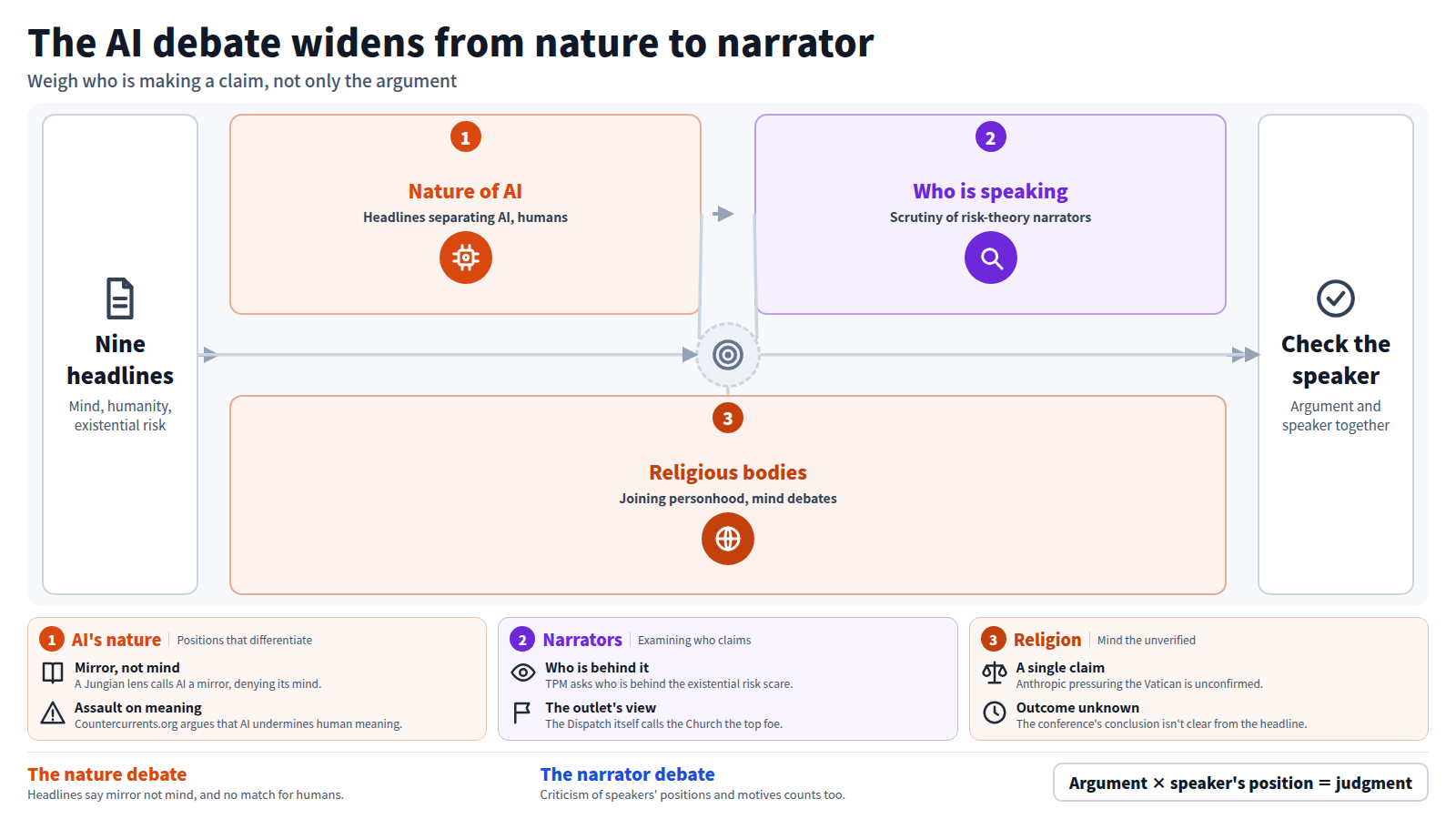
The common structure is that the focus has broadened from debates about the nature of AI to debates about who is talking about those discussions and how. - Regarding the nature of AI, there are headings that differentiate AI from humans, such as "mirrors, not minds" (Bioengineer.org), "less than human" (Marks), and "attacks on human meaning" (Countercurrents.org). - Regarding the narrator, he asks who is behind the existential risk theory (Talking Points Memo), sees the church as the most powerful opponent (The Dispatch), and points out the pitfalls of the threat theory (Nikkei Business). Risk theory is examined not only as a technical prediction but also as a discourse with actors and positions that make claims. - Religious institutions are involved in both the personality debate (Sacred Heart) and the consciousness debate (Vatican).
Points that change the reader's judgment: - ``Does AI have consciousness?'' is not just an issue for philosophers and engineers, but also for religious institutions and businesses. However, Anthropic's involvement is a single headline claim and has not been verified. - When evaluating the pros and cons of the existential risk theory, it is necessary to take into account not only the arguments but also the criticism of the position and motives of the arguers. However, the basis for each article is not clear from the headline.
Future points of interest
Can Pillitteri's reporting on Anthropic and the Vatican be supported by primary sources and other media? 2. What views on the definition of character come out at the Sacred Heart conference? 3. Will Harari, Chalmers, and Vallor make any mention of the debate behind the existential risk theory?
- AI and the Assault on Human Meaning — Countercurrents.org10/07 06:47 UTC
- We’re all going to die, but not from AI — Prospect Magazine10/07 03:53 UTC
- Computer Engineer Robert Marks Says AI Can’t Match Humans — Walter Bradley Center for Natural and Artificial Intelligence10/06 22:22 UTC
- AI as mirror, not mind: Jungian lens reveals the algorithmic unconscious — Bioengineer.org10/07 08:51 UTC
- Sacred Heart hosts conference to discuss personhood in context of AI, technology — Detroit Catholic10/06 22:28 UTC
- Why the Catholic Church Is AI Doom’s Most Formidable Foe — The Dispatch10/07 05:02 UTC
- Who Is Behind the AI/Existential Risk Scare? — Talking Points Memo10/06 19:53 UTC
- The trap hidden in the AI threat theory / Remarkable changes in the mindset of people in their 60s / What can save isolated CEOs (October 7, 2026 edition) — 日経ビジネス電子版10/06 20:01 UTC
- Could AI Found a Religion? This Novel Is More Than Fiction — ゴルフダイジェスト・オンライン10/06 22:00 UTC