AI in Medicine — Cancer & Rare Disease — 2026-09-28 (Mon)
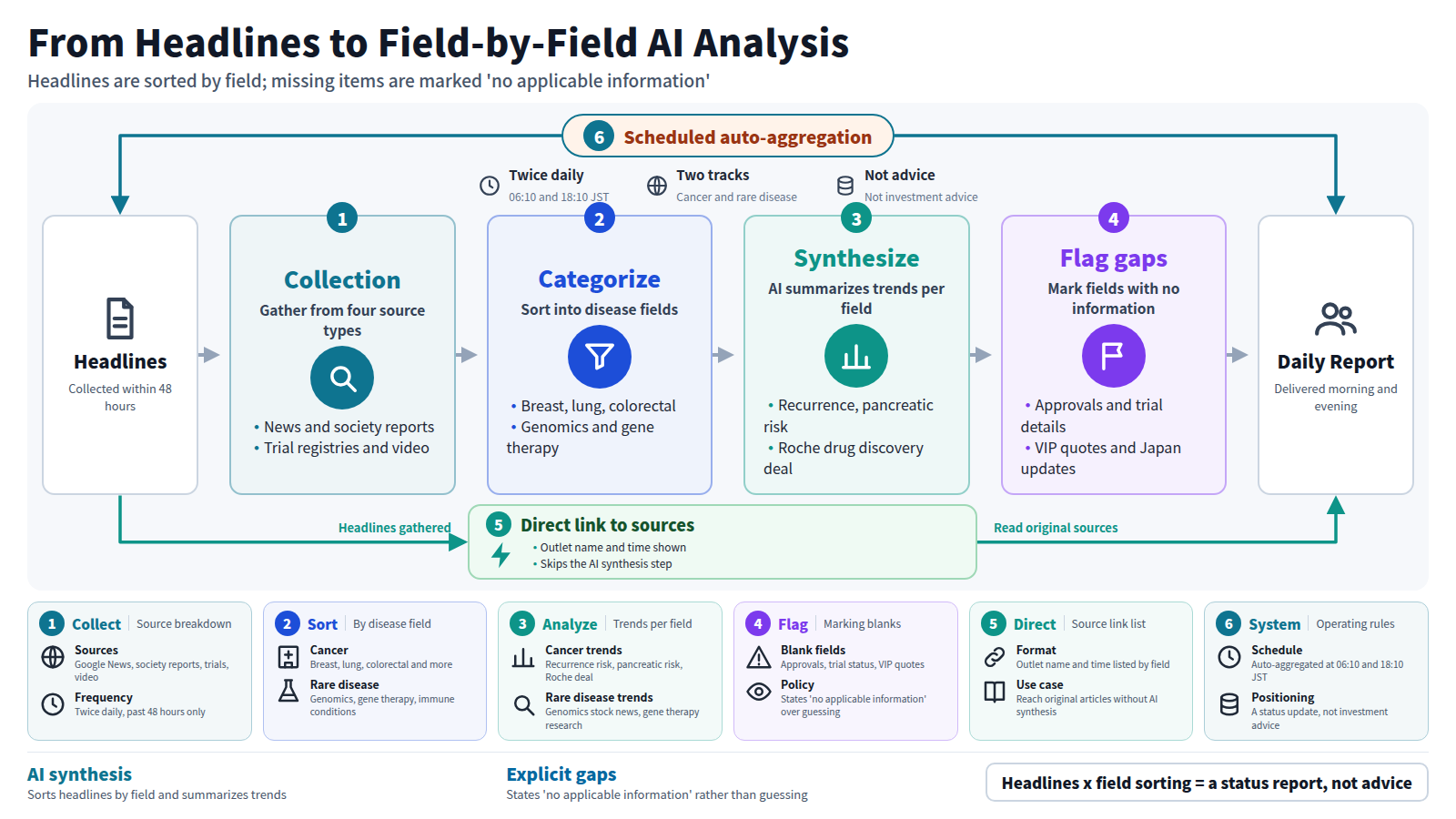
Source links point to the original outlet. The AI Integrated Analysis is auto-generated from the headlines below only and is not intended to add facts beyond them. Not investment advice.
Latest news on AI and cancer treatment
Overview
Several movements were seen in the diagnostic/imaging field (breast cancer screening, pancreatic cancer risk prediction, pathology/image-based technology). In the field of treatment selection and drug discovery, an AI drug discovery partnership with Roche was reported. Separate regulatory approval/designation information is not included in the heading.
Breast cancer
- Target: Breast cancer recurrence risk assessment. Study shows AI can provide more precise prediction of recurrence risk (MedicalNewsToday, no detailed research stage). - Target: Mammography for breast cancer detection. It was reported that India's PGIMER (Institute of Medical Research and Education) is proceeding with the introduction of AI-assisted mammography equipment (introduction stage, no clinical results listed).
lung cancer
No relevant information (there is a general oncology-related report in the headline stating that AI informs doctors of the uncertainty regarding the success of cancer treatment, but there is no mention specific to lung cancer).
Malignant brain tumor
No applicable information
Leukemia/lymphoma
No applicable information
Colon cancer/digestive organ
- Target: Pancreatic cancer risk. It was reported that a research team at the Mayo Clinic has developed an AI model that predicts the risk of pancreatic cancer up to three years before the onset of the disease (single-center study, development stage; forward-looking/retrospective and accuracy indicators are not listed in the headline).
Rare cancer
No applicable information
Diagnosis/Pathology/Image
- It was reported that there is a system in which AI notifies doctors when AI is uncertain about the likelihood of success in cancer treatment (Bioengineer.org, target cancer type and verification stage not listed). - The introduction of "Agentic AI" (autonomous AI) into the field of medical oncology and its development from AI joint decision-making support to autonomous tumor board operations was discussed (Oncodaily, concept/perspective article). - A survey on knowledge, attitude, and awareness of AI among medical students was reported (Cureus, an education/awareness survey, not an evaluation of clinical performance).
Treatment selection/drug discovery
- It was reported that Roche Holding has entered into a new AI drug discovery partnership (Yahoo Finance, no details on development stage or target disease). - It was reported that Heidelberg was recruiting for medical AI-related postdocs, engineers, and researchers (information on research infrastructure, not an announcement of results).
Regulations/Approval
No relevant information (There is an editorial titled ``Why excellent medical AI continues to fail in clinical practice,'' but the heading does not include information on approval and designation of individual products by FDA, EMA, and PMDA.)
Clinical trial implementation status
No relevant information (No specific description of the trial name, target cancer type, phase, or registration status from ClinicalTrials.gov can be found in the provided text).
Japanese movements
No applicable information
Remarks from VIPs
No relevant information (the list of important people being tracked is blank, and quotations with titles are not included in the headings).
Note: This report is based solely on the headline text provided and does not refer to the text of the linked article. Numerical values, causal relationships, and clinical significance are not described beyond the scope specified in the heading.
Latest news on AI and rare and incurable diseases
Overview
Only three headlines were collected this time, and there is little concrete content indicating major progress in diagnosis, therapeutic drugs, or systems. There are fragments of stock news on genome-related stocks, a doctoral student's efforts on applying machine learning to gene therapy, and an academic conference presentation on retinal inflammation detection using AI. There are no headlines that directly refer to shortening the diagnosis of designated intractable diseases, approving therapeutic drugs, or reforming the system.
Diagnosis of rare diseases
No applicable information
Gene analysis/genome
A stock-related article about TEMPUS AI (NASDAQ: TEM) was found, but the content was chart information for investors, and it was not possible to confirm from the headline what kind of genetic analysis and mutation determination the company had conducted in the rare disease field. Since there is no description of specific analysis methods, judgment accuracy, or target diseases, it is not possible to evaluate the content.
Development of therapeutic drugs
There is a headline that a doctoral student at the University of North Carolina at Chapel Hill in the US is working on gene therapy research using machine learning. The stage is not clear from the headline, and it is not possible to determine whether it is in the preclinical stage or the basic research stage. There is no specific description of target disease names, drug names, or effects.
Nerve/muscular diseases
No applicable information
Immunology/Collagen disease
At Retina Society 2026, it was announced that AI can detect retinal inflammation without using staining. The target disease name, number of cases, and detection accuracy are unclear from the headline, and the information is only at the presentation stage at an academic conference (it is not possible to confirm whether it is a peer-reviewed paper or a case report). A direct relationship with the immunological disease group listed in the heading (Takayasu's arteritis, Behcet's disease, etc., 348 diseases included in the above list) has not been shown.
Rare metabolic/endocrine diseases
No applicable information
System/Patient Support
No applicable information
Japanese movements
No applicable information
Remarks from VIPs
No applicable information
- AI could offer more precise breast cancer recurrence risk, study finds — MedicalNewsToday09/27 10:04 UTC
- PGIMER to acquire AI assisted mammography for breast cancer detection — NewsBytes09/26 04:38 UTC
- AI Tells Doctors When It Is Unsure About Cancer Treatment Success — Bioengineer.org09/27 20:47 UTC
- Women – and pharma – in AI: Where are we now? — pharmaphorum09/25 22:53 UTC
- If Whoever Wins AI Wins, Why Are We Preventing It From Reaching Its Full Potential in Healthcare? — townhall.com09/26 04:01 UTC
- Mayo Clinic Researchers Develop AI Model That Predicts Pancreatic Cancer Risk Up to 3 Years Before... — Medical Dialogues09/26 07:09 UTC
- Agentic AI in Clinical Oncology: From AI Co-Pilots to Autonomous Tumor Board Workflows — Oncodaily09/27 15:47 UTC
- Institution Seeks AI, Intelligent Systems To Curb Nigeria’s Traffic Violations — News Agency of Nigeria09/27 19:06 UTC
- Assessment of Knowledge, Attitudes, and Perceptions Regarding Artificial Intelligence Among Undergraduate Medical Students — Cureus09/27 08:56 UTC
- AI is already reading your pet's X-rays. The AVMA president explains what's changing at the vet, and what never will — Yahoo Creators09/27 14:28 UTC
- Roche Holding (SWX:ROP) Signed New AI Drug Discovery Partnerships — Yahoo Finance09/27 20:06 UTC
- Apply for Heidelberg Medical AI Jobs 2026: Postdocs, Engineers and Researchers Wanted in Germany — Global South Opportunities09/26 09:43 UTC
- Why brilliant healthcare AI keeps failing at the bedside—and how to fix it — Bioengineer.org09/25 22:27 UTC
- TEM News | TEMPUS AI INC-CL A (NASDAQ:TEM) — ChartMill09/26 00:00 UTC
- Doctoral student uses machine learning to transform gene therapy — The University of North Carolina at Chapel Hill09/18 07:00 UTC
- Retina Society 2026: AI flags retinal inflammation without dye | Eye Care Network - Modern Retina — Ophthalmology Times09/27 14:06 UTC