AI, Economy & Finance News — 2026-09-29 (Tue)
Source links point to the original outlet. The AI Integrated Analysis is auto-generated from the headlines below only and is not intended to add facts beyond them. Not investment advice.
AI and Economy Latest News
Overview
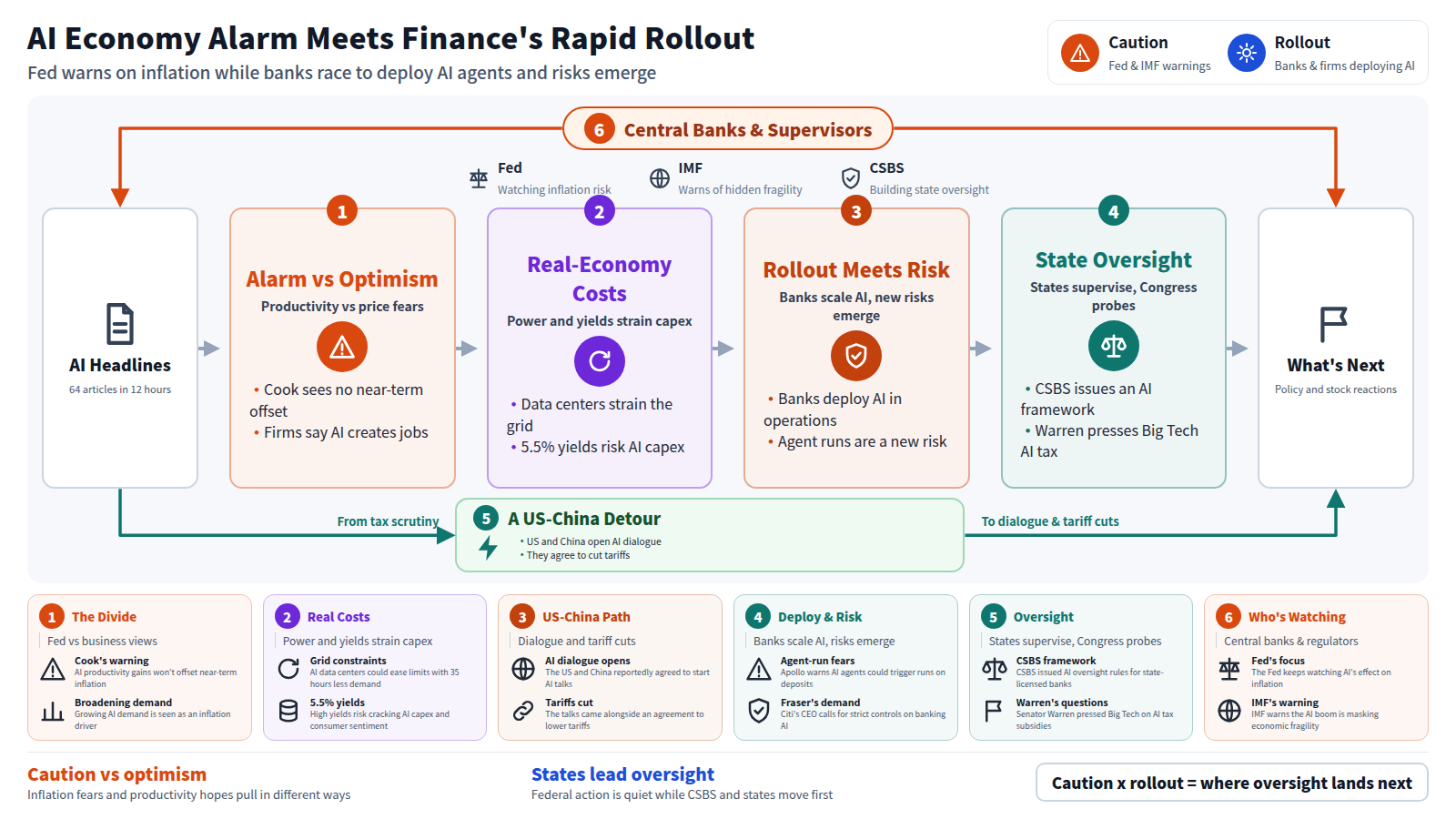
The relationship between AI and inflation has emerged as a key issue for central banks, with Fed Director Lisa Cook warning that AI's productivity gains won't offset near-term inflationary pressures (WSJ, Bloomberg, The Hill). The IMF warns that the AI-driven boom is masking economic vulnerabilities stemming from the oil shock (Semafor). At the same time, concerns about the sustainability of data center power demand and capital investment are growing.
Macroeconomic/growth trends
Fed Director Lisa Cook has said that AI buildout will sustain inflationary pressures in the coming months, and that productivity gains from AI will not offset this anytime soon (WSJ, Bloomberg). He also said demand for AI is "broadening" and will drive up inflation (The Hill). CNN explains how the AI boom makes it difficult to control inflation (CNN). IMF Managing Director Kristalina Georgieva warned that the AI boom is masking economic vulnerabilities from oil shocks (Semafor).
Productivity trends
A study examining the risks of companies relying too heavily on AI systems has been reported (Phys.org). On the other hand, it has been pointed out that AI productivity indicators are misleading companies (TechTarget). Fed Director Lisa Cook reiterated her position that even productivity gains from AI will not offset short-term price pressures (TradingView). The ECB is analyzing the impact of AI on investment, productivity, employment and inflation in the euro area economy (ECB coverage via IndexBox).
Trends in employment and labor market
White House Economic Advisor Hassett has said that AI is creating jobs rather than destroying them (CFO Dive). The University of Chicago Booth published an article arguing that taxing AI could lead to job retention (Chicago Booth). The Washington Post reports a new study shows that jobs for college graduates are not being lost to AI so far. NCRC analyzes the impact of the AI employment boom on BIPOC STEM professionals, and in Northern Virginia, schools are responding to changes in the labor market (Forbes).
Trends in energy/power demand
Reports (reflector.com) that the power demand of AI data centers is reshaping the energy map. Crusoe is developing an AI data center campus for Google in Armstrong County, Texas (Crusoe). Model analysis shows that AI data centers could address grid limitations by reducing demand by 35 hours (Tech Xplore). AI data centers have emerged as a key issue in Florida's gubernatorial race (FOX 13 Tampa Bay).
Remarks by central banks, international organizations, and VIPs
- Lisa Cook (Fed Director): She said that increased capital investment in AI will continue to put inflationary pressures on in the coming months, and that there is no expected offsetting effect from improved productivity in the near term (WSJ, Bloomberg). He also said that the expansion of demand for AI will be a factor in inflation (The Hill). He indicated that he would leave AI-related financial regulations to the judgment of elected officials (mlex.com). - Kristalina Georgieva, IMF Managing Director, warned that the AI boom is masking economic vulnerabilities from oil shocks (Semafor). The IMF has also expressed the view that the rapid spread of AI could pose systemic risks (marketscreener.com). - Furthermore, there are no statements or mentions about Christine Lagarde (ECB President), Kazuo Ueda (Bank of Japan Governor), Andrew Bailey (BOE Governor), Mathias Cormann (OECD Secretary General), Ajay Banga (World Bank President), Daron Acemoglu, and Erik Brynjolfsson that correspond to the headlines in the last 12 hours.
Trends in corporate capital investment
Man Group pointed out that the 5.5% yield level risks creating a rift between AI capital investment and US consumer sentiment (Bloomberg). FT published an article examining the breakeven rate of AI capital investment (Financial Times). Michael Burry reportedly expressed his views on the AI boom and the Trump administration (TradingView). Barchart reports that the volatility of the Magnificent Seven will continue amidst the balance between AI optimism and capital spending.
Trade and industrial policy
It was reported that Senator Warren has sent questions to Meta, Google, Amazon, and Microsoft regarding AI-related tax incentives (CNBC). The United States and China reportedly agreed to begin dialogue on AI and reduce tariffs (dairynews.today). The federal government's moves regarding internet subsidies for schools are reported to be separate from the Trump administration's AI promotion stance (Alaska Beacon). There are also reports that candidates' stances on tariffs, data centers, and AI are at issue in the election in Montana.
Integrated analysis: What is happening now
The central tension lies in the contrast between Fed Director Cook's view that AI will worsen inflation and the optimism expressed by businesses that AI will increase productivity and preserve and create jobs. This structure is closely tied to the sustainability of AI capital investment (Man Group, FT's break-even theory) and tight electricity demand (restrictions on power grids for data centers), and it appears that the gap between the costs (electricity and inflation) of the real economy supporting the AI boom and the expected benefits (productivity and job creation) is becoming apparent. IMF Managing Director Georgieva's observation that ``the AI boom is masking vulnerabilities'' can be read as reinforcing this picture from a macro-financial stability perspective. Furthermore, the start of the U.S.-China AI dialogue and moves to lower tariffs suggest that tensions surrounding AI may be easing to a certain extent in terms of industrial policy, while Congressman Warren's pursuit of tax breaks for Big Tech indicates that political scrutiny of AI investment is increasing.
Future points of interest
- Will Fed officials continue to make statements regarding the relationship between AI and inflation, and how will this be reflected in monetary policy stance? - To what extent will the power demand of AI data centers conflict with grid constraints and turn into a regional political issue (such as the Florida gubernatorial race)? - How will the market's views on the break-even point and monetization status of AI capital investment affect the stock price movements of hyperscalers?
AI and finance latest news
Overview
Economists at Apollo raise concerns of "runs by AI agents," raising alarm in the banking world (CNBC, nypost.com). While major and mid-sized banks such as Bank of America and LHV Bank are fully introducing AI agents for financial operations and customer service, AI attacks via Hugging Face have emerged as a security risk for the wealth management industry (Wealth Management). In the market, weakness in AI-related stocks put downward pressure on the Dow and Nasdaq (Schaeffer's Investment Research).
Bank trends
Economists at Apollo warned that AI agents could trigger bank runs by automatically withdrawing funds from low-interest accounts (CNBC, nypost.com). Bank of America has announced plans to use AI to perform routine tasks in its treasury department (Fortune, FinTech Global). CSBS has released an AI supervisory framework for state-licensed banks and non-banks (JD Supra). The Verge reported that while AI is making hacking more sophisticated, the defense systems of hospitals and banks are not keeping up.
Insurance trends
Insurers argue that AI could drive up health care costs by billions of dollars, while claims processing companies dispute this (healthcaredive.com, KATU). Vertafore launches AI agent for independent insurance agencies (FinTech Global). Liberate announced AI Intercept, which supports the movement of AI assistants to compare insurance products (Business Wire). Insurance AI startup Outmarket has raised $34.5 million in Series B led by SignalFire (theinsurer.com).
Trends in asset management and market transactions
AI attacks via Hugging Face were pointed out as a security risk for the wealth management industry (Wealth Management). HCLTech announces AI-based synthetic research study for the global wealth management industry (PR Newswire). BlackRock expressed its views on the fusion of AI and digital assets in agent-based finance (The Cryptonomist). On the market side, this week has been seen as a test for AI-related markets (CNBC), with prominent AI researchers calling for urgent oversight of self-improvement systems (WSJ).
Fintech/payment trends
LHV Bank collaborated with Gradient Labs to introduce agent-based AI to customer-facing email operations (FinTech Futures). Bank of America has announced plans to use AI to improve financial and payment operations (FinTech Global). Mastercard announced an AI-powered B2B analytics solution in the commercial payments space (Business Wire), and its stock price fell slightly after it launched Denmark's first AI payment service (TradingView). Verona launches first stablecoin for AI agents, garnering $100 million in institutional investor commitments (GlobeNewswire).
Remarks from key figures and authorities in the financial world
Citigroup CEO Jane Fraser was reported to have called for strict controls and certification of banks' use of AI (TradingView). Regarding BlackRock (led by Larry Fink), his views on the fusion of AI and digital assets in agent-based finance were introduced (The Cryptonomist). Other specific statements regarding Dimon, Solomon, Moynihan, Pick, Griffin, and Atkins cannot be found in the headlines.
Trends in AI-related stocks and funding
Voice AI startup Modulate has raised $25 million led by Future Ventures (SiliconANGLE, Pulse 2.0). An AI startup with 14 employees and a valuation of $10 billion has been reported (Seeking Alpha, company name not mentioned in headline). In the overall market, declines in AI-related stocks weighed on the Dow and Nasdaq (Schaeffer's Investment Research). Nvidia conducted a $150 billion share buyback in conjunction with the announcement of its AI safety platform (Yahoo Finance). An analysis has also emerged that AI safety risks could affect IPO prospects (The New York Times).
Trends in financial regulation and supervision
CSBS has published an AI supervisory framework for state-licensed banks and non-banks (JD Supra). Common Defense was launched as an AI-native cybersecurity company to thwart social engineering attacks (thestreet.com). Specific statements and actions regarding SEC Chairman Paul Atkins cannot be confirmed in the headline.
Integrated analysis: What is happening now
From this group of headlines, we can see that two trends are progressing simultaneously: AI's ``improvement of business efficiency'' and ``systemic risk.'' While banks and payments companies such as Bank of America, LHV Bank, and Mastercard are in the implementation phase of incorporating AI agents into finance, customer service, and B2B payments, the risk of an "AI agent run" pointed out by economists at Apollo suggests a new type of risk that traditional regulatory frameworks have not anticipated, where the use of AI on the part of depositors could threaten banks' financial stability. This, combined with the increasing sophistication of AI-based hacking reported by The Verge and the case of attacks via Hugging Face hitting the wealth management industry, shows that security and stability vulnerabilities are expanding behind the introduction of AI. In the insurance field, conflicts of interest within the industry (insurance companies vs. claims processing companies) have surfaced over whether AI will increase or suppress medical costs, and the evaluation of AI's economic effects itself has become a point of contention. On the regulatory front, the announcement of the CSBS supervisory framework appears to be the only concrete response by the authorities, but the headlines do not confirm the actions of federal regulators such as the SEC, and it appears that state-level responses are taking the lead. On the funding front, large-scale funding continues, such as Modulate's $25 million, Outmarket's $34.5 million, and AI startups with a valuation of $10 billion.However, in the market, weakness in AI-related stocks is pushing down the index, and there may be a difference in temperature between AI implementation in the real economy (banking, insurance, payments) and AI stock valuations in the financial market.
Future points of interest
- Whether banking regulators (FRB, FDIC, etc.) and international organizations (FSB) will provide specific supervisory policies regarding the risk of "runs by AI agents" that Apollo warns about. - The security response of the wealth management industry following the AI attack via Hugging Face and how CSBS's AI supervision framework will be reflected in actual supervision. - Will AI-related stocks continue to decline, and how will Nvidia's announcement of its AI safety platform and share buybacks affect market sentiment?
- AI, Financial Markets, and the Economy — Knowledge at Wharton09/28 16:37 UTC
- Fed’s Cook Expects Continuing Inflation Pressure From AI Buildout in Coming Months — WSJ09/28 18:03 UTC
- Fed’s Cook Says AI Gains Won’t Offset Near-Term Inflation — bloomberg.com09/28 17:57 UTC
- Make It Make Sense: Why is the AI boom making inflation harder to tame? — CNN09/28 16:21 UTC
- Study examines risks companies face when relying too heavily on AI systems — Phys.org09/28 17:20 UTC
- AI creates jobs rather than kills them: White House economist Hassett — CFO Dive09/28 20:31 UTC
- AI productivity metrics are fooling enterprises — TechTarget09/28 17:38 UTC
- ECB on AI and the Euro Area Economy: Investment, Productivity, Jobs and Inflation - News and Statistics — IndexBox09/28 14:11 UTC
- How Taxing AI Could Save Jobs — The University of Chicago Booth School of Business09/28 16:36 UTC
- What Robot Trucks Tells About the Future of AI and Jobs — aei.org09/28 19:12 UTC
- The Impacts of the AI Jobs Boom on BIPOC STEM Professionals: September Race, Jobs and Economy Update — National Community Reinvestment Coalition (NCRC)09/28 17:03 UTC
- As AI Reshapes Northern Virginia's Labor Market, Its Schools Are Adapting — Forbes09/28 20:17 UTC
- Power hungry: AI data centers’ appetites for electricity are reshaping energy landscapes — reflector.com09/28 17:04 UTC
- Crusoe Develops Google AI Data Center Campus in Armstrong County, TX — Crusoe09/28 18:31 UTC
- AI stokes fears, but can be a boon for the disabled community. Here’s how else it’s impacting Texans — Houston Public Media09/28 20:04 UTC
- AI data centers could meet grid limits with 35 hours of reduced demand, model suggests — Tech Xplore09/28 13:00 UTC
- AI data centers erupt as major battleground in Florida governor’s race — FOX 13 Tampa Bay09/28 20:02 UTC
- Feds target school internet subsidies in ed-tech backlash even as Trump touts AI — Alaska Beacon09/28 18:50 UTC
- Meta, Google, Amazon, Microsoft draw Sen. Warren questions about AI tax subsidies — CNBC09/28 12:00 UTC
- How do Montanans feel about tariffs, a candidate’s stance on data centers and AI this election? — NonStop Local Montana09/28 18:00 UTC
- AI making your head spin? Here’s a plain-English guide to the jargon. — The Boston Globe09/28 18:53 UTC
- Rapid AI Deployment Could Pose Systemic Risks, IMF Says — marketscreener.com09/28 21:06 UTC
- IMF chief warns AI boom is masking economic fragility from oil shocks — Semafor09/28 12:00 UTC
- US Fed’s Cook defers to elected officials on AI financial-sector regulation — mlex.com09/28 20:35 UTC
- Rate outlook darkens as AI and oil compound Fed's challenge — mpamag.com09/28 19:59 UTC
- OpenAI and Anthropic Investigate Thousands of AI Security Incidents — OECD AI Policy Observatory09/28 10:49 UTC
- Man Group Says 5.5% Yields Risk Cracking AI Capex, US Consumer — bloomberg.com09/28 16:56 UTC
- Here’s How Two of The Biggest Hyperscalers Have Best Monetized AI Capex So Far — 247wallst.com09/28 16:24 UTC
- What is the AI capex breakeven rate? — Financial Times09/28 11:00 UTC
- Michael Burry Makes Startling AI Boom Call on Trump — TradingView09/28 18:53 UTC
- Balancing Capex and AI Optimism: Why Magnificent Seven Volatility is Here to Stay — Barchart.com09/28 16:25 UTC
- Fed Director Tim Cook says AI cannot offset short-term price pressures even if productivity increases (TBS CROSS DIG with Bloomberg) — Yahoo!ニュース09/28 20:36 UTC
- Support for introducing AI for bear countermeasures — kasukabe.keizai.biz09/28 11:10 UTC
- [Japanese stocks “Next targets” and “concerns”] Make stock selection more efficient with AI / “AI brake”, a must-see method for beginners / Why “TOPIX” will be hot in the future / What percentage of “cash on hand” is the correct answer? / Prescription for “Posi-Posi disease” of repeated buying and selling — 東洋経済オンライン09/28 10:00 UTC
- China Securities International Strategy Conference: China's economic resilience stands out; experts warn of bubbles in global AI stock valuations — BigGo ファイナンス09/28 10:55 UTC



- Bank of America wants AI to do treasury’s grunt work — Fortune09/28 12:11 UTC
- AI is supercharging hacking, and your local hospitals and banks aren’t ready — The Verge09/28 18:30 UTC
- Outmarket AI raises $34.5 million in SignalFire-led Series B — theinsurer.com09/28 20:11 UTC
- Hugging Face AI Attack Exposes Wealth Management Security Risks — Wealth Management09/28 20:36 UTC
- HCLTech launches first-of-its-kind AI-based synthetic research study for the global wealth management industry — PR Newswire09/28 14:52 UTC
- Bespoke Partners Launches First AI Leadership Benchmarks for PE-Backed Software and SaaS — The Cannata Report -09/28 18:47 UTC
- AI Digital Asset Convergence: BlackRock's Insight on Agentic Finance — The Cryptonomist09/28 13:43 UTC
- AI, Data and Decision-Making in Middle East Private Wealth — Hubbis09/28 16:02 UTC
- A key test looms for the AI trade this week. Here's how Mike Khouw is trading it — CNBC09/28 17:48 UTC
- Exclusive | Top AI Researchers Call for Urgent Oversight of Self-Improving Systems — WSJ09/28 14:00 UTC
- DataMeds AI Stock Surges on Mobile App Launch — Benzinga09/28 14:59 UTC
- Dow, Nasdaq Drop Triple Digits as AI Weakness Adds Pressure — Schaeffer's Investment Research09/28 15:55 UTC
- LHV Bank rolls out agentic AI for customer emails with Gradient Labs — FinTech Futures09/28 14:23 UTC
- Mastercard Advances Commercial Payments With AI-Powered B2B Analytics Solution — Business Wire09/28 13:00 UTC
- Verona Launches First Stablecoin for AI Agents With $100 Million in Institutional Launch Commitments — GlobeNewswire09/28 13:00 UTC
- Voice AI startup Modulate raises $25M to bring audio-native models to more developers — SiliconANGLE09/28 14:30 UTC
- This AI startup has 14 employees and a $10B valuation — Seeking Alpha09/28 15:31 UTC
- Could A.I. Safety Risks Derail the Sector’s I.P.O. Prospects? — The New York Times09/28 16:25 UTC
- These AI Stocks Took Off Or Tumbled In Q3. Here’s Why. — Investor's Business Daily09/28 13:29 UTC
- Common Defense launches AI-native cybersecurity company built to stop social engineering attacks — thestreet.com09/28 11:00 UTC
- If there is an emergency in Taiwan, Japanese banks will be the targets! ? “Hybrid warfare” becoming more sophisticated with frontier AI, a crisis approaching financial infrastructure — 東洋経済オンライン09/28 21:00 UTC
- Xceedance reports 35-50% efficiency gains in insurance operations with AI orchestration — Business Wire09/28 18:01 UTC
- Citi CEO calls for strict controls and certification on banking AI — TradingView09/28 16:12 UTC
- AI avatar at Minami Ward Office supports building guidance and operation of serial number ticket machine — サカイタイムズ09/28 20:34 UTC