AI, Welfare & Long-term Care News — 2026-10-07 (Wed) Evening News

Source links point to the original outlet. The AI Integrated Analysis is auto-generated from the headlines below only and is not intended to add facts beyond them. Not investment advice.
Overview
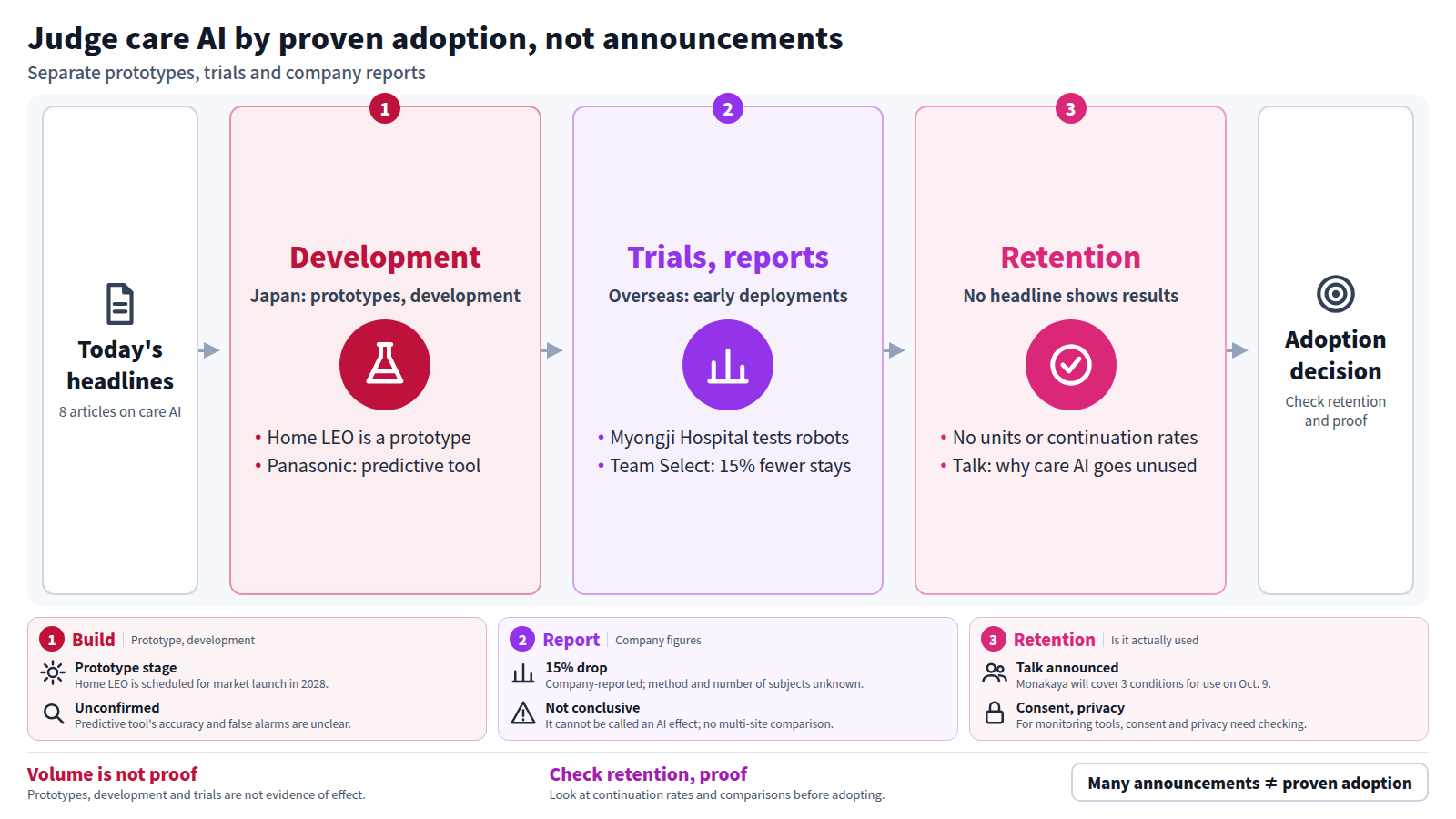
- The moves were mainly aimed at equipment and technology development and countermeasures against labor shortages. In Japan, there will be presentations of prototypes and development, and discussions on human resource development, and overseas (South Korea and the United States) there will be cases of implementation in hospitals and homes. - There are no headings regarding revisions to the system (nursing care fees and staffing standards). There is only one case in the United States that shows the effectiveness, and the headline says it is still at the stage of announcement by the company.
AI in nursing care settings
- There are no headings indicating labor savings in recording, billing, shifts, and care plans (whose labor is reduced and how many minutes). -
Overseas/Hospital
Myongji Hospital and Lavoro AI test robot for non-clinical hospital work (Korea Biomedical Review). As the headline suggests, it is still in the trial stage, and details about effectiveness figures and whether it will be targeted at nursing care or hospital work are unknown. -
Domestic
Monakaya is scheduled to give a lecture at "H.C.R.2026" on October 9th. The title is ``Reasons why nursing care AI is not used and three conditions for it to be used'' (PR TIMES). Although it can be read as a lecture dealing with the issue of retention, the contents of the three conditions and the supporting data are not clear from the headline. It is a PR announcement, and the evidence level is limited to a lecture announcement.
Labor shortage and workers
-
Overseas/Korea
South Korea plans to rely on AI and robots to prepare for future nursing care worker shortages (Korea JoongAng Daily). Only the headlines make it unclear about staffing standards, turnover, foreign personnel, and the distinction between jobs that can be replaced by AI and jobs that cannot. - In Japan, there is a report (Asahi Shimbun) that the government will support the development of human resources who utilize AI and digital technology in the medical and nursing care fields. For details, see "8. Japan's movements" and "9. Remarks from important people."
Dementia care
No applicable information
Home care/monitoring
-
Overseas/USA
Team Select expanded its AI platform to a full census of residents and reported a 15% reduction in hospitalizations (Home Health Care News). - The operator reported a 15% reduction in hospitalizations. The comparison method, number of subjects, period, and whether or not randomization was used are unclear from the headline, and it is not possible to determine whether it is a comparison of multiple facilities or a single operator. It is not possible to conclude that this is an effect of AI. - The number of false alarms and oversights, the consent of individuals and their families, and the treatment of privacy are not mentioned in the headlines. -
Domestic
Panasonic Holdings develops AI technology "Predictive Solution" that detects signs of changes in health status (Panasonic Newsroom Global). Development announcement stage. It is unclear from the headline alone the detection accuracy, false alarms/overlooks, data acquisition methods, and consent handling.
Care robots/equipment
-
Domestic
Kawasaki Heavy Industries has completed a prototype of Home LEO, a social robot that uses physical AI to support the lives of the elderly. Scheduled for market launch in 2028 (Robostar). - The proof stage is a prototype. There are no verification results regarding the number of units introduced, continuation rate, or effectiveness. -
Overseas/Korea
The Myongji Hospital test mentioned above is also in the early stages of introducing robots. - There are no headings for the transfer support/rehabilitation field.
System/Insurance
No relevant information (there are no headings regarding long-term care insurance, long-term care fees, comprehensive community care, and local government demonstrations).
Japanese movements
- Panasonic HD: Developed "predictive solution" (development stage). - Kawasaki Heavy Industries: Home LEO prototype completed, scheduled to be released on the market in 2028 (prototype stage). - Government: It was reported that the government plans to support the development of human resources who utilize AI and digital technology in medical and nursing care fields (Asahi Shimbun). - Nakanaya: The reason why nursing care AI is not used will be discussed in the "H.C.R.2026" lecture on October 9th. - Domestic headlines mainly focus on development, planning, and announcements, and there is no indication of the number of units introduced in the field or the retention rate. There is talk of its introduction, but I cannot confirm any evidence of its success beyond the headlines.
Remarks from VIPs
- Sanae Takaichi, Prime Minister (President of the Liberal Democratic Party): The headline is ``How to develop human resources using AI and digital in medical care, nursing care, etc., with government support'' (Asahi Shimbun), and her name is added. From the headline, it is not possible to confirm what he himself said. - The list of important people being tracked is blank, so there are no other cases. Supplement: Disability welfare and support technology (overseas) - Disabled veterans will receive AI-powered Meta Glasses to aid vision (Spectrum News). It is only a headline, and the verification of effectiveness, number of targets, and privacy policy are unknown. - Lawyers for Uber and Netflix say the risks will increase as AI becomes more accessible (Law360). It's a discussion about legal risks, but the specifics are unclear from the headline. Summary (evidence stage) - Prototype: Kawasaki Heavy Industries Home LEO - Development announcement: Panasonic Predictive Solution - Trial start: Myongji Hospital × Lavoro AI - Company report: 15% reduction in hospitalizations for Team Select (verification method unknown) - There are no headings that apply to multi-center comparisons or randomized controlled trials. - There are no headlines that touch on the consent of the parties and the handling of privacy, and this is an issue that needs to be confirmed in the future regarding monitoring and predictive detection technology.
- Myongji Hospital, Lavoro AI to test robots for nonclinical hospital tasks — Korea Biomedical Review10/07 02:36 UTC
- Korea turns to AI, robots to tackle looming care worker shortage — Korea JoongAng Daily10/06 22:55 UTC
- Team Select Scales AI Platform To Full Census, Reports 15% Drop In Hospitalizations — Home Health Care News10/06 20:54 UTC
- Kawasaki Heavy Industries completes prototype of “Home LEO,” a social robot that supports the lives of the elderly using physical AI, scheduled for market launch in 2028 — ロボスタ10/07 04:00 UTC
- How to Train AI and Digital Talent in Healthcare and Nursing Care, With Government Support — 朝日新聞10/06 21:00 UTC
- Monakaya to Speak at H.C.R.2026 on Oct. 9 on Why Care AI Goes Unused and 3 Conditions for Use — PR TIMES10/07 01:00 UTC
- Disabled veterans get AI Meta glasses to help with vision — Spectrum News10/07 08:53 UTC
- Uber, Netflix Lawyers Say Wide AI Accessibility Raises Risks — Law36010/06 20:52 UTC