AI and Cancer Research ── Prostate ── 2026-10-09
Prostate cancer: treatment, trials and AI
- Abstract
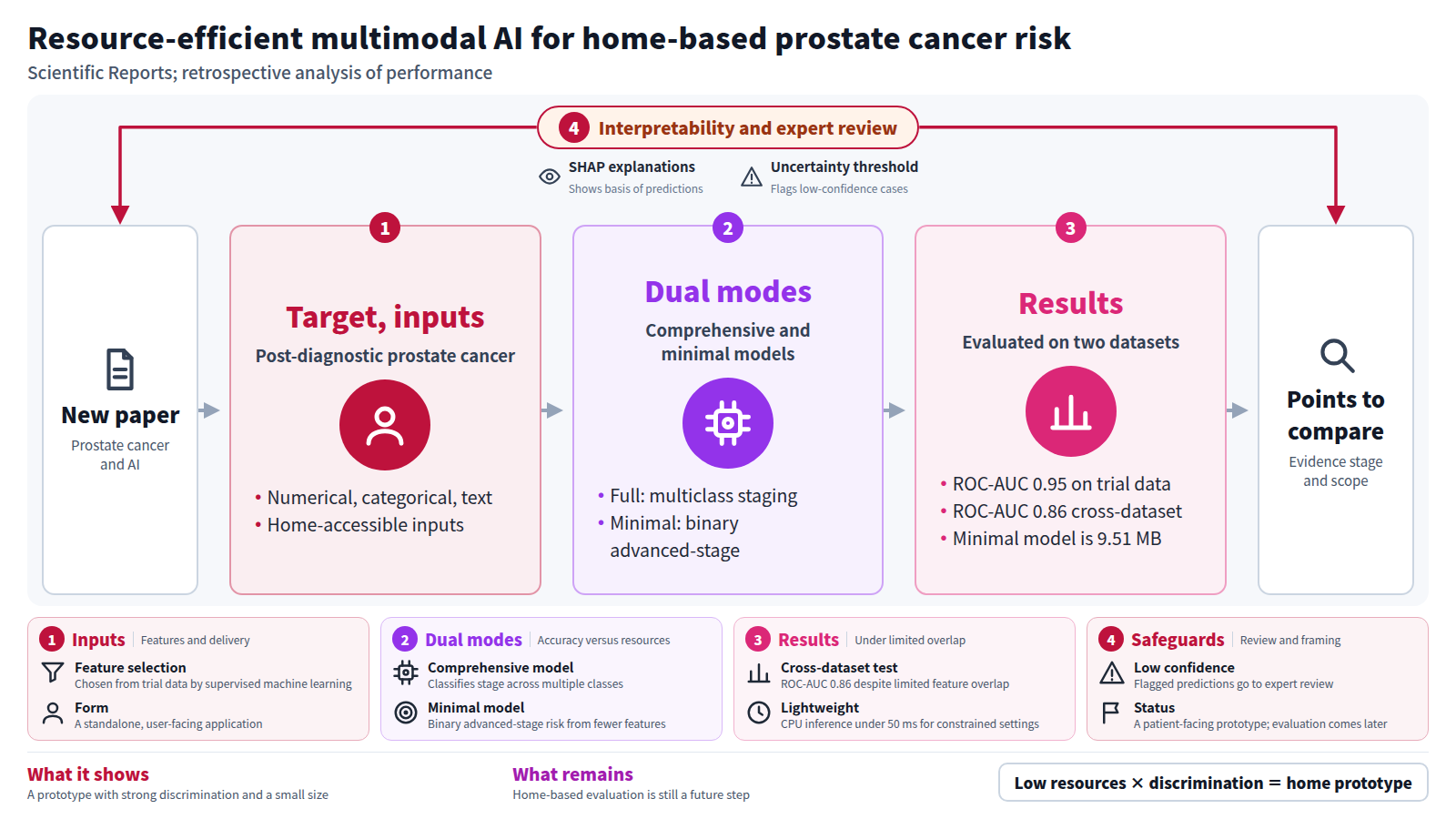
Prostate cancer remains one of the most prevalent malignancies among men worldwide. Effective post-diagnostic management requires repeated staging and longitudinal risk assessment. However, existing clinical decision support systems (CDSS) rely predominantly on structured and resource-intensive clinical data, which limits their scalability and accessibility outside conventional care settings. This study presents a resource-efficient multimodal AI framework for post-diagnostic prostate cancer staging and advanced-stage risk stratification for home-based monitoring. The system integrates potentially home-accessible inputs, including numerical, categorical, and unstructured textual features, systematically selected from the Cancer Screening Trial dataset through supervised machine learning and is implemented as a standalone, user-facing application. The dual-mode framework consists of a comprehensive model for multiclass stage classification and a minimal model for binary advanced-stage risk stratification using a reduced feature set, balancing predictive performance with resource efficiency. The CDSS demonstrates discriminatory performance in a retrospective analysis of the Prostate, Lung, Colorectal and Ovarian cancer screening trial dataset (ROC-AUC 0.95), while cross-dataset evaluation of a feature-restricted model using the Surveillance, Epidemiology, and End Results dataset showed an ROC-AUC of 0.86 under limited feature overlap. The minimal model has a lightweight implementation with a serialized size of 9.51 MB and sub-50-ms CPU inference latency, supporting real-time deployment in resource-constrained settings. Model interpretability is supported through SHapley Additive exPlanations, while an uncertainty thresholding mechanism enables the system to flag low-confidence predictions for expert review. This work presents a patient-facing prototype for oncology risk assessment, with potential for future evaluation in resource-constrained, decentralized, and home-based care settings.
Journal IF-equivalent: 5.2 (OpenAlex 2-year mean citedness, value as of 2026-10-04, retrieved 2026-10-05; not the official Clarivate IF)Reference: Khan AS, Tabassum S, Nag AK, Majumder S. Resource-efficient multimodal AI for post-diagnostic prostate cancer risk stratification for home-based monitoring. Sci Rep. 2026 Oct 7 [Epub ahead of print]. doi:10.1038/s41598-026-75102-1.Checked: Abstract only