AI and Cancer Research ── Breast ── 2026-10-09
Breast cancer: treatment, trials and AI
- Abstract
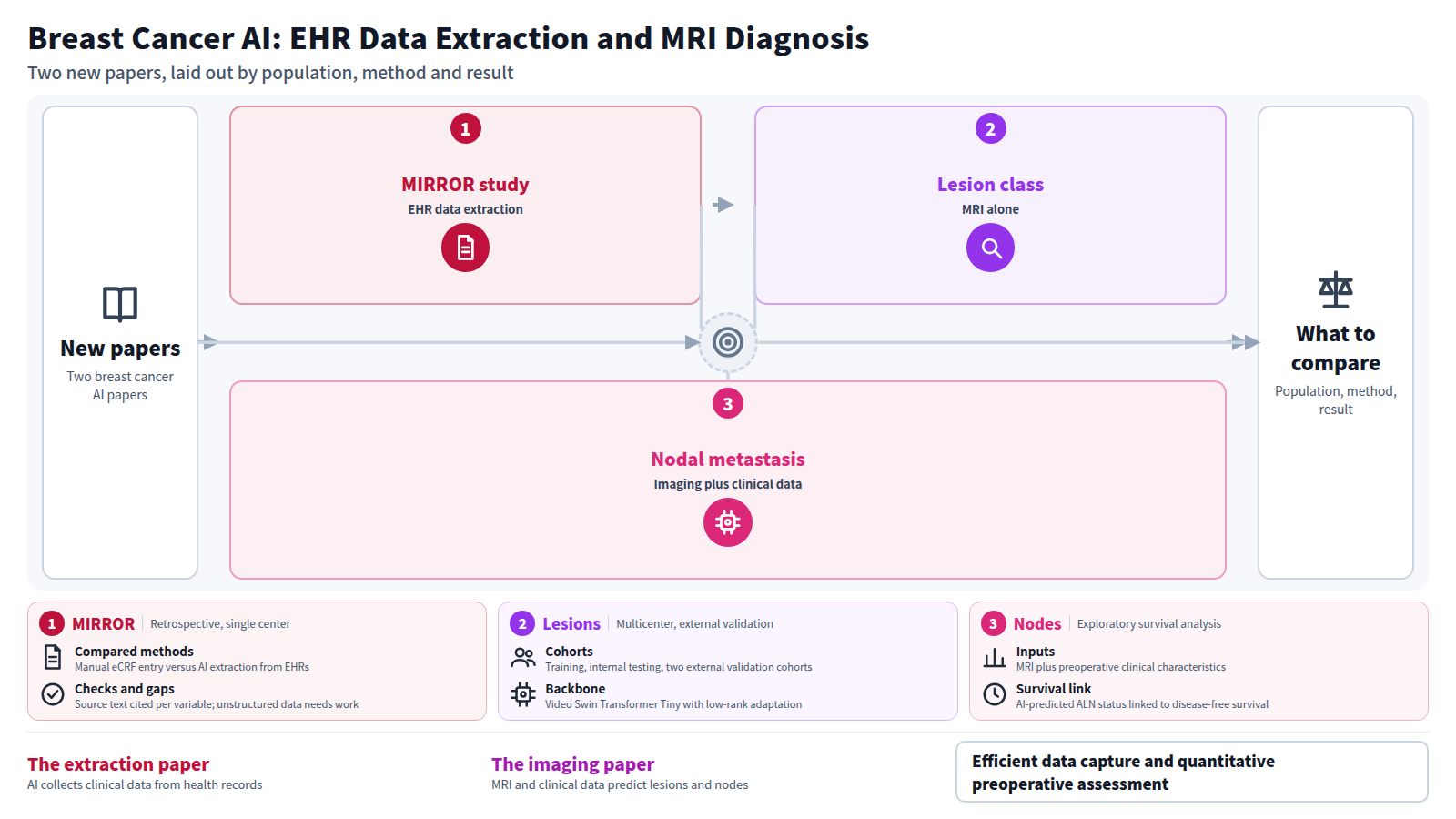
Manual data entry and curation is the most used method of data collection for real world evidence and clinical trials but is a time-consuming task associated with significant human effort and transcription mistakes. MIRROR is a retrospective study that compared manual data capture from electronic case report forms (eCRF) to automated data extraction from electronic health records (EHRs) using artificial intelligence (AI). Clinical information was extracted from EHRs of 113 breast cancer patients participating in 11 clinical trials, with the system providing references to the original text for each variable to enable efficient verification. All patients were enrolled at the Virgen del Rocío University Hospital (Sevilla, Spain). Analyses provided high rates of accuracy, precision, recall and F1-score for most structured and unstructured clinical data domains. Future efforts should focus on improving unstructured data extraction and implementing standardized eCRF among sites to ensure consistent extraction and evaluation of clinical information.
Journal IF-equivalent: 6.2 (OpenAlex 2-year mean citedness, value as of 2026-10-08, retrieved 2026-10-09; not the official Clarivate IF)Reference: Parra-Calderón CL, Mina L, Ruiz-Borrego M, García J, Domínguez CD, Guich J, et al. Artificial intelligence for clinical data extraction from EHRs in breast cancer trials: the MIRROR study. npj Breast Cancer. 2026 Oct 7 [Epub ahead of print]. doi:10.1038/s41523-026-01060-6.Checked: Abstract only - Abstract
ABSTRACT Accurate preoperative assessment of breast lesion malignancy and axillary lymph node (ALN) status is important for individualized breast cancer management, yet current approaches are limited by diagnostic variability and invasive nodal staging. We aimed to develop and validate a multicenter artificial intelligence framework for breast lesion classification and ALN metastasis prediction using dynamic contrast‐enhanced magnetic resonance imaging (MRI) and preoperative clinical information. In this multicenter study, 3320 patients from four hospitals were assigned to a training cohort, an internal testing cohort, and two independent external validation cohorts. Lesion classification was based on MRI alone, whereas ALN prediction additionally incorporated clinical characteristics. MRI sequences were analyzed using a Video Swin Transformer Tiny backbone with low‐rank adaptation and attention‐based multiple‐instance learning, with gated multimodal fusion used for ALN prediction. The model achieved AUCs of 1.000, 1.000, 1.000, and 0.994 for lesion classification and 0.991, 0.974, 0.987, and 0.960 for ALN prediction across the four cohorts. Calibration and decision curve analyses further characterized model performance, while exploratory survival analysis showed that AI‐predicted ALN status was associated with disease‐free survival. These findings support the potential of AI‐assisted breast MRI to provide quantitative information for breast lesion characterization and preoperative assessment of ALN involvement.
Journal IF-equivalent: 5.4 (OpenAlex 2-year mean citedness, value as of 2026-10-08, retrieved 2026-10-09; not the official Clarivate IF)Reference: Ren W, He Z, Deng Z, Huang Z, Cai G, Ban X, et al. Cross‐Modal Artificial Intelligence Integrating Dynamic MRI and Clinical Data for Breast Cancer Diagnosis and Nodal Metastasis Prediction. MedComm – Oncology. 2026 Oct 6;5(4):e70100. doi:10.1002/mog2.70100.Checked: Abstract only