AI and Cancer Research ── Cancer biology ── 2026-10-08
Cancer molecular biology and AI
- Abstract
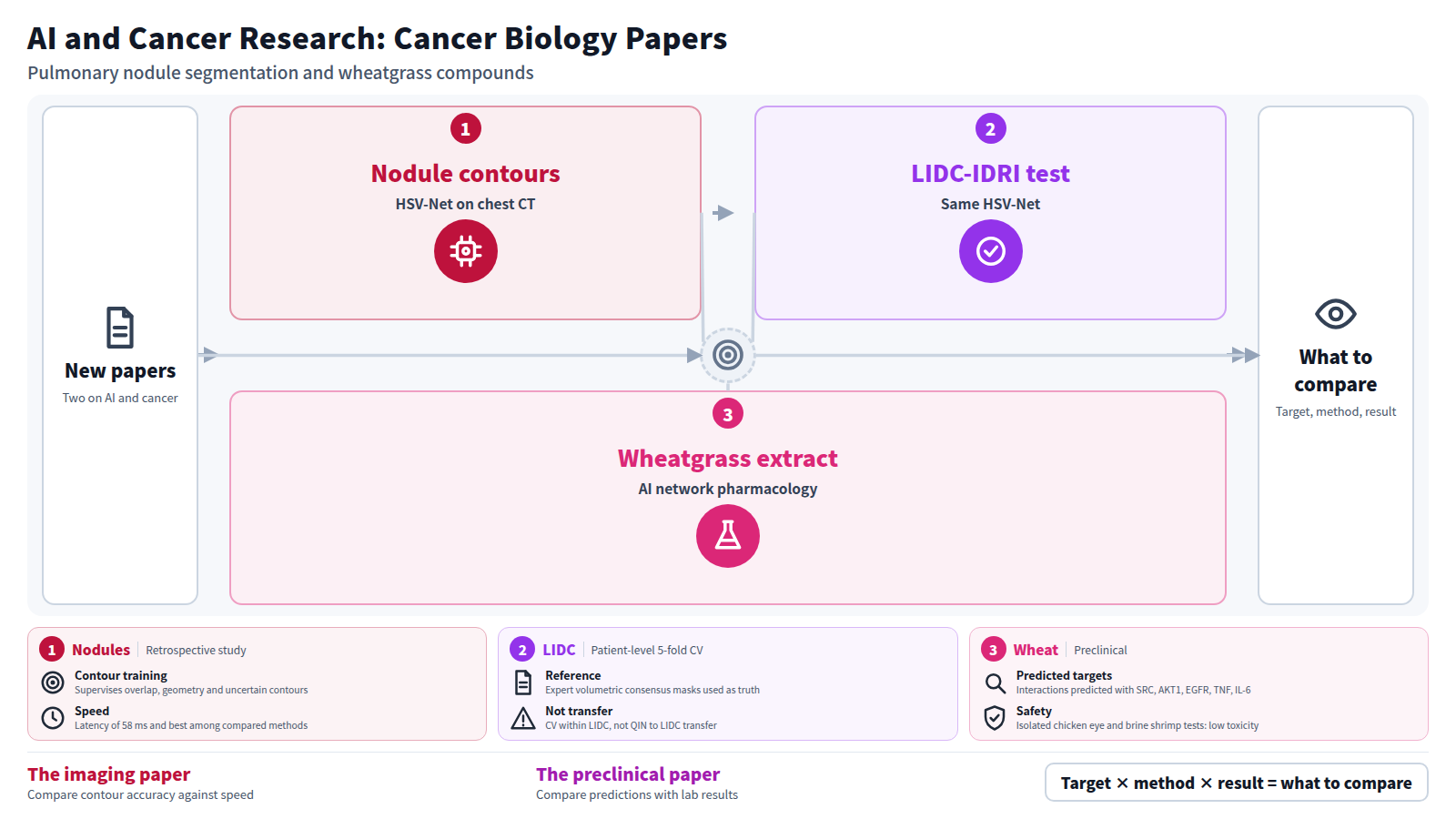
Accurate voxel-level segmentation of pulmonary nodules on chest CT is needed for diameter and volume measurement, growth tracking, and quantitative assessment in lung cancer screening. The task remains difficult: nodules vary in attenuation, size, and contact with vessels or pleura, and clinically relevant morphology often lies in a thin, ambiguous margin. Existing systems commonly trade contour fidelity for speed—large prompt-driven foundation models can be accurate but slow, whereas compact CNN or SSM decoders are efficient yet tend to smooth spiculated and ground-glass borders. We propose HSV-Net (Hybrid State-space–Vision Network), a dual-stream 3D network that is prompt-free after nodule localization: an SSM3D stream provides whole-patch context with linear-complexity state-space blocks, and an OrthoLoRA stream adapts frozen DINOv2 features on axial, coronal, and sagittal slices. A Hybrid Gated Mixer (HGM) fuses the two streams before FPN decoding, and Progressive Contour Learning (PCL) supervises overlap, signed-distance-field geometry, and uncertainty-weighted contour refinement. On a 10-patient QIN Lung CT/QIN-LungCT-Seg development subset ( n = 12 tumors; nested patient-level 5-fold CV), HSV-Net obtained the highest mean Dice (90.1% ± 1.0%; 95% CI [88.9, 91.3]) and Boundary F1 (86.3% ± 1.3%) among the compared methods on 128 × 128 × 64 patches, with a latency of 58 ms. A standard full-volume nnU-Net v2 baseline reached 88.6% ± 1.0% Dice on the same QIN folds, still below HSV-Net. On an independent LIDC-IDRI benchmark with expert volumetric consensus masks (186 patients/294 nodules; patient-level 5-fold CV within LIDC, not QIN→LIDC transfer), HSV-Net achieved 87.8% ± 1.1% Dice and 83.6% ± 1.3% Boundary F1, outperforming full-volume nnU-Net (87.1% ± 1.0% Dice). LUNA16 was retained only as a proxy size/localization check with diameter-matched spherical references, not as contour external validation.
Journal IF-equivalent: 2.7 (OpenAlex 2-year mean citedness, value as of 2026-10-02, retrieved 2026-10-03; not the official Clarivate IF)Reference: Cheng L, Wan X. HSV-Net: hybrid state-space and self-supervised vision fusion with progressive contour learning for CT pulmonary nodule segmentation. Front Oncol. 2026 Oct 6;16:1964406. doi:10.3389/fonc.2026.1964406.Checked: Abstract only - Abstract
This study integrates AI-guided network pharmacology with multi-scale experimental validation (in vitro and ex vivo) to elucidate the therapeutic potential of small molecules from Triticum aestivum (wheatgrass) hexane extract.AI-assisted compound screening, molecular docking, and pathway enrichment identified bioactive constituents with predicted interactions against breast cancer-associated targets, including SRC, AKT1, EGFR, TNF, and IL-6.Network analysis revealed dual modulation of oxidative stress response pathways and mitotic spindle assembly checkpoints, alongside potential interference with pro angiogenic signaling.Experimental validation confirmed these predictions: the extract exhibited significant free radical scavenging activity (DPPH assay) and reduced oxidative DNA damage, as demonstrated by the COMET assay in relevant cell models.Antimitotic activity was evident through in vitro root tip assays and ex vivo CAM (chorioallantoic membrane) assays, which also revealed suppression of angiogenesis.Ex vivo toxicity assessment using the isolated chicken eye test showed a favorable safety profile, and brine shrimp lethality assays indicated low systemic toxicity.These findings demonstrate that small molecules from a wheatgrass hexane extract exert their anticancer potential via a synergistic mechanism, attenuating oxidative stress, inducing mitotic arrest, and inhibiting angiogenesis, supported by AIdriven target prediction and validated through comprehensive biological models.This combined computational experimental framework highlights the value of artificial intelligence in accelerating the discovery and mechanistic understanding of phytochemical-based therapeutics.
Journal IF-equivalent: 0.0 (OpenAlex 2-year mean citedness, value as of 2026-10-07, retrieved 2026-10-08; not the official Clarivate IF)Reference: [No authors listed]. Identification of Anti-Oxidative, Anti-Mitotic, and Anti-Angiogenic Compounds from Triticum aestivum via AI-Based Network Pharmacology and In Vitro Assays. IJDDT. 2026 Oct 6;16(64s). doi:10.25258/ijddt.16.64s.86.Checked: Abstract only