A yardstick to measure trust in AI

AI adoption and investment is moving forward in healthcare, finance, and research. Hospitals already have AI equipment, but according to Earth.com, most of it is being used without being properly tested. The numbers are stacking up, with research reporting a 91% accuracy rate in predicting migraines before they occur. On the other hand, there are also indications from preprints that AI reviewers may give different verdicts to manuscripts that simply restate the same science. What I learned over the course of this half-day was not so much the speed of adoption, but rather the question of where to use the yardstick to check whether the output is correct or not. In each of the following sections, we will examine investment, information warfare, and creation in order to see if there is a yardstick.
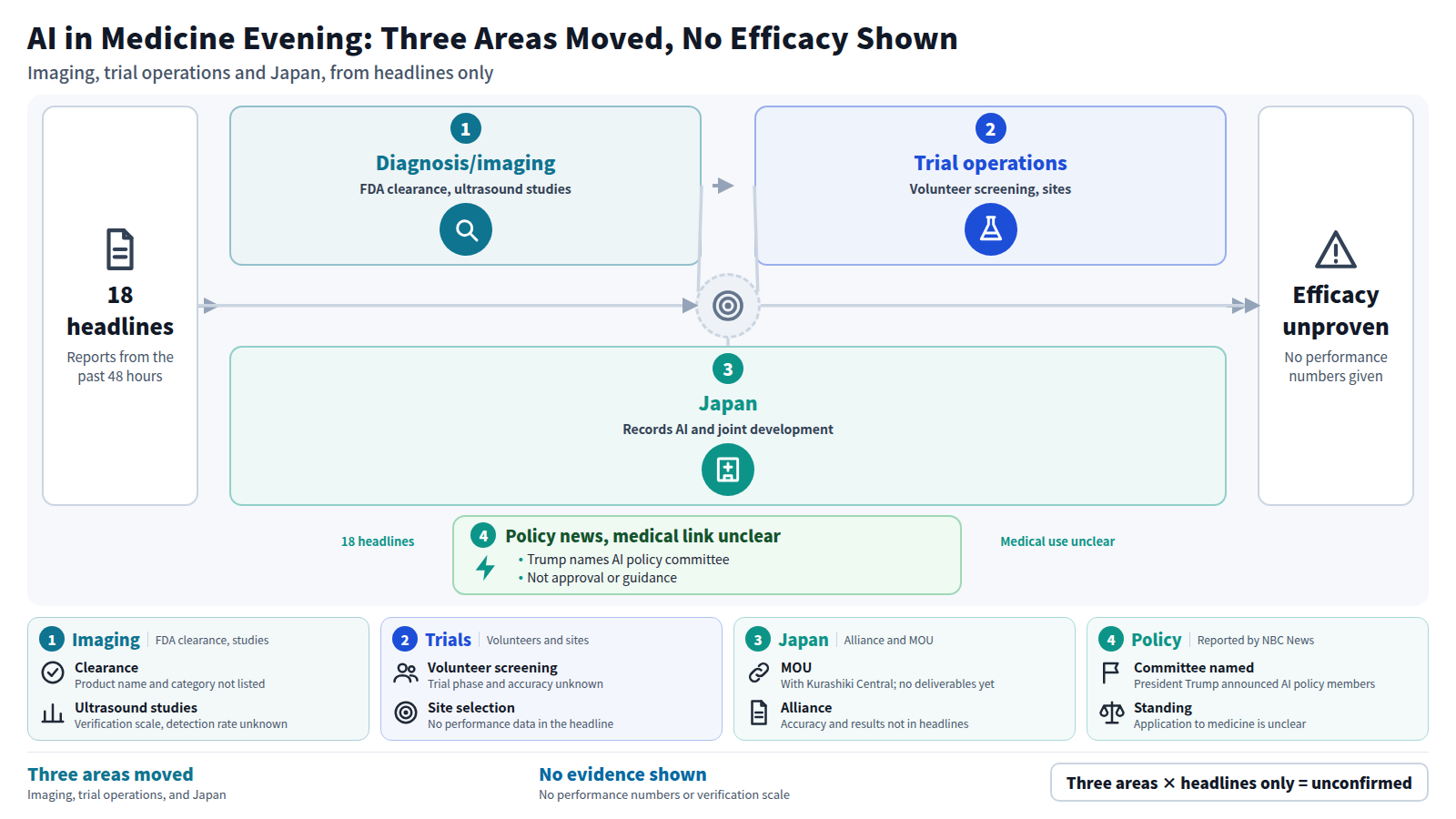
Medical AI is already in hospitals. However, Earth.com reports that most devices are being used without being properly tested. Meanwhile, on the research side, reports on predictive AI continue to be reported. MedicalNewsToday covered whether AI can predict migraines before they start, and reported that a study found the accuracy was 91%. Bioengineer.org highlights a study in which AI combined brain scans and clinical data to predict stroke recovery outcomes. While validation of equipment entering hospitals is weak, accuracy numbers are piling up in papers.
The targets of prediction are not limited to brain diseases. The Journal of Electronics Electromedical Engineering and Medical Informatics has published ProtoSurv-X, which makes it possible to predict the survival of brain tumors. npj Precision Oncology includes MAVEN, an automated multimodal framework for predicting VETC and early recurrence of hepatocellular carcinoma. UCLA reported on its efforts to use AI to test for Alzheimer's disease and dementia, and Live Science reported that a new AI "voice clock" could indicate the speed of aging from your voice. Although the diseases and input data are different, they all achieve the same goal: predicting the future.
When reading, you need to look at the size of the number and where it was confirmed. The accuracy of 91% is within the conditions of the study. The same accuracy in the hospital setting cannot be guaranteed under the circumstances described by Earth.com. The fact that research is increasing is no substitute for individual equipment being tested in the field.