Who will benefit from AI efficiency?

It was reported that Oracle will reduce its workforce by 13% in fiscal 2026 by increasing efficiency through AI, and the stock price hit its lowest level in about two months. Data centers and AI emerged as issues of contention in Virginia's midterm elections. In the former case, the burden of reductions is felt on employment, and in the latter case, the burden of the reduction appears on the local area as a place to store equipment. The introduction of AI is often talked about in terms of the magnitude of its results. However, when we look at the trends discussed this time, it becomes clear that the benefits of efficiency and growth and the associated burdens are not reaching the same people. The burden will vary depending on employment, prices, region, and discipline. The criterion for measuring the pros and cons of introducing a system is not only what is gained, but also who bears the burden. In this text, we will examine the destination of this burden section by section.
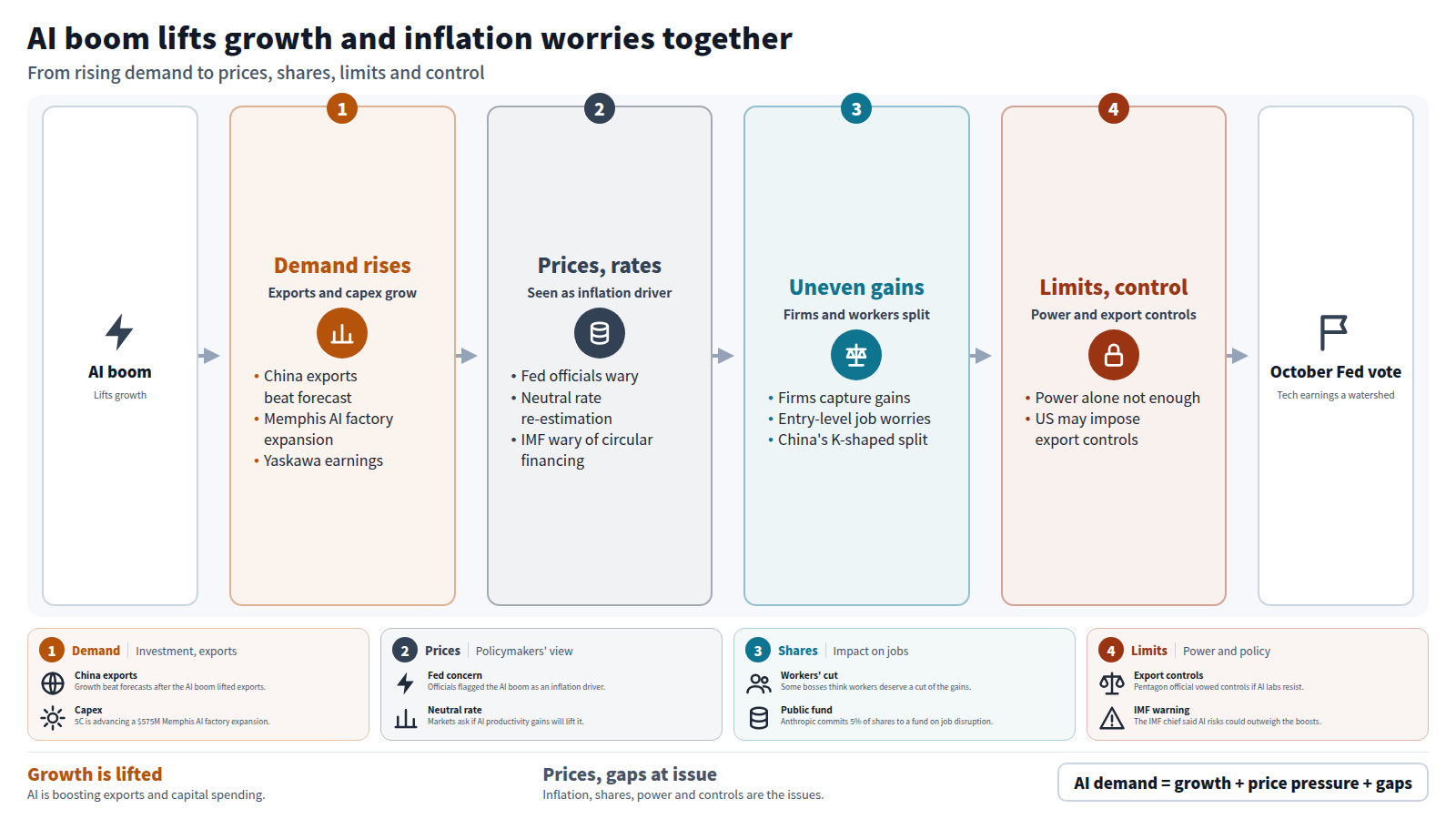
Oracle's stock price hit its lowest level in about two months, and it was reported that the company will cut its workforce by 13% in fiscal 2026 by increasing efficiency through AI (Stocktwits). The results of efficiency improvements are first seen in the numbers of personnel. AI-related layoffs are tracked by Layoffs.fyi, where you can see a list of companies and how widespread the cuts are (Layoffs.fyi). Employment is not the only place where the burden will shift. The Fed recognizes that the AI boom will increase inflationary pressures, and it has been pointed out that other sectors and entities may bear the costs (Reuters). Efficiency improvements in one company will result in a burden on prices and employment elsewhere. When evaluating implementation, you need to look not just at internal cost savings, but also at what's being transferred externally.
On the other hand, people's roles have not been uniformly reduced. Fifth Third Bank's CEO says he doesn't see AI agent Muse as a threat (Banking Dive). In airline flight management, AI co-pilots integrate pre-arrival information and prepare for return (Bioengineer.org). Here, AI is responsible for gathering information and making preliminary preparations, and the final decision can be interpreted as leaving a lasting impression on humans. The advertising industry is also discussing why soft skills will become important in the age of AI (Campaign Middle East). The idea is that the more routine tasks taken on by AI, the more work that will be required of humans to rely on interpersonal coordination and judgment.
Oracle's layoffs and the cases of flight management and banking show that the same AI implementation can have different results. The difference lies in whether to use the free time and manpower to reduce time or to redefine work that only humans can do. However, redefinition is only possible if the people and regions available for the role are secured. The next question is the distribution of who bears the burden and where.