AI and Cancer Research ── Prostate ── 2026-10-08
Prostate cancer: treatment, trials and AI
- Abstract
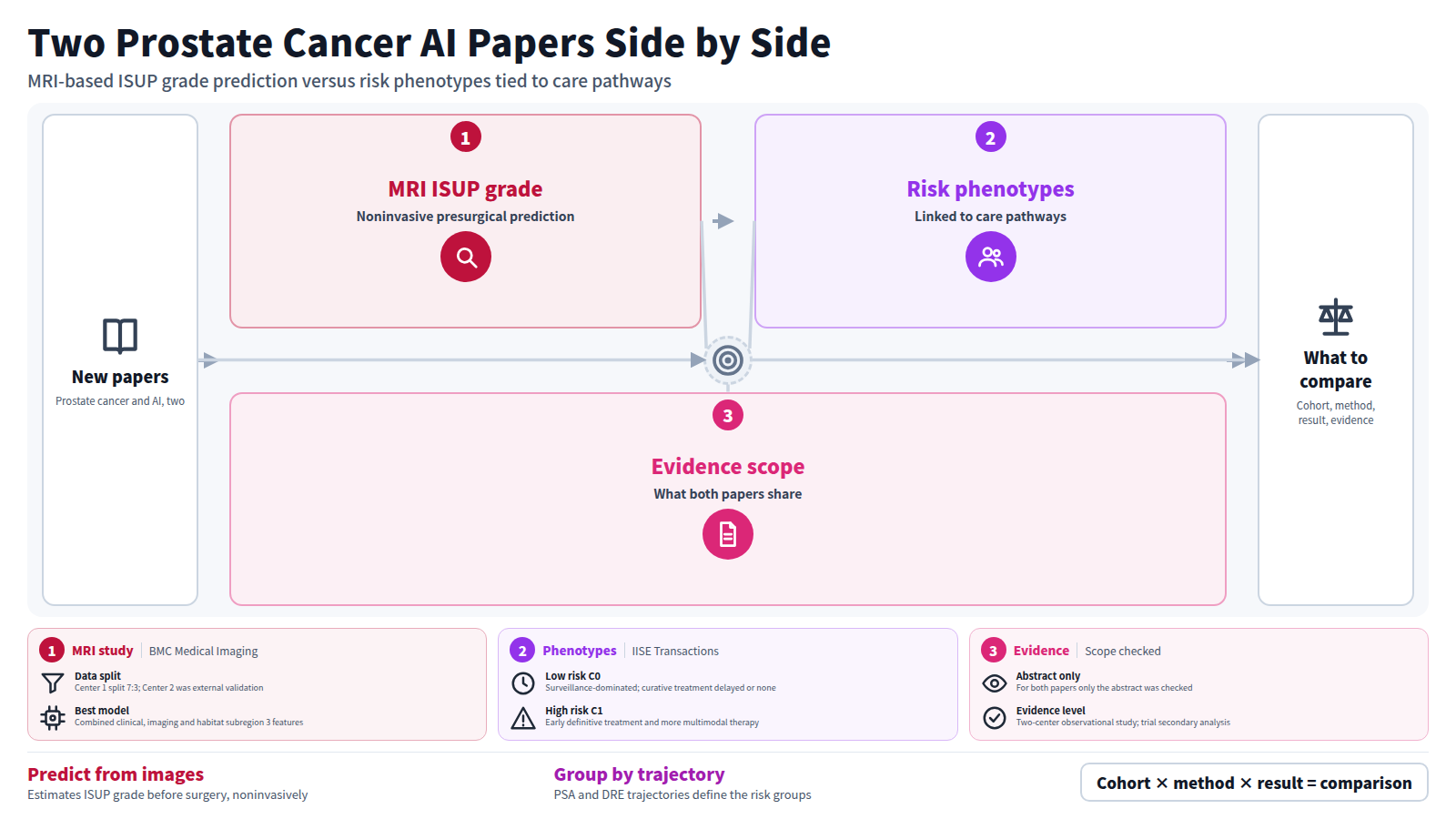
To evaluate the diagnostic performance of a noninvasive preoperative ISUP classification model for prostate cancer based on biparametric MRI (bpMRI) habitat imaging (HI). Retrospective data were collected from patients with pathologically confirmed prostate cancer in two medical centers between July 2021 and August 2024, including clinical information, pathological results, and bpMRI (T2WI + DWI) features. Patients from Center 1 were randomly assigned to the training and internal validation cohorts at a 7:3 ratio, whereas those from Center 2 were adopted as the external validation cohort. The K-means clustering algorithm was applied to segment habitat subregions, followed by radiomic feature extraction from each subregion. Predictive models were established using five machine learning algorithms, and SHapley Additive exPlanations (SHAP) analysis was performed to quantify and visualize feature importance. The predictive performance of all models for prostate cancer ISUP classification was assessed using ROC analysis. Calibration curves and decision curve analysis were further adopted to evaluate model calibration and clinical net benefit. A total of 412 patients were enrolled in this study, comprising a training cohort ( n = 196), an internal validation cohort ( n = 82), and an external validation cohort ( n = 134). Multivariable analysis identified total prostate-specific antigen (tPSA) (OR = 1.041, p < 0.001) and ADC ratio (mean ADC of tumor/normal tissue) (OR < 0.001, p < 0.001) as independent predictors for prostate cancer ISUP classification. Of the 40 established predictive models, the comprehensive model integrating clinical factors, conventional imaging features, and radiomic features derived from T2WI habitat subregion 3 yielded the optimal performance. AUC values of the comprehensive model were 0.867, 0.900, and 0.826 in the training, internal validation, and external validation cohorts, respectively. The model also achieved superior predictive efficacy and clinical net benefit compared to all other models. The bpMRI–based comprehensive model integrating clinical, imaging and habitat radiomic features enables noninvasive preoperative prediction of prostate cancer ISUP classification. It may serve as an auxiliary tool to facilitate individualized preoperative treatment decision-making.
Journal IF-equivalent: 3.8 (OpenAlex 2-year mean citedness, value as of 2026-10-02, retrieved 2026-10-03; not the official Clarivate IF)Reference: Chen S, Wang Y, Chen H, Cui J, Jiang K, Shen L, et al. MRI habitat analysis using interpretable machine learning models for ISUP grade group prediction in prostate cancer. BMC Med Imaging. 2026 Oct 6 [Epub ahead of print]. doi:10.1186/s12880-026-02870-7.Checked: Abstract only - Abstract
Efficient prostate cancer management relies on risk stratification to inform clinical decision-making, care planning, and resource allocation. However, existing approaches often fail to incorporate treatment intensity, care pathways, and downstream resource utilization needed to support healthcare systems. Using data from 4,579 men enrolled in a randomized controlled trial, this study applies STRATA-PC, a treatment-aware, survival-informed phenotyping framework that leverages longitudinal prostate-specific antigen (PSA) and digital rectal examination (DRE) trajectories along with baseline clinical characteristics to derive clinically interpretable risk phenotypes and examine how data-driven risk groups relate to real-world prostate cancer care pathways and resource utilization. STRATA-PC demonstrates strong discrimination for overall survival and prostate cancer–specific mortality and identifies three well-separated phenotypes. The low-risk phenotype (C0) is characterized by surveillance-dominated care pathways with delayed or no curative treatment, reflecting low immediate clinical urgency and sustained outpatient monitoring. The high-risk phenotype (C1) exhibits early initiation of definitive treatment, greater use of multimodal therapy, and a higher likelihood of post-treatment escalation, indicating concentrated near-term demand and increased coordination complexity. The intermediate-risk phenotype (C2) demonstrates delayed treatment initiation with a higher propensity for late multimodal escalation following extended monitoring, representing a transitional care pathway with deferred but more complex downstream resource utilization. This study examines STRATA-PC-derived phenotypes from a healthcare operations perspective by comparing survival risk, symptom burden, treatment modality selection, escalation behavior, and timing of care initiation. These findings show how patient-level risk heterogeneity translates into structured variation in care pathways and healthcare demand, providing actionable insight for resource planning.
Journal IF-equivalent: 0.7 (OpenAlex 2-year mean citedness, value as of 2026-10-07, retrieved 2026-10-08; not the official Clarivate IF)Reference: Ghavidel A, Pazos P. Linking Artificial Intelligence (AI)–derived risk phenotypes to prostate cancer care pathways: Implications for treatment intensity and healthcare operations. IISE Transactions on Healthcare Systems Engineering. 2026 Oct 5 [Epub ahead of print]. doi:10.1080/24725579.2026.2740606.Checked: Abstract only